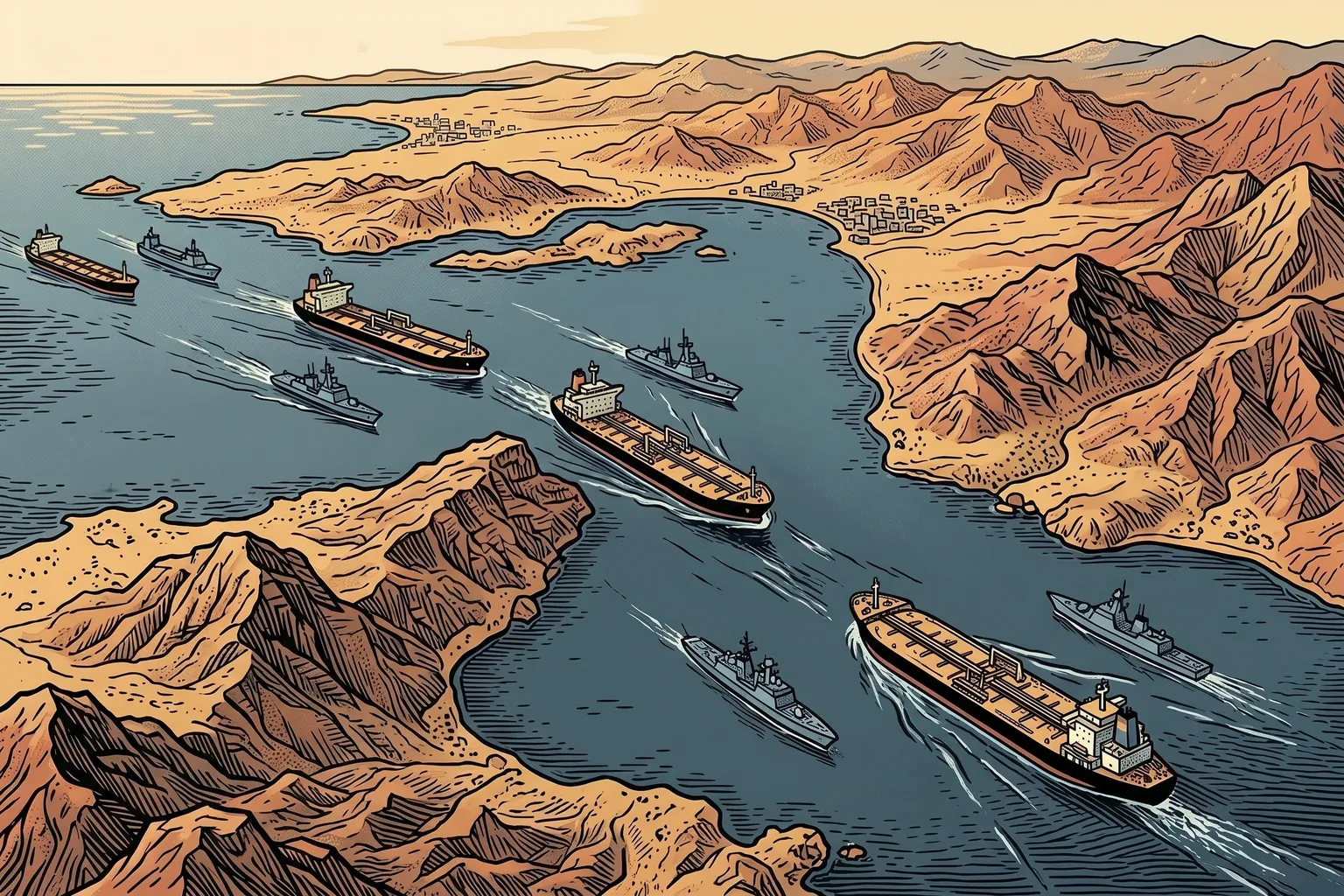
The Strait of Hormuz carried commercial traffic normally Wednesday morning, and diplomatic talks between the United States and Iran continued, according to officials from both governments, though neither side described the substance or location of the sessions, Reuters reported. Iranian missile and drone strikes on Kuwait’s international airport and a U.S. naval facility in Bahrain on Tuesday killed one person and injured more than sixty. U.S. forces responded with strikes on a communications station on Qeshm Island. U.S. Central Command said Iran’s attack was “a deliberate, calculated, and unjustified attack” on civilian infrastructure. As of Wednesday, the ceasefire framework, twice extended since April, remained formally in place. Both the military exchanges and the diplomatic channel are still open.
What that dual condition looks like in constitutional terms has come into focus this week. The War Powers Resolution, passed by Congress over President Nixon’s veto in November 1973, requires the president to notify Congress within 48 hours of introducing armed forces into hostilities and to withdraw those forces within 60 days absent a congressional vote. The administration filed its notification when CENTCOM began strikes on Iranian territory last week. The 60-day clock is running. Across the 53 years since the law’s passage, presidents from both parties have argued their authority as commander in chief extends beyond its limits. Congress has debated and stopped short of forcing a vote in most cases. Several senators said publicly Wednesday they believe a vote is required; none had filed a resolution to compel one.
The Algiers Accords remain the only successful conclusion to an American-Iranian standoff that anyone in the current negotiating rooms can point to. After 444 days of American hostages held in Tehran, Algeria brokered an agreement in January 1981: the hostages came home, frozen Iranian assets were released, and the United States pledged non-interference in Iranian internal affairs. It ended the hostage crisis. It didn’t end the underlying conflict. In the 45 years since, the two countries have negotiated and fought simultaneously, through the 1988 end of the Iran-Iraq War, through the 2015 nuclear agreement and its collapse in 2018, and now through talks running parallel to military strikes in the Gulf. Whether this iteration ends differently is the essential question of a summer that is only three days old.
Today is June 4. Thirty-seven years ago, on the night of June 3 into the morning of June 4, 1989, Chinese military forces moved on protesters in Tiananmen Square in Beijing, ending seven weeks of demonstrations that had gathered as many as a million people in the capital at their peak. The Chinese government has never released an official death toll. Estimates from diplomatic cables, contemporaneous accounts by journalists who were present, and subsequent investigations range from several hundred to more than a thousand. The government’s stated figure, where it is offered at all, cites 200 to 300.
No commemoration took place on the Chinese mainland Wednesday. The date was blocked in domestic search engines and social media posts referencing it were removed. In Hong Kong, where a candlelight vigil in Victoria Park drew tens of thousands every year from 1990 until organizers were arrested and the event banned in 2020 under the national security law, there was no public gathering. Taiwan held observances and renewed its call for accountability. Beijing dismissed them without response, AP reported.
The anniversary arrives this year inside a diplomatic structure that connects China, Iran, and the United States directly. China has been purchasing Iranian crude oil throughout the period of U.S. military engagement and accounts for an estimated 90 percent of Iran’s oil exports. American officials have asked China to use its economic relationship with Tehran to press Iran toward restraint. China has called for restraint from all parties and continued buying the oil. On the day the world marks Tiananmen, China’s government is declining two separate requests for a different kind of accounting, one historical and one diplomatic, on the same Wednesday morning.
Brain scans of nearly 1,000 people with autism spectrum disorder, combined with data from 20 genetically modified mouse models, have produced what researchers say is strong evidence that autism isn’t one condition but two. Scientists from the Child Mind Institute in New York and the Istituto Italiano di Tecnologia in Italy published the findings this week, identifying two biologically distinct subtypes: one characterized by hyperconnectivity, in which brain regions communicate more than typical, and one characterized by hypoconnectivity, in which communication between regions is reduced, ScienceDaily reported. The two subtypes showed different responses to the same interventions.
“Brain-based biological markers reveal distinctions that current behavioral assessments don’t fully capture,” said Dr. Adriana Di Martino of the Child Mind Institute, who led the study. About one in 36 children in the United States is currently diagnosed with autism spectrum disorder, according to the CDC. Clinicians have long known that individuals on the spectrum vary enormously in their symptoms and needs. Identifying distinct biological subtypes opens the possibility of targeted treatments matched to each patient’s specific neural profile rather than the average of the broader diagnosis, which is the gap the researchers say their work points toward closing.
Cancer Discovery published a separate study Wednesday identifying a protein called NFIL3 as the primary driver of a persistent problem with CAR T-cell therapy. The treatment, first approved by the FDA in 2017, works by engineering a patient’s own immune cells to identify and destroy cancer cells. It has produced significant results in blood cancers. Against solid tumors it has performed less well, partly because the engineered cells exhaust themselves and stop working. When researchers disabled NFIL3 in CAR T cells in animal models, those cells stayed active longer and controlled tumors more effectively, Cancer Discovery reported. The finding identifies why the cells fail, which is the scientific prerequisite for figuring out how to stop the failure.
Moving from animal models to human trials takes years, and CAR T therapy is already expensive enough that availability is limited even in cancers where it works. The NFIL3 finding doesn’t change today’s treatment options. It changes what the next options might look like, which is how most oncological progress works: slowly, and then not.
A finding published in Cancer Discovery this week added a complication to one of the more settled ideas in nutrition. Yale researchers found that oleic acid, the primary fat in olive oil, significantly accelerated pancreatic tumor growth in mouse models, while omega-3 fats from fish oil reduced disease burden by roughly half, ScienceDaily reported. The researchers were careful to specify that the finding is particular to pancreatic cancer and doesn’t implicate oleic acid in cardiovascular disease, where olive oil’s benefits are well-established in separate bodies of research.
Pancreatic cancer has a five-year survival rate of about 13 percent, one of the lowest of any major cancer and one that hasn’t improved substantially in decades. The Yale work involved mouse models, and the researchers said dietary interventions in human patients would require separate clinical investigation. The finding doesn’t tell anyone to stop using olive oil. It tells researchers that the specific biology of pancreatic tumors may respond to dietary fats in ways that have practical significance, and that this response hadn’t been carefully measured before.
One more thing. Phyllis Goodwin’s new column in the Ideas section, “At Large: The Appointment,” opens with a tablet at the front desk asking whether her emergency contact information has changed since last Tuesday. Her emergency contact is Don. Don has been her emergency contact for fifty-two years. Nothing has changed. The tablet thanked her and asked about twelve symptoms in small enough type that reading glasses were required. That was only the beginning. The piece is an exact and genuinely funny account of what the modern medical visit has become: the kiosk, the clipboard with questions the kiosk already asked, the patient portal that sent a two-fifteen-in-the-morning confirmation two weeks before a routine follow-up, Don’s philosophical objection to the parking garage’s pre-payment sequence, and nine minutes with an excellent physician that were preceded by an infrastructure considerably larger than the visit itself. Phyllis is writing about something that will feel familiar to anyone who has recently sat in a waiting room with 2019 magazines, which is most of us. It’s in the Ideas section today. At Large: The Appointment.
It is Wednesday, June 4. Diplomatic talks between the United States and Iran continue as the War Powers clock runs toward its 60-day limit; China marked the 37th anniversary of Tiananmen by blocking the date online and declining U.S. pressure to restrict Iranian oil sales; researchers identified two biologically distinct subtypes of autism and named the protein that causes CAR T-cell exhaustion; and Yale researchers found that oleic acid accelerates pancreatic tumor growth in mouse models, complicating olive oil’s reputation. That’s the day.