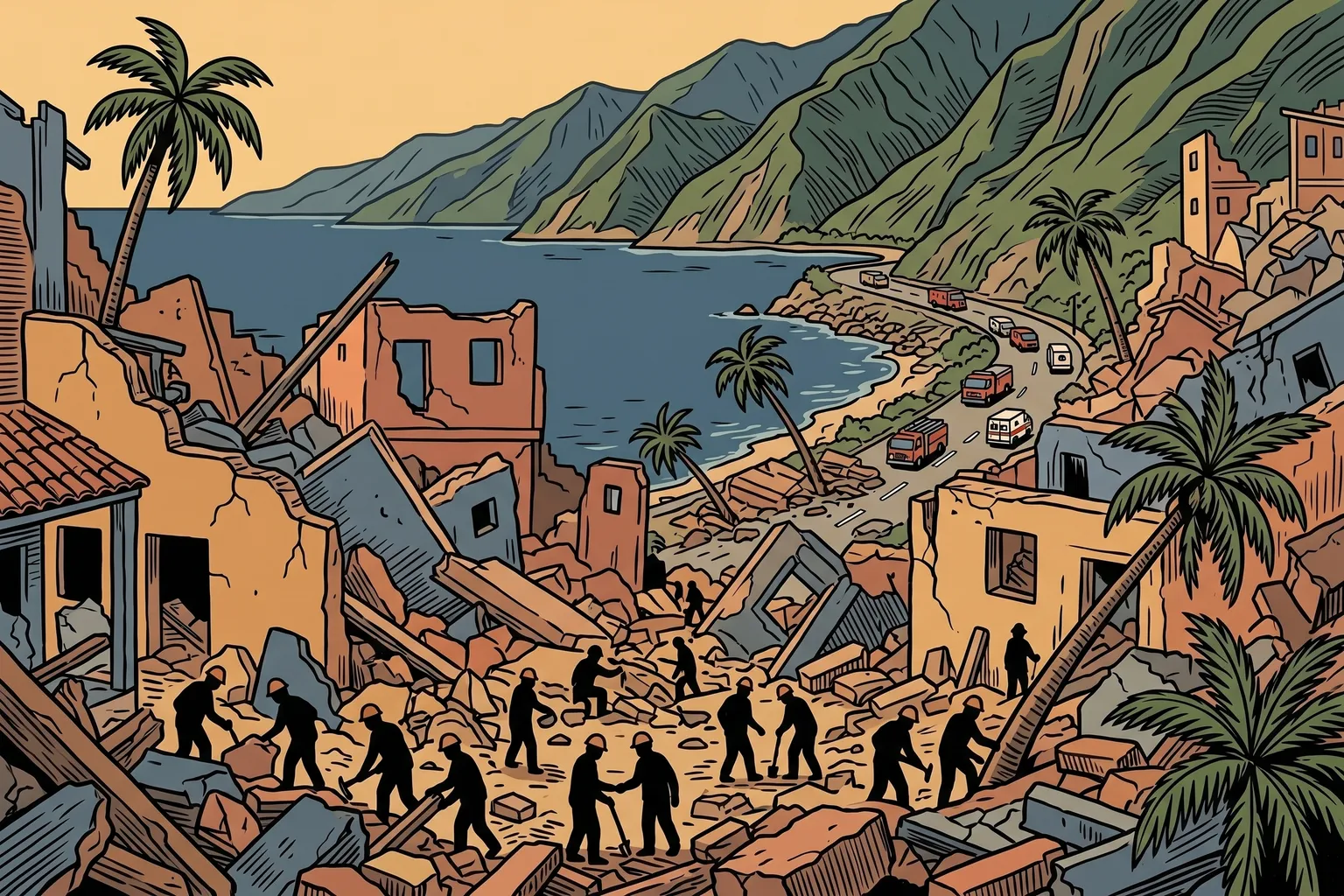
Two earthquakes struck Venezuela within forty seconds of each other on Tuesday, a 7.2 magnitude foreshock followed by a 7.5 magnitude main event. The 7.5 is the largest earthquake in Venezuela in more than a century, according to data from the United States Geological Survey. The country’s largest recorded quake, the San Narciso earthquake, struck near Caracas in the early morning of October 29, 1900, at 7.7 magnitude. At least 32 people are confirmed dead and more than 700 are injured. Acting President Delcy Rodriguez said the toll is expected to rise.
The epicenters were in Yaracuy state, west of Caracas. The northern coastal state of La Guaira has been declared a disaster zone, having suffered the most extensive structural damage. Neighborhoods in Caracas, including Altamira and El Paraiso, also reported significant collapses. Search and rescue teams have been deployed across multiple provinces.
The USGS issued a preliminary casualty assessment Wednesday, noting that many buildings in the affected region are constructed from unreinforced brick masonry and adobe. Its models estimated a 39 percent probability that the final death toll could reach between 1,000 and 10,000, and a 37 percent probability of deaths reaching between 10,000 and 100,000. These figures represent risk modeling, not predictions. They explain why response teams are treating this as a major humanitarian emergency before the full picture has emerged. Al Jazeera is tracking what happened and what is known.
La Guaira’s geography compounds the difficulty. The state sits between the Caribbean coast and Caracas, containing Venezuela’s main seaport and the Simon Bolivar International Airport, the principal air gateway serving the capital. Infrastructure damage there affects not just the people who live and work along the coast but the routes through which any outside assistance must arrive. The 7.5 is now the fourth-largest earthquake in Venezuelan history. What it will cost in lives depends on what the rescue operation finds in the coming days. NBC News has been following the casualty figures.
On Tuesday, the United States Senate voted 50 to 48 to pass a war powers resolution directing President Trump to remove American forces from the Iran conflict unless Congress authorizes the operation. The House had passed the same measure earlier this month. Four Republicans voted with the Democratic caucus: Bill Cassidy of Louisiana, Susan Collins of Maine, Rand Paul of Kentucky, and Lisa Murkowski of Alaska. Pennsylvania’s John Fetterman was the lone Democrat to vote against. The resolution isn’t legally binding and isn’t sent to the White House for a signature. It carries the weight of a congressional statement and nothing beyond that. NPR’s account of the vote is here.
Trump responded on social media, writing that the Senate had provided “aid and comfort to the Enemy” and calling the four Republican senators “Losers.”
On Wednesday morning, Trump met with Republican senators in a closed session at the Capitol. The meeting turned into a confrontation. Multiple sources told ABC News and The Hill that Trump directly challenged Cassidy over his vote. When Trump asked why any senator would vote for the resolution, Cassidy answered. What he said, according to those accounts: “You have not told the American people what’s going on. It was supposed to last four weeks. It’s lasted four months. Our original objectives have not been achieved, and I want to know what’s going on.” Trump called Cassidy a “lunatic” at one point, according to the same sources. The ABC News account of the exchange is here.
That evening, Cassidy received a briefing on Iran from Vice President JD Vance and special envoy Steve Witkoff. In a subsequent Senate procedural vote, Cassidy voted against advancing the resolution. Rand Paul voted present. CNN reported on the Senate’s reversal.
The War Powers Resolution was enacted in November 1973, passed over President Nixon’s veto after years of friction over the executive branch’s authority to commit American forces abroad without a congressional declaration of war. It requires the president to notify Congress within 48 hours of deploying troops and limits any such deployment to 60 days without congressional authorization. No administration since Nixon’s has acknowledged its full constitutionality. What the events of this week illustrate is a pattern that has run for more than fifty years: Congress invokes the mechanism; the executive resists; and political dynamics in Congress tend to shift before the underlying legal dispute reaches anything like resolution.
Tuesday’s ceasefire declaration ended the military phase of the conflict with Iran, but it opened a contested question about what the framework agreement actually requires. The most immediate: whether International Atomic Energy Agency inspectors will have access to Iran’s uranium enrichment sites, including facilities struck by U.S. and Israeli forces over the past year.
IAEA Director General Rafael Grossi spoke to the question on Wednesday. “Obviously, to do that, we will have to inspect,” he said. “Whether this happens the day after tomorrow or in one week or in 10 days, it’s important, but not essential. This is going to happen.” Iran’s position differs. Foreign Ministry spokesperson Esmail Baghaei told reporters in Tehran on Tuesday that UN inspectors were not scheduled to examine the nuclear sites, directly contradicting remarks made the day before by Vice President Vance. CBS News has been following the inspection dispute closely.
When the Obama administration’s nuclear deal with Iran was being finalized in 2015, IAEA access to Iranian nuclear facilities was among the final and most contested elements to be resolved. The underlying argument was the same one playing out now: what verification means in practice, and who gets to define it. The current agreement provides sixty days to answer that question in a final deal. The inspection dispute has arrived in the first week.
The World Health Organization declared the Ebola outbreak in eastern Democratic Republic of Congo a Public Health Emergency of International Concern on May 17. As of June 23, the DRC Ministry of Health had reported 1,094 confirmed cases and 277 confirmed deaths, making this the second-largest Ebola outbreak on record. The WHO’s situation page has current numbers.
The cause is Bundibugyo virus, a species of Ebola for which no approved vaccine or specific treatment currently exists. This is DRC’s seventeenth Ebola outbreak; the number of cases in this one has risen faster than in any previous outbreak of the disease. Ituri Province accounts for the large majority of confirmed cases across 22 health zones, with additional cases in North Kivu and South Kivu. Eastern DRC has been subject to sustained armed conflict for decades, a condition that complicates every aspect of outbreak response: movement restrictions, health worker access, community trust, and the integrity of the cold chain that vaccines and treatments require. Doctors Without Borders and other organizations are responding in the field. The 2014-2016 epidemic in West Africa remains the largest Ebola outbreak on record, with more than 11,000 deaths. DRC has been battling Ebola outbreaks since 1976, when the disease was first identified there. This is the worst one the country has faced.
The day after the House cleared the 21st Century Road to Housing Act 358-32 and sent it to the president’s desk, Trump canceled the planned Wednesday signing at the Capitol. He announced on social media that he won’t sign the legislation until Congress passes the SAVE America Act, a sweeping elections measure that would require proof of citizenship and voter ID for federal elections. Republican leaders have acknowledged they don’t currently have the votes to pass the SAVE Act over a Democratic filibuster, and they haven’t moved to end it.
The housing legislation would restrict large institutional investors from purchasing single-family homes and ease certain building regulations intended to increase housing supply. Both chambers passed it with overwhelming bipartisan margins. The practice the bill targets accelerated significantly after the 2008 housing crash, when private equity firms began acquiring foreclosed single-family properties at scale. A restriction of that kind at the federal level would have been difficult to imagine a decade ago. Speaker Mike Johnson told reporters Wednesday morning that he spoke with Trump and that the president still plans to sign the bill within ten days. NBC News has the account of the canceled signing.
Our Wednesday colleague spotlight is Arthur Dandridge, writing this week in the Ideas section. Arthur has spent the spring tracing the tradition of Black American literature from Wright through Baldwin to Hurston. This week he arrives at Colson Whitehead, the only novelist to win the Pulitzer Prize twice in fiction, for The Underground Railroad in 2017 and The Nickel Boys in 2020. Arthur’s argument is that Whitehead carries the tradition forward without ever repeating it. “He reinvents himself every time,” Arthur writes. “Most writers find a groove and stay in it. He treats the groove as a place to visit.” His recommendation for a first Whitehead novel is Sag Harbor, the 2009 book about a Black teenager’s summer on Long Island, written from the inside of a world Whitehead knows. It’s a piece about nine novels and what it means for a writer to inherit a tradition and make it entirely his own. Arthur’s guide to Colson Whitehead is in the Ideas section.
Howard Fenn writes The Day, Monday through Friday.