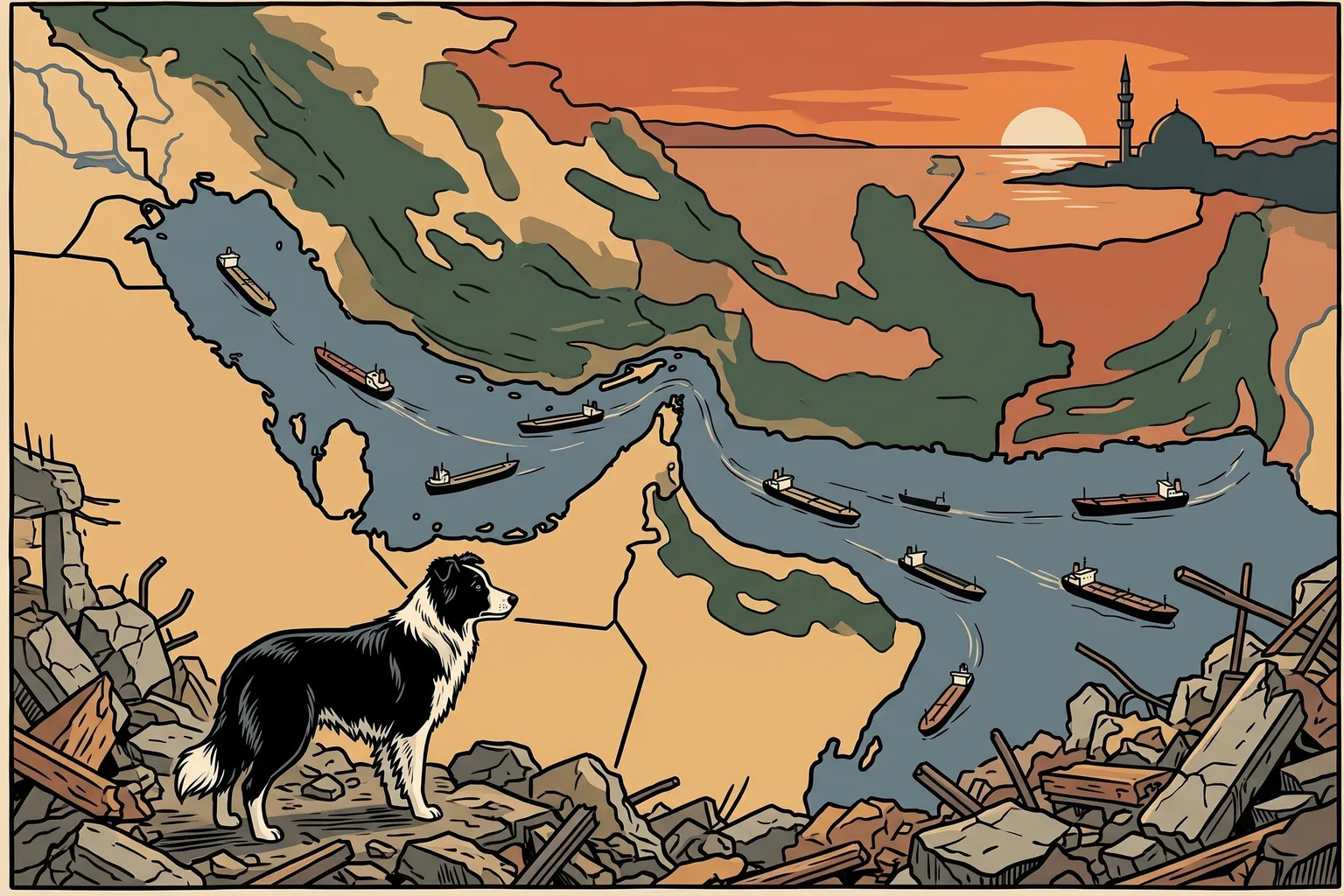
Two things happened on Wednesday that together describe the state of the Persian Gulf after four months of conflict. U.S. Central Command announced the completion of a second consecutive day of strikes on Iranian military targets. And the Strait of Hormuz, through which roughly a fifth of the world’s oil and a fifth of its liquefied natural gas normally moves, has nearly stopped moving ships.
President Trump declared the ceasefire with Iran “over” on Tuesday, formalizing what had already been unraveling for weeks. The interim agreement reached in June had been under strain as Iran continued to harass commercial shipping along the Oman-supported corridor through the strait and the U.S. responded with escalating pressure. CENTCOM reported completing strikes on approximately 90 Iranian military targets on Wednesday, one day after hitting roughly 80. NBC News has been following the exchange.
Iran’s response targeted three Gulf states: Qatar, Bahrain, and Kuwait. Iran’s Islamic Revolutionary Guard Corps said it struck U.S. military installations in Bahrain and Kuwait’s Ali Salem Airbase and downed an American MQ-9 drone. Qatar’s Foreign Ministry called the Iranian strikes on its neighbors “a blatant violation of the sovereignty” of both countries. Bahrain is home to the U.S. Navy’s Fifth Fleet headquarters. Air raid sirens sounded at least twice in Bahrain on Wednesday, according to ABC News. ABC News live updates are here.
Shipping data show the strait is effectively closed for practical purposes. Most observable vessel movement is following an Iran-approved route along the northern channel. The Oman-supported corridor that the U.S. has been trying to reopen shows almost no traffic. Bloomberg is tracking Hormuz shipping here.
In 1987 and 1988, the U.S. Navy escorted Kuwaiti tankers through this same waterway under Operation Earnest Will, protecting commercial shipping while Iran and Iraq attacked each other’s oil convoys. In April 1988, after an Iranian mine damaged the USS Samuel B. Roberts, the U.S. launched Operation Praying Mantis, destroying two Iranian oil platforms and sinking or disabling several Iranian naval vessels in a single day. The strait grew quieter for years after that. It never stayed quiet permanently. What the strait is today is what it has always been across multiple generations of American foreign policy: a place where the world’s energy needs and the region’s instabilities concentrate in a passage twenty-one miles wide at its narrowest point.
Wednesday is the Ideas section’s day on the colleague spotlight calendar. This week that goes to Bob Whitfield.
Bob published “Not Yet a Disaster” on Sunday, July 6, reporting on the heat wave that killed at least twenty-five people in New Jersey and put more than 185 million Americans under weather alerts over the Fourth of July weekend. His subject is the gap in the Stafford Act, the law that governs federal disaster declarations: extreme heat has never received a major disaster declaration in the history of the program, despite killing more Americans each year than hurricanes do in most years. Bob’s piece is careful, specific, and worth your time. It’s in the Ideas section.
Ayatollah Ali Khamenei was buried on Wednesday in Mashhad, the northeastern Iranian city where he was born, completing six days of state funeral ceremonies and processions that drew millions of mourners across Iran and Iraq. He was interred at the Imam Reza shrine, one of the holiest sites in Shia Islam, which holds the remains of the eighth Shia imam and receives tens of millions of pilgrims each year. U.S. News has the account of the burial.
Mojtaba Khamenei, who was proclaimed Supreme Leader by a clerical assembly following his father’s death in the joint U.S.-Israeli airstrike on February 28, didn’t appear at the burial. He hasn’t appeared in public since the strike, which left him with serious injuries. Iranian officials told The New York Times that authorities blocked him from attending because they feared Israel could use his location to target him. I24 News reported on the security concerns surrounding his absence.
The elder Khamenei led Iran as Supreme Leader for thirty-seven years, from 1989 until his death. When Ayatollah Khomeini died on June 3, 1989, Khamenei was serving as president of Iran and helped lead the funeral ceremonies in Tehran, where crowds were so massive that authorities had to airlift Khomeini’s body by helicopter to prevent it from being mobbed. Khamenei knew at close range what it meant to bury a supreme leader of the Islamic Republic. On Wednesday, a generation later, he was the one being buried, while the country he governed is at war and its new leader can’t show his face.
The NATO summit that opened in Ankara on Tuesday concluded Wednesday with a formal declaration. Member nations pledged €70 billion in military equipment, assistance, and training for Ukraine in 2026 and committed to sustaining at least equivalent levels in 2027. The declaration formalized a goal of reaching 5 percent of gross domestic product in defense and security spending by 2035, noting that the Alliance had already averaged 4 percent. The summit announced a Drone Edge initiative under which member nations will invest $14 billion in unmanned systems over five years, along with more than $50 billion in new collective procurement commitments. The full Ankara Summit Declaration is at NATO’s official site. Al Jazeera’s five-point summary of the summit is here.
The death toll from Venezuela’s June 24 twin earthquakes rose to 3,811 on Wednesday, according to figures released by National Assembly President Jorge Rodriguez. The injured number 16,740. Rescue and recovery operations continue with roughly 30,000 Venezuelan emergency workers and 2,700 foreign personnel from 24 countries still in the field. The Patriot has the latest toll figures.
There is a mixed-breed border collie named Tsunami working in the ruins of buildings along Venezuela’s northern coast.
He has heterochromia, one eye brown and one blue, which makes him easy to spot when he comes out of the rubble. His handlers say he has helped locate twenty-five survivors from collapsed structures over the past two weeks. He is part of an international search-and-rescue corps deployed with teams from more than twenty countries, 137 dogs in total, working alongside Venezuelan emergency workers and foreign specialists to find people still alive beneath the debris. CNN’s account of the rescue dogs is here.
The toll is 3,811. The dogs are still working.
Howard Fenn writes The Day, Monday through Friday.