The 10-day ceasefire proposal brokered by Qatari, Egyptian, and Pakistani mediators has been on the table since Sunday. Iran hasn’t accepted it. Washington hasn’t rejected it. Iranian Foreign Ministry spokesman Esmaeil Baghaei confirmed the mediation effort to Reuters, saying “mediators are working and trying to prevent tension from escalating.” No agreement has been announced. Neither side has said the proposal is dead.
The practical cost of the stalemate is measurable. Before the conflict resumed on July 7, roughly 130 vessels crossed the Strait of Hormuz each day, moving approximately 20 percent of the world’s oil trade. Al Jazeera has tracked the shipping collapse. Since fighting resumed, that traffic has been near zero for sixteen days. The United Nations reported last week that approximately 6,000 seafarers remain stranded aboard hundreds of vessels anchored in the Gulf. Brent crude has held above $97 a barrel since the fighting resumed. The economic pressure is real. It hasn’t been sufficient, on either side, to produce movement.
In July 1987, the United Nations Security Council passed Resolution 598 calling for an immediate ceasefire in the Iran-Iraq War. Iran rejected it. For twelve months, fighting continued. Ayatollah Khomeini finally accepted the resolution on July 18, 1988, describing the decision in a letter to Iranians as “more deadly than drinking poison.” What moved Iran wasn’t international pressure. It was the calculation, made at extraordinary human cost, that the war could not be won at any price the country could survive. What Resolution 598 provided was a mechanism for an exit once the exit became necessary. The current 10-day proposal may be offering something similar. The mechanism exists. Both governments are still running the calculation.
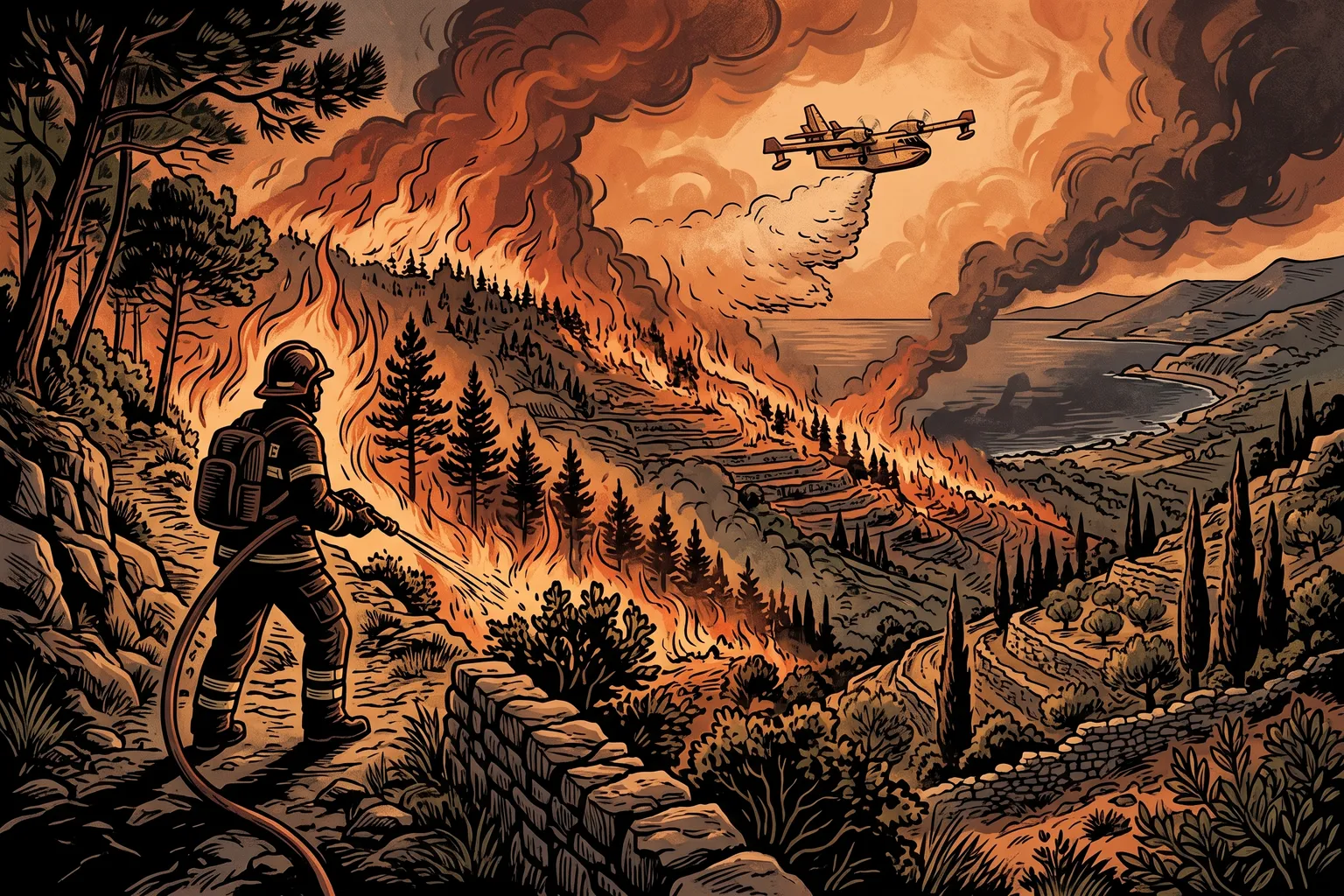
Three firefighters died Wednesday as wildfires burned simultaneously across Sicily, southwestern France, and central Spain. Two died in France, one in Italy. Italian Interior Minister Matteo Piantedosi confirmed the Italian death, saying the firefighter “died after falling ill while battling the flames,” according to France 24.
France evacuated more than 10,000 people overnight from the Gironde department, where fire consumed more than 2,000 hectares. A single fire in Spain burned approximately 79,000 acres and forced 34 villages to evacuate. Sicily deployed 6,000 firefighters, forest guards, and civil protection personnel; as of Wednesday, 300 of the island’s 344 fires had been brought under control. Euronews has covered the full situation. The fires are occurring in the third week of a heat wave that has pushed temperatures above 40 degrees Celsius across southern Europe and broke all-time June records across the region. It’s the same atmospheric pattern that drove the heat dome over the eastern United States. It’s just arriving later, and in a different place, on the other side of the Atlantic.
Ukraine’s senior military command is in transition. President Zelensky dismissed Commander-in-Chief Oleksandr Syrskyi this week and appointed General Mykhailo Drapatyi as his replacement, eight days after the removal of Defense Minister Mykhailo Fedorov. That earlier dismissal triggered protests in Kyiv, Lviv, Odesa, and Dnipro. Ukraine is rotating its two highest defense positions simultaneously in the middle of an active war.
Strikes on Ukrainian territory continued Wednesday. Russian attacks on the Kherson region killed one person and injured 20, according to the Ukraine TrustChain daily report for July 23. French President Macron said this week that the Coalition of the Willing is now the sole provider of international military support to Ukraine. The Council on Foreign Relations has tracked the coalition’s structure. France’s involvement has grown to include a substantial share of military intelligence contributions. The pattern of Russian strikes on Ukrainian civilian areas has not varied materially through this change in Ukrainian command.
The death toll from Venezuela’s June 24 earthquake sequence has risen to 5,398 as of Wednesday, according to BSS News, up 52 from Tuesday’s count of 5,346. Large-scale emergency search-and-rescue operations have effectively ended. Four weeks after two earthquakes struck within a minute of each other off Venezuela’s northern coast, the operational focus has shifted from rescue to recovery and humanitarian aid.
The Venezuelan government still hasn’t released an official missing-persons count. Multiple NGOs have estimated thousands remain unaccounted for in areas rescue crews couldn’t reach in the first days after the shocks. The USGS early projection that the final toll could exceed 10,000 hasn’t been revised. The 5,398 figure isn’t a final one.
Andy Burnham is three days into his tenure as Britain’s prime minister. His first policy announcement allocated 340 million pounds toward ending rough sleeping in England. His cabinet includes John Healey as Chancellor of the Exchequer, Ed Miliband as Foreign Secretary, and Shabana Mahmood continuing as Home Secretary. Trump posted that he had spoken with Burnham after the appointment and that it went “very well,” per CNBC, walking back his earlier characterization of Britain as a “Poverty Stricken Disaster.” Burnham’s office confirmed the call.
My colleague Warren Holt published a piece in the Ideas section on July 14 that’s stayed with me. The Occupation Problem is about what research shows on why some men thrive after work ends and others don’t. Warren’s argument isn’t about staying busy. It’s about where a particular kind of intelligence goes when the job that organized it is finished. It’s well-reported and worth finding.
The heat dome covering the eastern two-thirds of the United States continues. More than 200 million Americans remain under heat alerts or advisories. The confirmed heat death toll stands at least 44. Congress hasn’t scheduled a floor vote on the Extreme Heat Emergency Act, which would add extreme heat to the list of disasters eligible for Stafford Act relief. The Congressional Research Service explains the legal structure here.
The structural problem is the same as it was last week. The Stafford Act was built around property damage, not human mortality. Heat kills people, not buildings, and the statute’s definition of “major disaster” doesn’t accommodate that. Every gubernatorial request for a Stafford declaration citing extreme heat has been denied, going back to Missouri in 1980, Illinois in 1995, and California in 2022. Until the statute changes, extreme heat is not a federal disaster, whatever number of Americans it kills.
Uganda began its 42-day countdown toward declaring the Ebola outbreak over on July 16, the day its last confirmed patient was discharged from Mulago National Referral Isolation Centre in Kampala. UN News reported the milestone. If no new cases are confirmed, Uganda would be declared Ebola-free on August 27.
The Democratic Republic of the Congo hasn’t reached that threshold. Congo’s health ministry recorded 2,344 confirmed cases and at least 930 deaths as of Sunday. The WHO, which declared a Public Health Emergency of International Concern in May, has said 80 percent of new infections are now untraceable. Enhanced US airport screening at Washington Dulles, Atlanta’s Hartsfield-Jackson, Houston’s George Bush Intercontinental, and New York’s JFK remains in effect, extended through mid-August under a CDC order issued July 13. The CDC’s current guidance is here.
A MapBiomas report published this week found that 3.1 million hectares of Brazil’s Amazon burned in 2025. Euronews covered the findings. That’s down from 15.8 million hectares in 2024, and it’s the smallest burned area recorded since MapBiomas began tracking Amazon fires in 1985. Separately, deforestation across the Amazon in the first half of 2026 fell to a 10-year low, 1,295 square kilometers, a 38 percent decline from the same period last year, according to Mongabay.
Scientists are watching the second half of 2026 carefully. Forecasts of a strong El Nino event have conservationists concerned about what another drought year would do to gains that took two years to build. But the record stands as it stands. In 2025, the Amazon burned less than it had in at least forty years. That’s a reversal. Reversals are worth noting precisely because they aren’t automatic, which is what makes them news.
Howard Fenn writes The Day, Monday through Friday.