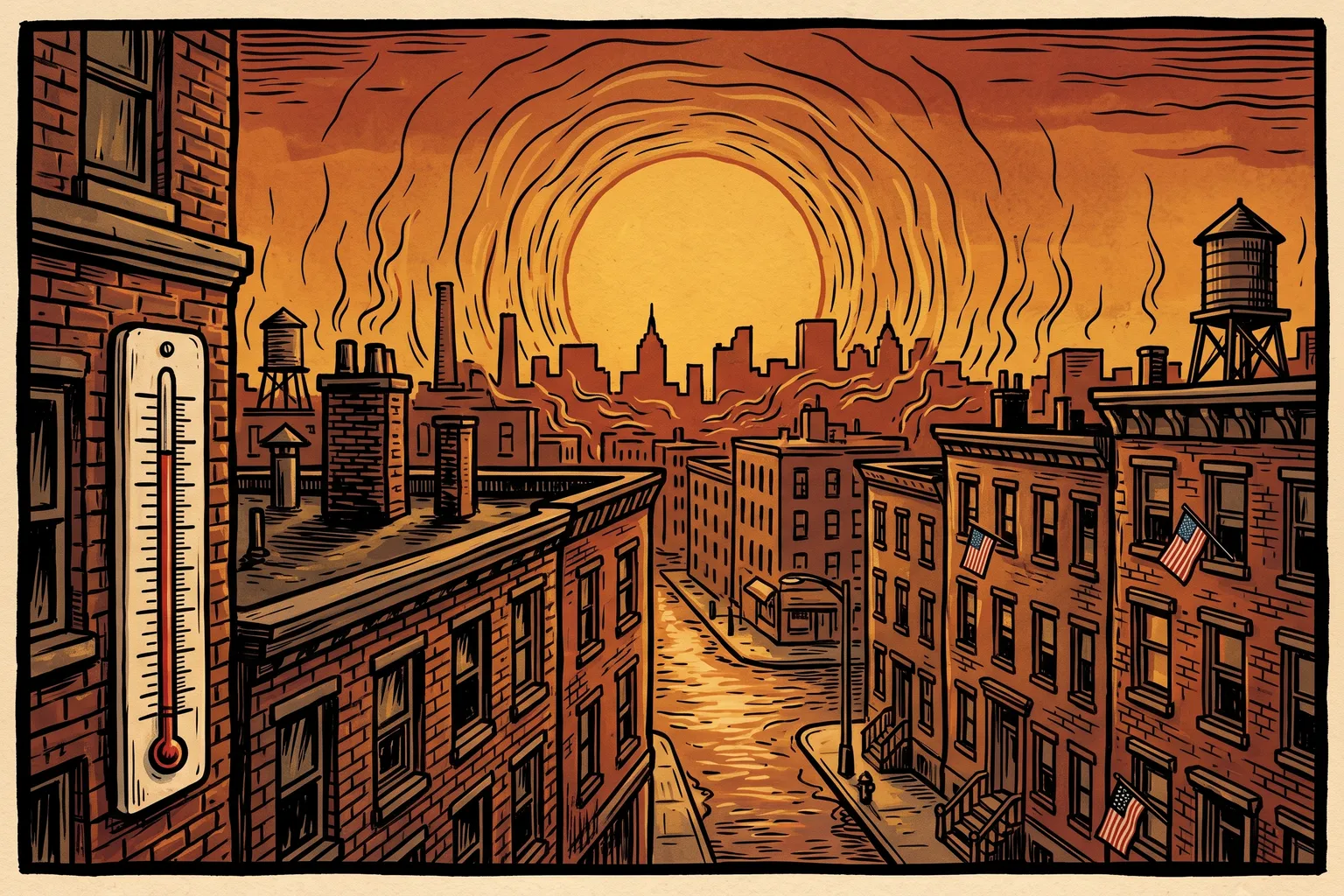
More than 160 million people across the eastern half of the United States were under extreme or major heat risk Wednesday as a heat dome settled over the region heading into the July 4th holiday weekend. The National Weather Service issued its Level 4 of 4 extreme heat designation for parts of more than 30 states. Forecast heat index values, which account for both temperature and humidity to reflect what the air actually feels like to the body, ranged from 104 degrees in New York City and Chicago to 108 in Washington and 111 in Nashville, with interior sections of New Jersey expected to approach 115 degrees. The dome has been building since late June and is forecast to peak Thursday before gradual relief arrives over the weekend.
Cities activated emergency protocols Wednesday. New York opened hundreds of cooling centers citywide and deployed mobile medical units. Washington extended an Extreme Heat Alert through July 5. Philadelphia declared a Heat Health Emergency and shortened the route of its July 4 parade. Chicago moved some outdoor holiday events indoors. These protocols exist because they didn’t exist in July 1995, when a heat wave struck Chicago over five days and killed at least 739 people. Many of the dead were elderly residents living alone, without air conditioning, in neighborhoods where the social ties that would have sent someone to knock on their door had frayed over years of disinvestment. The 1995 event reshaped how American cities prepare for extreme heat. Cooling centers became standard municipal infrastructure. Wellness check systems were formalized. Mandatory alert protocols were adopted across major cities. CNN has been tracking the heat dome’s expansion and its projection through the holiday weekend.
The Fourth of July timing compounds the risk in specific ways. Heat is the leading cause of weather-related deaths in the United States in an average year, and the Fourth is historically the single day when the most Americans are outdoors for extended hours. This year the holiday also coincides with the knockout stage of the FIFA World Cup, with matches scheduled in New Jersey and Philadelphia over the coming days, bringing large numbers of international visitors into cities already under extreme heat warnings. Whether the emergency systems built after 1995 can handle an event of this scope depends on what the next 72 hours look like. NPR has been reporting on the scope of warnings and who faces the greatest risk.
The Trump administration announced Tuesday that it won’t seek a 16-year extension of the United States-Mexico-Canada Agreement, the North American trade framework that replaced NAFTA when it took effect July 1, 2020. The deadline for requesting the extension was built into the deal. Without a formal request, USMCA enters a yearly review process, requiring each member government to reaffirm or renegotiate terms on an annual basis rather than operating under a fixed long-term commitment. The deal remains in force legally, but the stable long-term framework is gone.
U.S. Trade Representative Jamieson Greer said the administration was “not prepared to rubber stamp the agreement,” citing persistent trade deficits with Canada and Mexico. U.S. and Mexican negotiators are scheduled to meet during the week of July 20 to begin talks on rules of origin for industrial goods. Separate talks with Canada are expected to follow. The decision shifts North American trade relationships from a single agreed architecture to an ongoing series of bilateral negotiations with no defined endpoint. NBC News reported on the administration’s decision and its implications for supply chains across the continent.
The agreement now heading into annual reviews is an agreement Trump negotiated in his first term. NAFTA, which had governed continental trade since January 1, 1994, was a central target of his 2016 campaign. He signed its replacement, USMCA, in November 2018 and described it as superior. Six years into USMCA’s existence, the same administration has concluded that deal is also insufficient. What changed is the trade deficit figure, which grew during the years USMCA was in effect. The administration isn’t proposing a third agreement. It’s replacing the long-term framework with year-by-year negotiations on specific points. That is a different kind of arrangement than any that has governed North American trade since 1994. The Washington Post reported on the administration’s stated reasoning for the decision.
Eight days after twin earthquakes struck Venezuela’s northern coast, the confirmed death toll has reached more than 2,295, with more than 11,200 people injured. A satellite analysis using Sentinel imagery, published by NASA this week, estimated that approximately 59,000 buildings were damaged or destroyed across the affected region. In the coastal communities of Caraballeda, Macuto, Naiguatá, La Guaira, and Catia la Mar, more than half the structures showed a damage probability of at least 75 percent.
The humanitarian situation in the hardest-hit areas remains severe. Survivors in La Guaira, which contains Venezuela’s main seaport and its international airport, were reported Wednesday to be living without reliable access to drinking water or shelter. Damage to the port and airport has slowed the arrival of outside assistance, since both are primary entry points for aid coming into the capital region. Venezuela was already short of food, medicine, and functioning public infrastructure before June 24. The earthquakes didn’t change those underlying conditions. They added catastrophic structural damage on top of them. NPR reported Wednesday on what aid organizations are finding one week into the response.
A change to federal higher education borrowing went into effect Tuesday that will alter how millions of Americans pay for graduate school. Under provisions of the One Big Beautiful Bill Act signed into law last July, the federal government has eliminated the Grad PLUS loan program and replaced it with hard annual and aggregate borrowing limits for new graduate and professional borrowers.
Students who begin borrowing on or after July 1 face an annual federal loan cap of $20,500, with a lifetime aggregate limit of $100,000. Professional students in law, medicine, and dentistry face a $50,000 annual cap and a $200,000 lifetime aggregate limit. Under the prior system, Grad PLUS loans carried no effective annual ceiling. Borrowers could access federal money up to their full cost of attendance, which for a medical degree can exceed $300,000 over four years. Students who exceed the new caps will be pushed toward private lenders, which charge higher interest rates and offer fewer repayment protections than the federal loan system. Current students who had already borrowed under the old rules retain access to prior-law terms until they graduate or leave their program. New borrowers face the new limits immediately. The College Investor published a detailed summary of what changed on July 1.
Grad PLUS was created in 2005 under the Higher Education Reconciliation Act to fill the gap between the existing federal graduate loan limits and the actual cost of graduate school. The argument for eliminating it is that uncapped federal borrowing let tuition at graduate programs rise without price pressure, since students could borrow whatever the school charged at federal rates. The argument against the new caps is that students pushed toward private lenders are disproportionately those without family resources to cover the gap. Both of those things can be true at the same time. The effects on enrollment patterns and private borrowing will show up in data over the next several academic years. The change is in effect as of Tuesday.
Algeria held parliamentary elections Wednesday, calling more than 24 million registered voters to renew the 407 seats of the People’s National Assembly. The question going into the vote wasn’t which parties would prevail but how many voters would show up. The last parliamentary elections, held in 2021, produced an official turnout of 23 percent, the lowest recorded since Algeria gained independence from France in 1962.
The Hirak protest movement that began in February 2019 forced longtime president Abdelaziz Bouteflika from office after two decades in power. Seven years later, the political structures the protests targeted are largely intact. Human rights organizations reported ahead of the vote that restrictions on opposition candidates, independent media, and civil society had limited meaningful competition. Whether official turnout exceeds 2021’s historic low, or drops further, will be among the first numbers reported after polls close. Al Jazeera has been following the election’s context and what it reveals about post-Hirak Algerian politics.
Our Wednesday colleague spotlight is Bob Whitfield, writing in the Ideas section. Bob’s most recent column, published last Sunday, is called “Without a Vote.” It opens with a man named Gordon Kessler who lived two doors down from Bob’s parents on their street in Muncie, Indiana. Gordon was a machinist who lost his job at 57, too young for Medicare by eight years and earning just enough that Medicaid wouldn’t take him. He waited. He got to 65. What those years cost him, he never talked about.
The piece is built around a number: five million. Five million fewer Americans are enrolled in ACA marketplace plans today than were enrolled this time last year. The enhanced premium tax credits Congress passed in 2021 and extended through 2025 expired December 31 without a renewal vote. No senator announced the decision. No floor speech marked it. The credits expired because an expiration date arrived and the work required to continue them didn’t happen. The result for five million people is indistinguishable from a repeal, except the accountability is spread thin enough that nobody had to own the outcome directly. “Nobody voted for the gap,” Bob writes. “The gap arrived anyway.” What he traces, with considerable precision, is how a change affecting five million people happened without a vote. It’s in the Ideas section. It’s called Without a Vote.
Howard Fenn writes The Day, Monday through Friday.