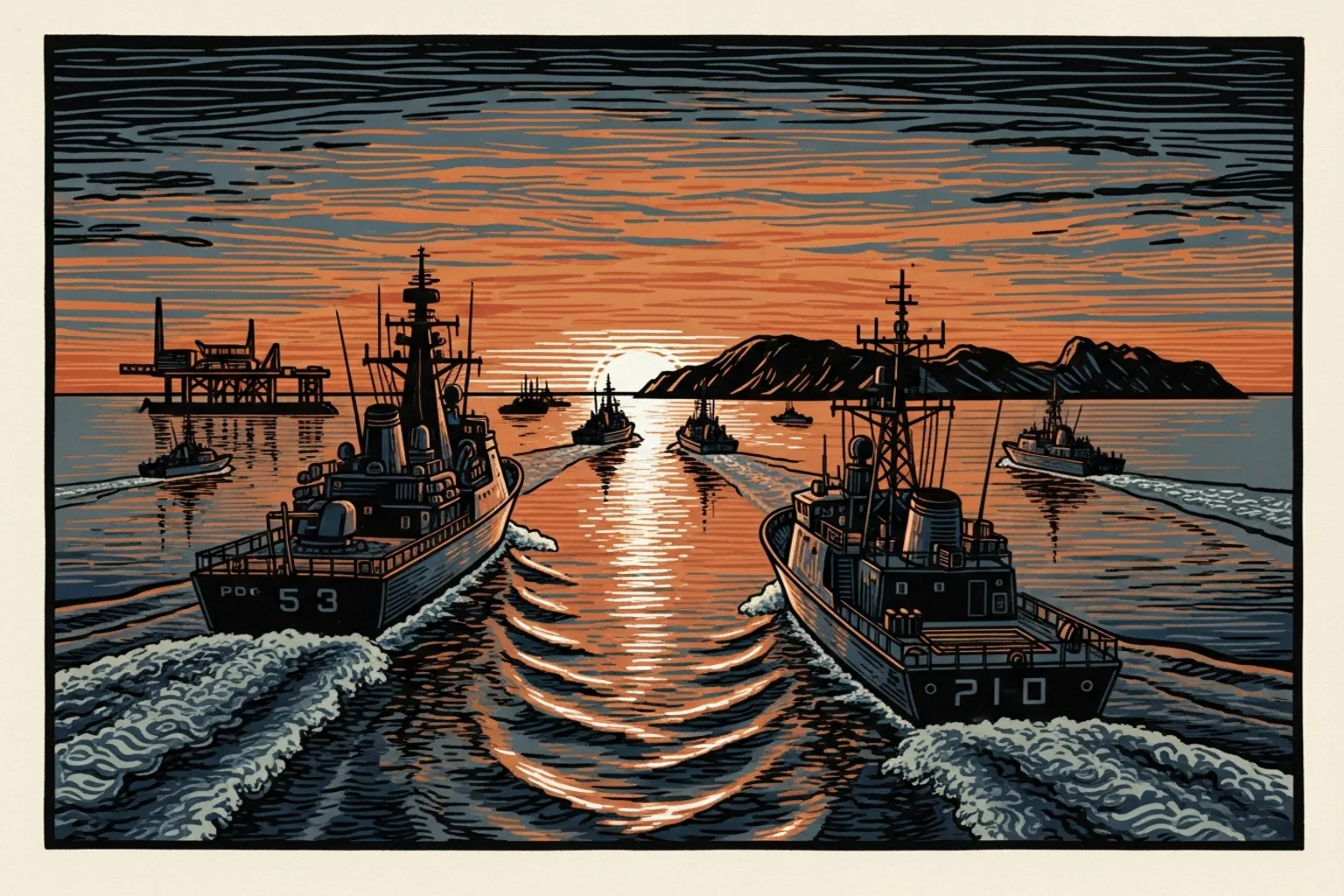
Iran launched ballistic missiles and drones at Kuwait and Bahrain on Tuesday, the sharpest day of fire in the Gulf confrontation in weeks, NPR reported. U.S. and Bahraini defense systems intercepted the missiles aimed at Bahrain. Iran’s missiles toward Kuwait broke apart before completing their trajectories. U.S. Central Command said Iran “launched several ballistic missiles toward regional neighbours; however, all failed to hit their intended targets.” Kuwait’s international airport sustained damage in the strike, and Kuwaiti authorities reported injuries among airport staff.
U.S. forces responded within hours, striking an Iranian military ground control station on Qeshm Island in the Strait of Hormuz. Qeshm has now been hit in successive exchanges since last week. The ceasefire framework negotiated in April, twice extended, remains nominally in place. Parallel diplomatic talks between the United States and Iran are still running. Both tracks are open at the same time, fire and negotiation running side by side, which is how the Gulf has operated for many decades without either track foreclosing the other.
New ambassador-level talks between Israel and Lebanon opened Tuesday at the U.S. State Department, The Times of Israel reported, with Deputy National Security Adviser Mike Needham and State Department Counselor Dan Holler leading the American side. A senior Hezbollah official rejected a U.S.-backed partial ceasefire proposal the same day.
Kuwait’s place in this conflict has historical precedent. In 1987, during the final years of the Iran-Iraq War, Iran was attacking Kuwaiti oil tankers in the Gulf as part of its pressure campaign against states that supported Iraq. Kuwait asked both the United States and the Soviet Union to protect its shipping. The Reagan administration agreed, reflagging eleven Kuwaiti tankers under the American flag in an operation called Earnest Will, the largest naval convoy escort since World War II. Iran mined the waters. The following spring, the USS Samuel B. Roberts struck a mine, triggering a direct U.S.-Iran military engagement. The Tanker War ended in August 1988 when Iran accepted a United Nations ceasefire, not because either side had prevailed but because eight years of warfare had exhausted both. Thirty-eight years later, Kuwaiti infrastructure is taking fire again, and U.S. forces are again in the water between them.
The Supreme Court ruled 6-3 on Tuesday that Alabama may use a congressional redistricting map that reduces the state’s majority-Black congressional districts from two to one, NBC News reported. The ruling blocks a lower court finding that Alabama’s plan intentionally discriminates against Black voters. Republicans are expected to gain a net of one House seat in November as a result.
The ruling is the latest turn in a story that runs back sixty-one years. The Voting Rights Act of 1965 required that states with a documented history of voter discrimination get federal approval before changing their election laws. In 2013, Shelby County v. Holder eliminated that preclearance requirement, and redistricting disputes that would have been blocked at the threshold now had to be litigated under Section 2 of the act in regular federal courts. Ten years later, in Allen v. Milligan, the Court ruled 5-4 that Alabama’s prior map violated Section 2 and ordered a second majority-Black district drawn, a ruling that surprised observers who had expected the Court to narrow the VRA further. Tuesday’s decision does the narrowing that Milligan didn’t. The three liberal justices dissented.
The Voting Rights Act was signed by President Lyndon Johnson on August 6, 1965. Johnson said at the signing: “The vote is the most powerful instrument ever devised by man for breaking down injustice and destroying the terrible walls which imprison men because they are different from other men.” What the act requires in 2026 is still being resolved in court, sixty-one years on.
Iowa’s Republican gubernatorial primary produced an upset Tuesday. Businessman Zach Lahn defeated Representative Randy Feenstra, whose late endorsement by President Trump in the final stretch of the race wasn’t enough to hold the lead, KWQC reported. NBC News called it the first time a Trump-backed candidate for governor, Senate, or House has lost a primary in the 2026 midterm cycle. Lahn ran closely aligned with the “Make America Healthy Again” movement associated with Health Secretary Robert F. Kennedy Jr.
Feenstra called Lahn to concede Tuesday night. “I just called Zach Lahn and said, ‘hey, you’ve got to carry this torch, we’ve gotta make sure to beat Rob Sand and I’m all in to help him out,’” Feenstra said. Lahn now faces Democratic State Auditor Rob Sand in November. Iowa’s general election will be a real contest. The primary settled one question the cycle had left open: in a race where a sitting president’s endorsement and the MAHA label compete directly, the MAHA label can win.
The Organization for Economic Cooperation and Development released its biannual Economic Outlook on Tuesday, projecting global growth will slow from 3.4 percent in 2025 to 2.8 percent in 2026, then recover to 3.1 percent in 2027, the OECD reported. Consumer price inflation in G20 economies is projected to rise to 4.0 percent this year. U.S. growth is projected at 2.0 percent under the baseline scenario.
The OECD also published a stress scenario built around a prolonged Iran-Israel conflict and the energy disruption it could produce. Under that scenario, global growth falls to 2.1 percent this year and 1.8 percent in 2027. The Gulf carries roughly twenty percent of the world’s seaborne oil. The military story and the economic story aren’t separate. They’re the same story with different units of measure, and Tuesday’s outlook made the connection explicit.
President Trump announced Tuesday that William “Bill” Pulte, the director of the Federal Housing Finance Agency, will also serve as acting director of national intelligence, Fox News reported. Pulte replaces Tulsi Gabbard, who resigned from the DNI post last month to be with her husband following his bone cancer diagnosis. Pulte will retain his position at the FHFA while taking on the intelligence role.
Trump posted on Truth Social: “William has deep experience managing the most sensitive matters in America, the safety and soundness of the Markets, and over 10 Trillion Dollars at Fannie Mae/Freddie Mac.” Acting officials don’t require Senate confirmation. Pulte was confirmed as FHFA director earlier in the administration. He’ll now oversee the nation’s intelligence agencies while continuing to regulate the federal housing finance system. The combination is unusual in the history of the position.
And one more thing worth reading.
Carol Gifford wrote about dry eye in “Dry Eye Treatment: The Real Causes and What Actually Works”, publishing today in the Health section. The piece opens with a patient who spent a year and a half using the wrong kind of drops, getting twenty minutes of relief at a time, because no one had explained what was actually causing her symptoms or what would actually fix them. Carol traces the problem to the tear film’s three-layer structure, explains why the most commonly recommended drops miss the root cause in most cases, and walks through the evidence on everything from warm compresses to prescription medications to punctal plugs. “Dry eye is extremely common,” she writes. “It’s also, in many cases, substantially treatable. Those two facts coexist, and a lot of people are living in the gap between them without knowing they don’t have to.” If your eyes have been bothering you and the drops aren’t doing much, this is the piece to read first.
It is Tuesday. Iran fired missiles at Kuwait’s airport and Bahrain; the U.S. struck Qeshm Island; the Supreme Court allowed Alabama to redraw its congressional map with one majority-Black district; Iowa’s Republican primary delivered the first Trump endorsement loss of the cycle; the OECD warned that a prolonged Gulf conflict could cut global growth to 1.8 percent next year; and President Trump named the FHFA director as his acting head of national intelligence. That’s the day.