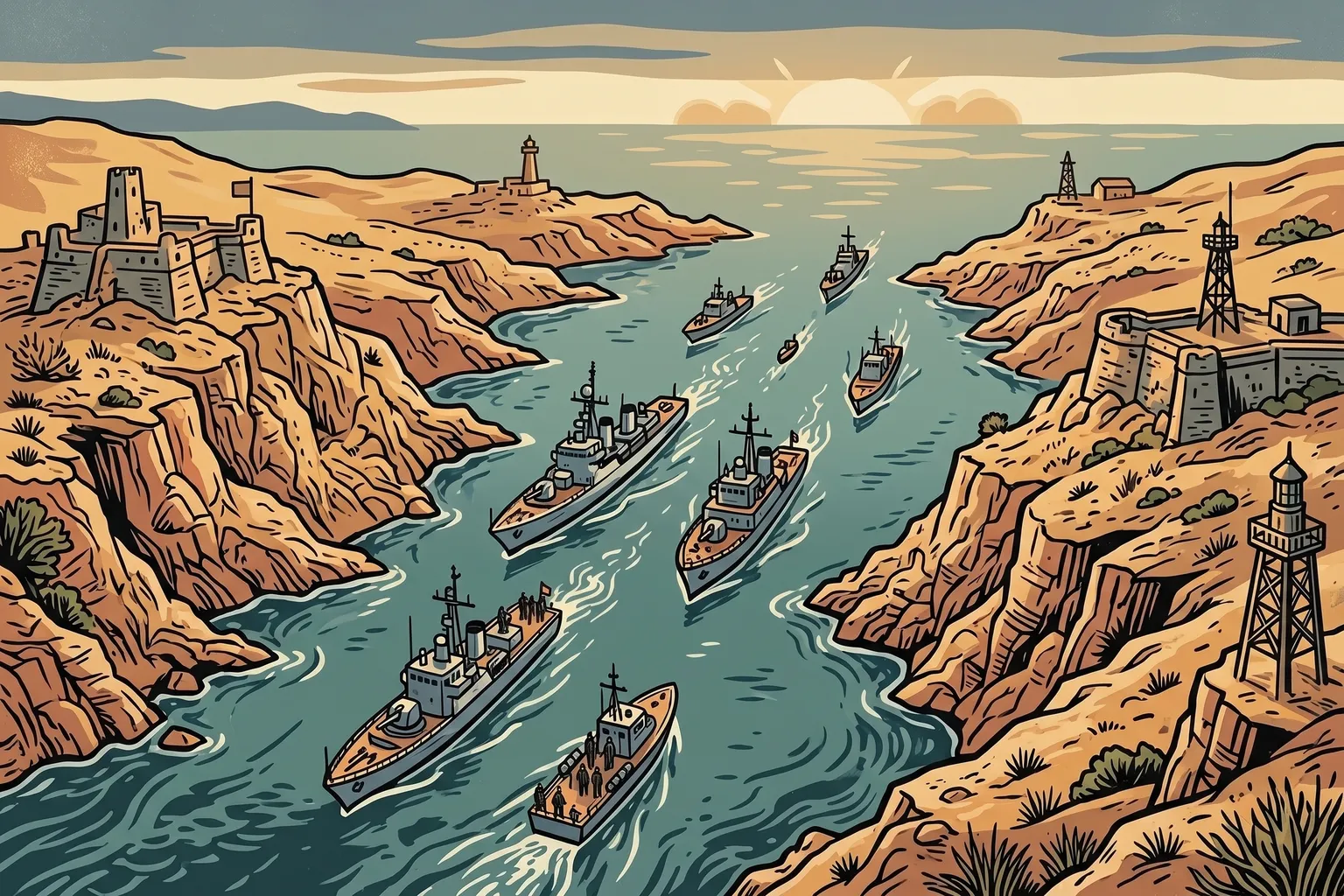
The Pentagon said Tuesday that an Iranian drone brought down the U.S. Army Apache helicopter that crashed near the Strait of Hormuz late Monday, and U.S. Central Command launched retaliatory strikes against Iranian air defense sites, ground-control stations, and surveillance radar near the strait beginning at 5 p.m. Eastern time Monday. The strikes ended shortly after 9 p.m. Iran answered before dawn Tuesday.
Iran’s Islamic Revolutionary Guard Corps launched drone and missile attacks on three American military installations: the U.S. Fifth Fleet in Bahrain, the Ali Al Salem Air Base in Kuwait, and the Azraq Air Base in Jordan. The IRGC said it attacked 21 American targets and destroyed four, claiming an F-35 fighter jet hangar at the Jordan base among them. The Jordanian military said it intercepted five missiles with no human injuries or material damage. Bahrain and Kuwait said their air defenses were engaged with incoming fire as well. No American casualties were reported by Tuesday afternoon.
Trita Parsi, an expert on U.S.-Iranian relations, said Tuesday that Tehran believes it “must respond proportionately, but very harshly and swiftly” to prevent the United States from establishing, in his words, “a new normal in which the United States can strike at Iran with more or less impunity.” Both governments communicated through intermediaries a preference for resumed negotiations while each described the other as having forced the escalation.
The sequence has a direct historical parallel. On January 8, 2020, five days after the U.S. killing of IRGC commander Qasem Soleimani, Iran fired ballistic missiles at two bases in Iraq hosting American troops: Ayn al-Asad in Anbar Province and the Erbil airport in the Kurdish region. There were no American fatalities. The Trump administration said it would not escalate further. Iran declared the strike sufficient retaliation, and the immediate crisis passed. What took months to emerge was the toll that hadn’t been reported at the time: more than one hundred U.S. service members were eventually diagnosed with traumatic brain injuries from the blasts, a number the Pentagon was slow to acknowledge and that accumulated quietly long after the headlines moved on. The comparison isn’t offered as comfort. It is context for what getting through a direct exchange without catastrophic escalation has required before, and what it sometimes left behind that wasn’t immediately visible.
The House passed a $70 billion budget package Monday to fund U.S. immigration enforcement agencies for the next three years, ending the longest appropriations lapse in the Department of Homeland Security’s history. The vote was 214 to 212, with all Democrats opposed and two Republicans joining the minority. The bill provides $38 billion for Immigration and Customs Enforcement, $26 billion for the Border Patrol, and $5 billion to cover unforeseen costs. It goes to the president for his signature.
The standoff began in the fall of 2025, when Democrats refused to pass a DHS appropriations bill in response to enforcement operations they described as unlawful. Congress funded most of the federal government during the interval, but DHS operated without a current appropriation for months. No negotiated compromise produced the bill. Republicans assembled a narrow majority on their own, and the bill moved.
ICE was created in 2003 from the reorganized remnants of the Immigration and Naturalization Service and parts of the U.S. Customs Service, consolidated into the newly formed Department of Homeland Security in the aftermath of September 11. In its early years the agency was focused primarily on border enforcement and workplace investigations. The $38 billion now allocated to it reflects two decades of expansion in both scope and political priority. The bill’s three-year horizon covers the remainder of the current administration and runs into the next Congress. Whether that framework holds past the 2026 midterms is a question the elections will answer.
Anti-immigration protests broke out in Belfast on Tuesday after video of a knife attack spread across social media, and organized demonstrations followed within hours. British leaders called for calm after a Sudanese man in his thirties was charged with attempted murder following the attack, which left a man in his forties with serious injuries to his eyes, face, and back. Masked protesters gathered at multiple locations across the city. Buses and cars were set ablaze. A building near Belfast’s city center caught fire and its residents were evacuated. Anti-immigration activist Stephen Yaxley-Lennon, who goes by the name Tommy Robinson, was among the first to circulate the attack video and call for demonstrations.
The pattern was close to identical to the Dublin riots of November 2023, when a stabbing near a school spread rapidly on social media, was accompanied by claims about the attacker’s background that were initially inaccurate and later corrected, and produced a night of arson and looting in the Irish capital. In both cases, a real criminal act became the occasion for a separate and organized act of violence directed at a broader population. Those are two distinct events, and the distinction matters. The protests in Belfast were organized and promoted online within hours of a video whose details were still being established by police. In Dublin in 2023, many of the initial claims about the attacker’s background that circulated alongside the video turned out to be inaccurate. The core dynamic, a real act of violence followed quickly by organized political demonstrations before the facts are settled, played out the same way both times.
The Senate Energy and Natural Resources Committee held a hearing Tuesday on a water dispute that most national coverage treats as a western regional matter and that is, by the numbers, a structural emergency. The subject was what happens to the Colorado River when the 2007 Interim Guidelines governing operations at Lake Mead and Lake Powell expire at the end of this year.
The hearing arrived days after the Bureau of Reclamation announced it would impose its own ten-year federal management framework on the seven basin states, bypassing a state-led consensus process that has failed twice. Interior Department and Reclamation officials testified alongside state water agency representatives and witnesses from agricultural, tribal, and environmental interests. Committee Chair Sen. Mike Lee of Utah and Ranking Member Sen. Martin Heinrich of New Mexico led the questioning. The hearing is Congress’s direct assertion of oversight over a negotiation that has played out almost entirely at the agency and state level for more than a year.
The underlying problem is not new. The Colorado River Compact of 1922, negotiated in Santa Fe with Herbert Hoover, then Commerce Secretary, chairing the federal delegation, divided 15 million acre-feet of water annually between the upper and lower basin states. A separate treaty in 1944 committed another 1.5 million acre-feet to Mexico. The flow data behind those allocations came from roughly sixteen years of measurements, from 1906 to 1922, that happened to fall during an unusually wet stretch of the river’s history. The actual long-term average flow, confirmed later by tree-ring paleoclimate reconstructions, runs well below what the compact assumed. Every management framework built on top of the compact has carried that original miscalculation forward. The 2007 guidelines were an attempt to manage shortage conditions the compact’s authors hadn’t anticipated. Now those guidelines expire into a prolonged drought and a set of competing legal claims the river cannot satisfy at once. The Bureau of Reclamation’s move to impose a federal solution rather than wait longer for the states is a significant shift in how the federal government relates to western water law. The legal and political consequences will play out over years, and forty million people’s water supply runs through them.
England’s National Health Service began offering a new treatment for ovarian cancer Tuesday, the first addition to NHS ovarian cancer therapy in more than twenty years, and the patients who will receive it are women whose disease has stopped responding to standard chemotherapy. The drug, mirvetuximab soravtansine, works by attaching to cancer cells that carry a particular protein, folate receptor alpha, and releasing a cancer-killing molecule directly into them. In clinical trials conducted at eight NHS hospitals, patients on the treatment lived a median of 16.5 months compared with 12.8 months on standard chemotherapy. More than a third of patients saw tumor shrinkage of at least thirty percent.
The NHS estimates up to 400 women per year in England will be eligible. Patricia Hill, 64, who participated in the trial, said the drug “adds life to years, rather than spending your life in bed recovering from side effects.” Another trial participant, Jenny Green, 71, said she had “hardly any side effects at all.” The drug is developed by AbbVie and sold under the brand name Elahere. It doesn’t cure ovarian cancer. It gives people more time, with more tolerable side effects, than what was available to them before. That matters.
It is Tuesday, June 10. The Pentagon confirmed an Iranian drone downed an American Apache helicopter near the Strait of Hormuz; CENTCOM struck Iranian air defense sites in response; Iran’s IRGC launched drone and missile attacks on American military bases in Bahrain, Kuwait, and Jordan, almost all intercepted, with no U.S. casualties reported; the House passed a $70 billion immigration enforcement funding package 214 to 212, ending months of DHS appropriations standoff; Belfast saw vehicles burned and a building evacuated after a knife attack video spread and organized protests followed; the Senate held a hearing on what happens to the Colorado River and forty million people who depend on it when the 2007 operating rules run out at year’s end; and England’s NHS began offering the first new ovarian cancer treatment it has made available in more than two decades. That’s the day.
In the health section today, Carol Gifford has published something worth your time if you or anyone close to you loses sleep to that relentless, crawling urge to move your legs once the lights go out. “Restless Leg Syndrome Treatment” covers what the condition actually is neurologically, why the ferritin-iron connection that most primary care doctors overlook can matter more than any prescription, what the augmentation risk in dopamine agonist therapy means and why that conversation often doesn’t happen before the medication is written, and which common over-the-counter and prescription drugs are quietly making RLS worse in people who don’t know the connection exists. Carol’s background is clinical and the piece reads like it. Specific, practical, and genuinely useful. It’s in the health section today.