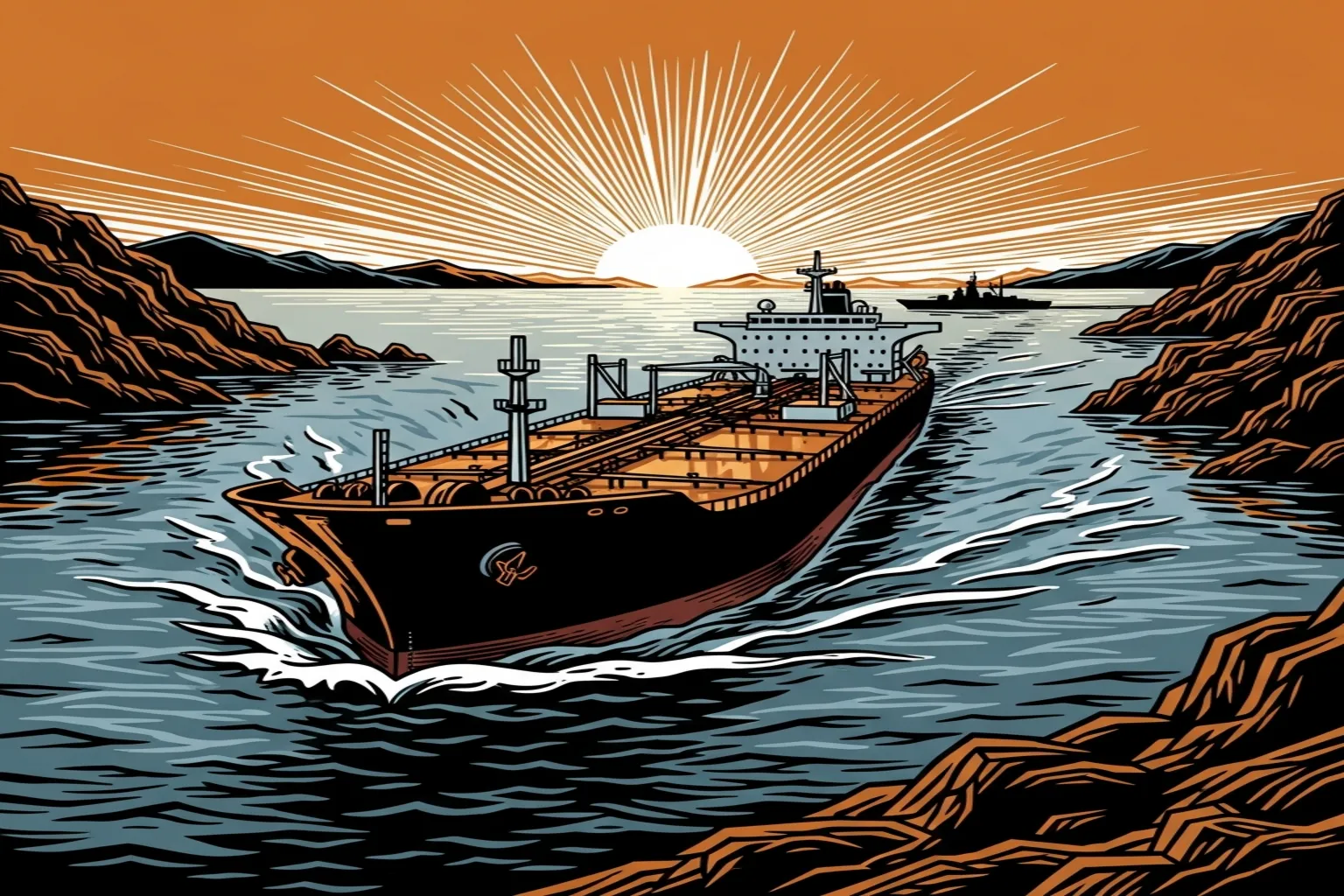
The June 17 ceasefire agreement gave commercial ships the right to pass through the Strait of Hormuz for sixty days. On Monday, three ships were attacked in the Strait anyway.
The first two, a Qatari LNG carrier called the Al Rekayat and a Saudi supertanker called the Wedyan, were hit within hours of each other. The Al Rekayat was left with an engine room fire at risk of explosion. The Wedyan was taking on water. Iran’s Islamic Revolutionary Guard Corps attacked a third vessel before the day was out. CENTCOM responded overnight, announcing strikes on more than 80 targets inside Iran: air defense systems, command-and-control networks, coastal radar installations, and more than 60 IRGC small boats operating in and around the Strait. The Treasury Department reimposed oil sanctions on Iran that had been suspended under the June agreement. CENTCOM called the tanker attacks “unwarranted, dangerous, and a clear violation of the ceasefire.” Iranian officials, by Tuesday morning, warned of a “crushing response.” The Washington Post reported on the U.S. strikes and what CENTCOM said about the decision to respond.
The June 17 agreement was reached in Islamabad following a February military campaign that killed Supreme Leader Ali Khamenei and targeted Iran’s nuclear and missile infrastructure. Under the memorandum, Iran agreed to allow commercial transit through the Strait for sixty days, with nuclear talks to follow. The attacks on the tankers came on Day 21 of that window.
Whether the June agreement can be revived, or whether it was a temporary pause in a conflict with no durable settlement in sight, is the question that determines what the next several weeks look like.
In 1987, the Reagan administration faced a version of this problem in the same waters. Iran and Iraq had been attacking tankers in the Persian Gulf since 1984 in what became known as the Tanker War. Kuwait asked the United States to reflag its tankers under American colors for Navy protection. The Reagan administration agreed. Operation Earnest Will, launched in July 1987, was the largest American naval convoy operation since the Second World War. The first reflagged tanker, the Bridgeton, struck an Iranian mine within days. The Navy kept going. The Tanker War continued another year before Iran accepted a United Nations ceasefire in July 1988. Roughly 20 percent of the world’s oil passes through the Strait of Hormuz. That figure hasn’t changed.
Day five of the six-day state funeral for the late Supreme Leader Ali Khamenei moved outside Iran on Tuesday. His body was transported to the Iraqi shrine cities of Najaf and Karbala for prayers before tens of thousands of mourners. President Masoud Pezeshkian and Parliament Speaker Mohammad Bagher Ghalibaf were present in Najaf. After the ceremonies in Karbala, the body was to return to Iran for burial in Mashhad.
The man who is now Supreme Leader didn’t appear. Mojtaba Khamenei, who acceded to the position following his father’s death in February, hasn’t been seen or heard from publicly in the four months since. Defense Secretary Pete Hegseth said in March that Mojtaba had been “wounded and likely disfigured” in the same strike that killed his father, his mother, and his wife. Reuters reported in April that he was recovering from severe injuries, possibly including an amputation. His image appeared on posters across Tehran during the funeral week. He didn’t appear in person. Time reported on the gap between the funeral’s messaging and Mojtaba’s continued absence.
When Ayatollah Ruhollah Khomeini died in June 1989, the Assembly of Experts convened the following day and selected a successor within roughly twenty-four hours. The transfer of authority was deliberate, visible, and orderly. Iran’s new leadership has had four months to stage its own version of that moment. Four months in, the Supreme Leader hasn’t appeared in public once.
The North Atlantic Treaty Organization opened its annual summit in Ankara on Tuesday with Ukraine at the center of the agenda, and Russia underscored the stakes before the sessions began. Kyiv was struck by Russian missiles and drones overnight for the third time in seven days. Mayor Vitali Klitschko reported fires in two city districts and at least two injured. A week earlier, a barrage involving 68 missiles and 351 drones killed at least 22 people in and around the capital. NPR has been tracking the escalation in the week before the summit opened.
Ukraine’s main request at Ankara was the same as it’s been for two years: more air defense munitions. The gap between Ukraine’s interception needs and what NATO countries have committed to deliver hasn’t closed. On the ground in eastern Ukraine, Russian forces have made incremental gains at significant cost in personnel and equipment. There’s no ceasefire framework in place. Ukraine won’t negotiate any settlement that requires ceding territory. Russia hasn’t indicated terms compatible with that position.
NATO was founded in April 1949, a response to what its founding governments described as an aggressive Soviet posture in Europe. Its first secretary general, Lord Ismay, is said to have described the alliance’s purpose as keeping the Americans in, the Russians out, and the Germans down. Seventy-seven years later, the leaders of that alliance are meeting in a country that joined in 1952 to decide what to do about Russia. The American commitment to the alliance, and to Ukraine, remains the central question at the table.
The confirmed death toll from Venezuela’s twin earthquakes climbed to 3,535 by Tuesday, according to Al Jazeera, up from the 2,595 figure reported earlier in the week. The earthquakes, measuring magnitude 7.5 and 7.2, struck northwestern Venezuela on June 24. Fourteen days later, approximately 50,000 people remain unaccounted for. Search and rescue teams from 30 countries are working across the affected region. NASA satellite data estimates as many as 59,000 structures were damaged or destroyed. The United Nations puts economic damage at $37 billion. Al Jazeera has been reporting on the updated toll and the scale of the international response.
Venezuela’s deadliest previous natural disaster was the 1999 Vargas mudslides, which killed an estimated 10,000 to 30,000 people. The range reflects how difficult counting the dead is in a disaster of that scale in a country with limited infrastructure. The same challenge applies now, compounded by a decade of economic collapse that left Venezuela’s public systems badly strained before a single stone moved on June 24. The disaster response is happening on top of a pre-existing humanitarian crisis. The two can’t be separated.
Twenty-nine people have died from heat-related causes in New Jersey since the Fourth of July weekend, according to state health officials, up from 25 reported earlier. The deaths span ten counties. Most victims were found in homes without air conditioning. State Health Commissioner Raynard Washington said: “Unfortunately, many of these individuals were found in homes without air conditioning.” Three additional heat deaths were reported in New York. Medical Daily reported on the updated toll and the state of federal emergency authority for heat events.
The deaths have renewed a longstanding debate about what the federal government can do in a heat emergency. The Stafford Act hasn’t been used to issue a major disaster declaration for extreme heat in the statute’s history. The law’s definition of “major disaster” was written around measurable physical damage: structures, infrastructure, property. Heat kills people without damaging buildings, and Congress hasn’t updated the definition. A Senate bill proposing to add extreme heat to the Stafford Act’s covered events was introduced last year and hasn’t advanced out of committee. The heat isn’t letting up.
One number in the June jobs report hasn’t gotten the attention it deserves.
The Bureau of Labor Statistics reported July 2 that employers added 57,000 jobs in June, about half the roughly 115,000 economists had forecast. Unemployment came in at 4.2 percent. Both figures were covered. The labor force participation rate, which fell 0.3 percentage points in a single month to 61.5 percent, got considerably less. That’s the lowest participation rate since March 2021, and outside of the COVID era, the lowest in fifty years.
What that means: roughly 720,000 people stopped looking for work in June. They don’t count as unemployed because they’re not searching. Mike Reid, head of U.S. economics at RBC, called it a “massive exodus.” Dan North, senior economist for North America at Allianz, said the participation rate was “a more important number” than the headline payroll figure. LPL Financial’s chief economist Jeffrey Roach described “a concerning trend” of people dropping out of the labor market. Fed Chair Kevin Warsh called the overall picture “steady” and kept the focus on bringing inflation to 2 percent. Whether 720,000 people exiting the labor force in a single month is a structural shift or a one-month anomaly is the question July’s report will have to answer. CNBC reported on the participation rate drop and what it means for the Fed’s calculations.
Our Tuesday colleague spotlight is Carol Gifford, who writes in the Health section. Carol spent two decades as a cardiac nurse and case manager before she started putting down what she’d learned, and her piece published June 30 is the one you want to read before someone you love comes home from bypass surgery, or before you go in yourself.
It’s called “What to Expect After Open Heart Surgery.” Carol’s premise, built on twenty years of watching patients and families get through the first days and weeks after a procedure, is that the hospital provides the clinical information and not the human information. She fills in what the discharge folder leaves out: why exhaustion hits so hard after even a short walk to the kitchen, why sleep doesn’t come easily, why the hand keeps going to the chest not from pain but from a need to confirm the chest is still there, why crying happens unprompted and what it means. She opens with a woman named Diane who called her the morning after her husband came home from a three-vessel bypass operation with a folder of printed instructions and a follow-up appointment two weeks out. What Diane wanted to know was whether what was happening in her living room was normal. Carol answers that question directly, and then answers the twenty questions behind it. It’s in the Health section. Here’s the piece.
Howard Fenn writes The Day, Monday through Friday.