Russia struck Ukraine’s capital with one of the largest single-night attacks of the war, launching 74 missiles and 496 drones over an eleven-hour period from Wednesday night into Thursday morning. At least 21 people were killed and more than 90 wounded, according to Ukrainian authorities. More than 130 buildings were damaged across Kyiv, the majority of them residential. Ukraine’s air force said it intercepted most of the drones, but about a quarter of the inbound missiles still reached their targets.
Ukrainian Foreign Minister Andrii Sybiha called it “a night of horror” in a post on X. The Russian Defense Ministry said the strike was a response to Ukraine’s sustained campaign against Russian energy infrastructure, including an oil refinery attack in the Nizhny Novgorod region earlier this week. Poland scrambled fighter jets during the assault. Finland temporarily restricted airspace. This is the dynamic of wars that have entered their escalation phase: Ukraine has spent recent weeks using longer-range systems to strike targets inside Russia that weren’t reachable a year ago. Russia’s overnight attack was, in part, the answer. NPR reported on the scale of the strike and the casualties through the night.
Russia began systematically targeting Kyiv’s power grid and water infrastructure in October and November of 2022. Those attacks killed fewer people in any single night than Thursday’s strike did. What made the 2022 campaign effective wasn’t the scale of individual strikes but repetition: the same infrastructure hit again and again through the winter. Thursday’s attack is larger by the numbers. Whether it represents a strategic shift in the air campaign or a single escalatory response will become clearer in the coming weeks. CNBC tracked the overnight sequence, including Poland’s jet scramble and Finland’s airspace action.
The Bureau of Labor Statistics released June’s employment numbers Thursday morning. The U.S. economy added 57,000 jobs last month, roughly half of what economists had projected and the weakest monthly figure in more than two years. The unemployment rate edged down to 4.2 percent, but the drop came largely from fewer people actively looking for work rather than stronger hiring. The labor force participation rate fell 0.3 percentage points to 61.5 percent, its lowest level since March 2021.
Leisure and hospitality shed 61,000 jobs in June, reversing most of May’s gain in that sector. Professional and business services added 36,000. Healthcare added 22,000. The months preceding June were revised downward as well: May’s total was cut by 43,000 and April’s by 31,000, reducing the running 2026 total by 74,000 more than had been counted. Average hourly earnings rose 3.5 percent from a year ago, in line with projections. The Bureau of Labor Statistics published the full June employment situation report.
One soft month doesn’t define a trend. September 2021 came in well below expectations and then revised sharply upward the following month. What June does confirm, in combination with the prior revisions, is that the labor market has been cooling since the first quarter. Three consecutive months of downward revisions to prior months is a pattern. The Federal Reserve heads into its July meeting with a jobs picture that’s harder to read than it looked 60 days ago. The September rate decision, which had been expected to lean toward a hold, just got more complicated. CBS News reported on what the June miss means for the broader economic outlook.
Iran’s joint military command issued a formal warning Thursday that oil tankers transiting the Strait of Hormuz must follow routes approved by Iran or face what the statement described as “an immediate and forceful response from the armed forces, endangering the security of the violating vessels.” The Strait of Hormuz is the narrow passage at the mouth of the Persian Gulf through which roughly 21 percent of the world’s traded oil flows. The warning follows an interim agreement between the United States and Iran allowing vessels to transit without paying fees during a 60-day window for negotiations. Iran’s position is that it controls the routing and will eventually charge fees. The U.S. has not accepted that premise. PBS NewsHour reported on the text of the Iranian warning and its context within the ongoing negotiations.
Iran has asserted this position before. During the Tanker War of 1987 and 1988, Iran attacked vessels in the Gulf it deemed to be aiding Iraq. The United States Navy reflagged eleven Kuwaiti tankers as American vessels and began escorting them through. The confrontation culminated in April 1988 with Operation Praying Mantis, when U.S. forces sank Iranian frigates and patrol boats after Iran mined an American ship. The current period isn’t 1988. The political context, the forces involved, and the diplomatic stakes are different. But the underlying dispute, Iran asserting navigational control over the Strait and the United States contesting it, has a longer history than this week’s statement, and that history includes what happens when the dispute goes unresolved.
In Tehran, preparations are underway for the state funeral of Supreme Leader Ali Khamenei, scheduled for July 4 through 9. His coffin will lie in state at the Grand Mosalla beginning Saturday morning. Iranian authorities expect between 15 and 20 million people to attend ceremonies over six days, with the procession moving to Qom on July 7 and burial in Mashhad on July 9. Tehran is banning private vehicles from the procession route and opening more than 700 parking areas to manage what officials have described as the largest traffic operation in the city’s history. Khamenei led the country from 1989 until his death. CNN reported on the scale of the preparations and the security operation surrounding the ceremonies.
The heat dome that settled over the eastern United States this week was still in place Thursday, with roughly 90 million Americans under heat advisories heading into the July 4th holiday weekend. Washington, D.C., is expected to reach 100 degrees or above through Saturday. Parts of New Jersey and Philadelphia, where FIFA World Cup knockout-round matches are scheduled this weekend, face heat index values near or above 110 degrees. The National Weather Service projected more than 300 temperature records could fall by Saturday. Some rain is expected at the National Mall before Thursday evening’s fireworks. The holiday falls squarely inside the dome. CBS News has been tracking the heat projections and which areas face the greatest risk through the weekend.
The death toll from the June 24 earthquakes along Venezuela’s northern coast rose to at least 2,595 as of Thursday, with more than 12,400 people injured and nearly 50,000 still unaccounted for, according to acting President Delcy Rodriguez. In La Guaira, where damage to the international airport and main seaport has slowed the arrival of outside aid, survivors in the hardest-hit neighborhoods were still reported without reliable access to water or shelter. The situation on the ground hasn’t improved meaningfully since the first days after the quakes. NPR updated the death toll and relief conditions Wednesday.
Then there is the story of Hernán Alberto Gil Flores.
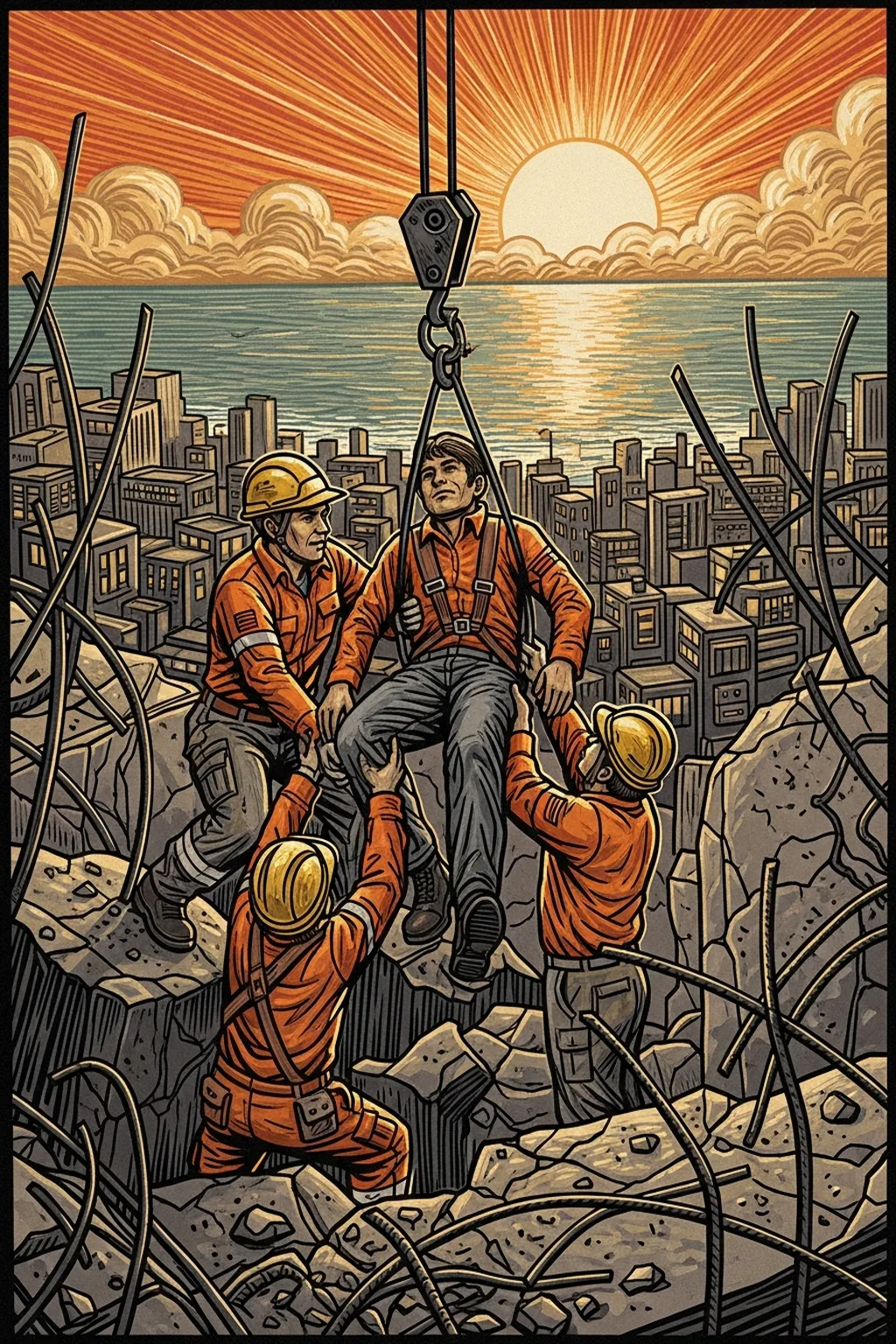
He is 44 years old. He worked as a security guard at the Galerías Playa Grande shopping mall in La Guaira. When the earthquakes struck on June 24, the mall collapsed around him. He survived inside an air pocket in his guard cabin, buried under 29 feet of rubble.
Rescue teams from Chile, the United States, Portugal, Mexico, Costa Rica, and Venezuela located him several days later and began working to reach him. The rubble was unstable. The first tunnel became unworkable. They started a second. They fed him hydration through tubing while they dug. The total rescue effort ran approximately 70 hours from start to finish.
That was Thursday morning. Nearly eight days after the earthquakes. In good condition.
Six countries, two tunnels, seventy hours, one man alive. CGTN reported his rescue and the multinational cooperation that made it possible.
Our Thursday colleague spotlight is Gary Kowalski, writing in the Living section. Gary’s most recent piece, published June 23, is called “Best Binoculars for Birdwatching: What I Learned Buying Three Pairs.”
It starts where a lot of Gary’s pieces start: on a golf course. Fourteenth hole, a course outside Traverse City, late September, four years ago. A wood thrush landed on the cart path. A playing partner named Phil Becker handed Gary his Nikon without comment. Gary looked through the glass for thirty seconds. The bird flew. He didn’t think much of it that day. Then he went home and told his wife Patty, who has identified every bird in their yard since 2004 and who received this news the way people receive news they have been waiting to share for a very long time.
He now owns three pairs. The piece walks through all three: a $75 Celestron for someone who doesn’t yet know what they want, a $200 Vortex Diamondback HD that Gary calls the sweet spot for most people, and a $600 Zeiss Terra ED that he bought the morning after he was certain he wasn’t going to. Along the way he explains why 8x42 is the right starting configuration, what close focus distance means and why five feet matters more than you’d expect when backyard birds land six feet away, and why the patience that birding demands and the patience that fly fishing demands turn out to be the same patience. He came to both later than most people do. He doesn’t think that’s a disadvantage. It’s called Best Binoculars for Birdwatching.
Howard Fenn writes The Day, Monday through Friday.