The ceasefire proposal has an answer. Iran rejected it.
The rejection came Thursday after Iraq’s Prime Minister Ali al-Zaidi traveled to Tehran carrying a US offer, following his meeting at the White House. The Times of Israel reported the rejection as Iranian officials made clear they wouldn’t accept what they described as terms centered on control of the Strait. American airstrikes had ended at 9 p.m. ET Wednesday, with US Central Command confirming strikes against Iranian military command centers, drone storage facilities, communication networks, coastal surveillance sites, and maritime infrastructure. The overnight strikes have continued without interruption since the blockade was reimposed on July 12. Iran’s response by Thursday morning had stretched to a neighboring country.
The Islamic Revolutionary Guard Corps launched drone and missile attacks on Kuwait, hitting three land border posts and an offshore oil rig operated by Kuwait Oil Company. The Kuwait Petroleum Corporation confirmed the strikes in a statement: “one of the vital sites in the oil sector was subjected to repeated, brutal Iranian attacks, resulting in severe material losses along with some injuries.” ABC News covered the Kuwait attack alongside the broader overnight developments. The IRGC separately claimed to have struck an Amazon data center in Bahrain; the claim hadn’t been independently confirmed by Thursday afternoon. Sirens were reported in Bahrain, and explosions were heard in Iraq’s Kurdish region.
The 10-day proposal brokered by Qatari, Egyptian, and Pakistani mediators sits in a different category. Iran’s foreign ministry acknowledged receiving it. As of Thursday, neither acceptance nor rejection of that proposal has been announced publicly. What Iran rejected Thursday was specifically the offer the Iraqi prime minister delivered. Two mediation tracks. One has been answered.
In July 1982, after Iraqi forces had been largely pushed out of Iranian territory, Iraq declared a unilateral ceasefire and proposed direct negotiations. Iran refused. The war wouldn’t end, Ayatollah Khomeini said, until Saddam Hussein was removed from power. What had been a defensive war became a war of expansion into Iraq. It lasted six more years. The final death toll, across both countries, is estimated at somewhere between 500,000 and one million people. The moment of rejection didn’t just close a door. It defined what the next phase looked like. The question now is whether the Qatari-led mediation survives Thursday to offer a different one.
The Strait handles roughly 20 percent of global oil trade. OPEC+ producers whose exports route outside the blockade zone have moved to increase production in August, a market signal that the disruption isn’t expected to resolve quickly.
Spain declared a national emergency for wildfires Thursday in Madrid and Avila provinces. It’s the first such declaration in Spanish history for a wildfire.
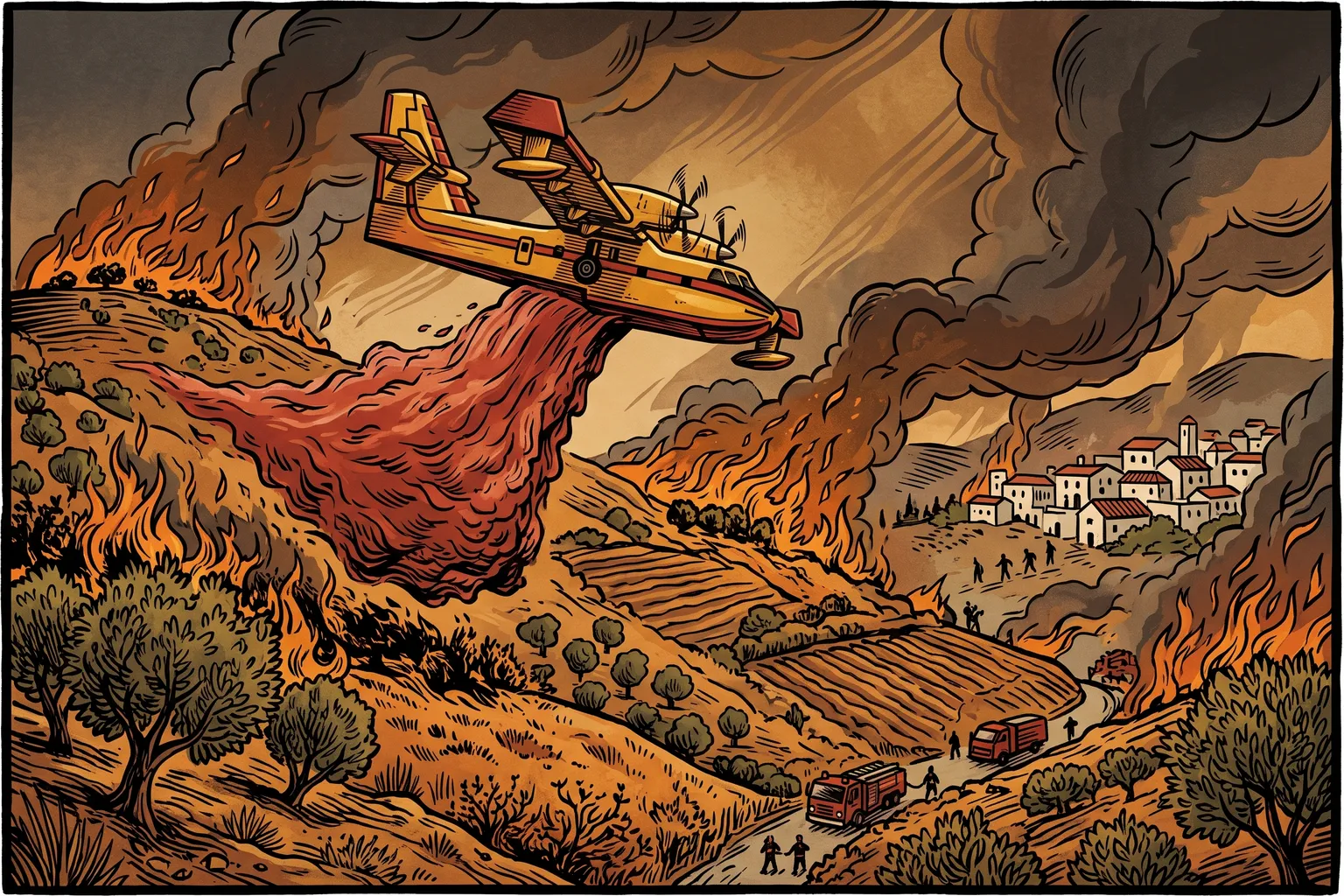
Interior Minister Fernando Grande-Marlaska placed the Military Emergencies Unit in command of fire operations near the capital. Euronews covered the declaration and the fires across all three countries. More than 10,000 people were evacuated from Villa del Prado and San Martin de Valdeiglesias in Madrid province, and roughly 1,500 more from El Tiemblo in Avila. Officials said shifting winds made containment difficult; fire crews had “somewhat limited their spread in the last few hours” but fires near the capital remained out of control into Thursday evening. Temperatures across the affected areas were forecast to reach 44 degrees Celsius, with no relief expected through the weekend. Copernicus satellite data shows Spain has burned 123,000 hectares this year, four times the comparable 2025 figure.
France activated the EU civil protection mechanism Thursday. Croatia had Canadair aircraft in the air. Portugal sent Air Tractor planes. The Gironde fire that began near Bordeaux has grown to roughly 8,700 hectares; the Arcachon Bay area has seen more than 20,000 people evacuated from their homes. French President Macron addressed the deaths of two firefighters who died battling the blaze: “I extend the nation’s condolences, gratitude and support to their families.” France 24 has covered the French and Spanish responses together.
Sicily reported 300 of its 344 fires controlled as of Wednesday evening. Three firefighters have died across the three countries. Across the European Union, Copernicus data shows 254,388 hectares burned since January. The same heat system driving wildfires across the Mediterranean basin is the same atmospheric pattern that produced the heat dome over the eastern United States. It arrives later on this side of the Atlantic and in different geography, but it’s coming from the same place.
General Mykhailo Drapatyi completed his first full day as Ukraine’s commander-in-chief Thursday. He’s 43. He replaced Oleksandr Syrskyi, who was dismissed by President Zelensky this week along with the defense minister before him. Drapatyi’s statement on taking command was brief: “There is a difficult task ahead, so we are not making loud promises.” He added that the military would “continue and intensify offensive operations in all domains.” Al Jazeera profiled him Thursday.
Ukrainian drones struck Wildberries logistics centers in Saint Petersburg and Tver on Thursday, among the deeper long-range strikes Ukraine has executed at this distance inside Russia. A separate drone attack targeted a Wildberries facility in Russian-occupied Crimea. Kremlin spokesman Dmitry Peskov said the command change at Ukraine’s top military position would change nothing: “Our armed forces keep advancing along the entire front line.”
Command transitions during active wars are difficult to read in real time. Eisenhower sidelined George Patton more than once during the war. The British went through three commanders in North Africa before Montgomery. What distinguished those transitions wasn’t the announcement. It was what came after it.
The confirmed death toll from Venezuela’s June 24 earthquake sequence stood at 5,398 as of Wednesday’s government bulletin. Thursday’s count wasn’t published by late afternoon. Roughly 21,235 people remain in temporary camps. The Venezuelan government still hasn’t released an official missing-persons count. The daily bulletin will come. The count will rise.
More than 200 million Americans remain under heat advisories or alerts Thursday. The confirmed death count of at least 44 was established in early July and hasn’t been revised to account for heat-related deaths in the weeks since. Congress hasn’t scheduled a floor vote on the Extreme Heat Emergency Act, which would amend the Stafford Act to authorize federal disaster declarations for extreme heat events. The legal gap that has stood since Missouri’s 1980 request was denied remains in place.
Jean Hadley, who writes The Long Table column in the Living section, published a piece a week ago that’s been more useful than she probably expected when she wrote it. Summer Salad Recipes That Are Actually Dinner is built around what farmers market abundance looks like in July, the tomatoes and stone fruit and corn that show up all at once and don’t need much done to them. Three cold dinners, none requiring the oven for more than a few minutes. Worth finding if you haven’t.
Andy Burnham is four days into his tenure as Britain’s prime minister. No major new policy announcement came Thursday. His cabinet, named Monday, includes John Healey as Chancellor of the Exchequer, Ed Miliband as Foreign Secretary, and Shabana Mahmood continuing as Home Secretary. Burnham has described his governing intention as “a cost-of-living government” and committed in his first days to ending rough sleeping in England, allocating 340 million pounds toward that goal. His government also named a Minister for Artificial Intelligence, the first time that portfolio has held cabinet rank in a UK government.
Uganda is on Day 9 of its 42-day countdown toward an Ebola-free declaration. The last confirmed Ugandan patient was discharged from Mulago National Referral Isolation Centre on July 16. If no new cases are confirmed, Uganda would be declared free of the outbreak on August 27. The Democratic Republic of the Congo, where the outbreak originated, recorded 2,536 confirmed cases and at least 1,033 deaths as of July 21. The WHO has noted that more than 80 percent of new infections are being detected outside known contact chains. US airport screening at Washington Dulles, Atlanta’s Hartsfield-Jackson, Houston’s George Bush Intercontinental, and JFK remains in effect through mid-August. The WHO outbreak page carries the current figures.
When Spain declared a national emergency Thursday morning, France had already put in a request to the EU civil protection mechanism. Within hours, Croatia had aircraft in the air headed west. Portugal had planes coming. The system that 27 member nations built for exactly this kind of cascading emergency activated without a summit, without a negotiation, without anyone having to invent the structure in the middle of a crisis. It wasn’t fast enough to prevent what this week produced. It didn’t save the three firefighters or the 254,000 burned hectares or the tens of thousands of people who left their homes with what they could carry. But when Grande-Marlaska made the call, the answer was already somewhere on a runway. Someone had built that. Decades ago. For this. That’s what the good ending looks like some days. Not that the fires were out. That the help didn’t have to be invented from scratch when they weren’t.
Howard Fenn writes The Day, Monday through Friday.