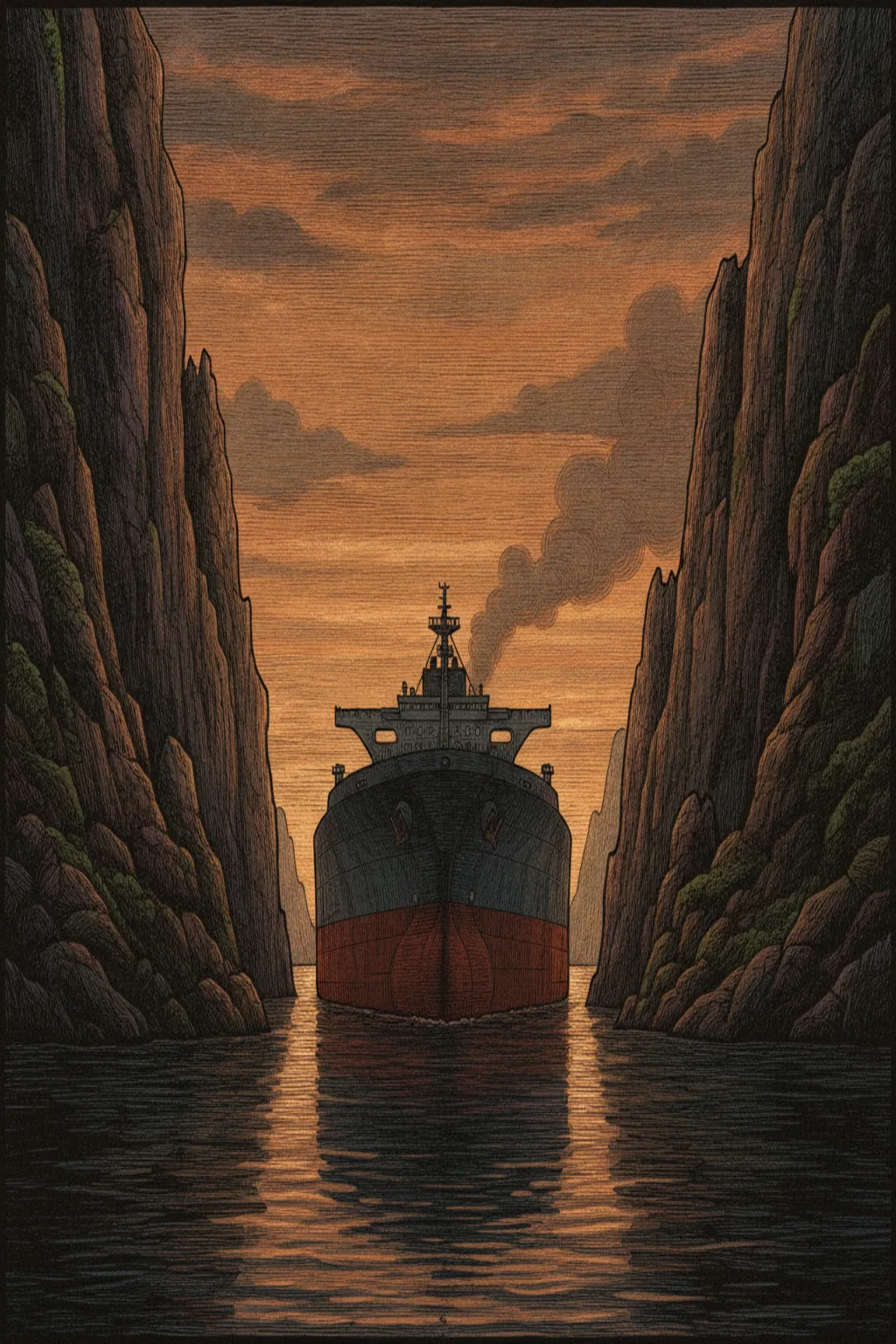
The Iranian foreign ministry reached out to Washington on Thursday seeking to restart negotiations. President Trump said he didn’t know if Iran was “worthy of making a deal.” At the Strait of Hormuz, five vessels were tracked moving through the waterway where forty-five had moved on Monday and where, before this conflict started in February, roughly a hundred and thirty ships passed each day.
This is what a pause looks like when neither side has decided whether to stop.
U.S. Central Command completed two consecutive nights of strikes on Iranian military targets before Thursday’s apparent diplomatic moment. The Tuesday night round hit roughly eighty installations. The Wednesday night round hit approximately ninety, targeting air defense systems, coastal surveillance assets, missile and drone storage sites, naval capabilities, and military logistics infrastructure along Iran’s coastline. The official CENTCOM statement: “At the direction of the Commander in Chief, U.S. Central Command forces have started conducting additional strikes against Iran to further degrade their ability to threaten freedom of navigation in the Strait of Hormuz.” The release is here.
Iran’s Islamic Revolutionary Guard Corps said it struck back each night, claiming hits on U.S. military sites in Kuwait, Bahrain, and Qatar, including a Patriot missile system in Kuwait, satellite antenna equipment in Qatar, and fuel storage in Bahrain. Air raid sirens sounded at least twice in Bahrain, home to the U.S. Navy’s Fifth Fleet headquarters. NATO Secretary General Mark Rutte called the American strikes “absolutely necessary” and said Iran “is basically violating the ceasefire.” Then, on Thursday, Iran reached out. NPR has the account here. Trump’s reported response, via TIME: he didn’t know if Iran was “worthy of making a deal.” Whether that’s a negotiating posture or a genuine statement of uncertainty will matter only if talks actually start.
The shipping data say more than any official statement. Al Jazeera reported Thursday that Lloyd’s List Intelligence data show no vessels above 10,000 deadweight tons have broadcast their location through the strait’s Southern Highway since July 7. Before the current conflict, the strait carried roughly 25 percent of the world’s seaborne oil and 20 percent of global liquefied natural gas. Oil markets are taking the situation seriously but haven’t panicked: Brent crude was trading around $76 per barrel Thursday morning, up roughly four dollars from the prior week and well below the $126 peak the market hit in March. Bloomberg is tracking oil here.
On July 20, 1988, with hundreds of thousands dead and eight years of war behind it, Iran accepted UN Security Council Resolution 598 and ended its war with Iraq. In his radio address announcing the decision, Ayatollah Khomeini called it the most difficult of his life, comparing it to drinking poison. He died less than a year later. The Islamic Republic that outlasted him spent the next three decades rebuilding and extending its military reach, and its supreme leader for all thirty-seven of those years, Ali Khamenei, who was buried in Mashhad last Wednesday, had been at Khomeini’s side when that decision was made. The country calling Washington on Thursday lost its supreme leader in February, has its new leader in hiding, and is watching the strait go dark. The question for 1988 and the question for today are different questions, but the strait is the same twenty-one miles wide.
On Wednesday, Germany confirmed it has agreed to purchase American-made Tomahawk cruise missiles and station them on German soil. Chancellor Friedrich Merz said the deal closes “an important strategic gap in our defense, and at the same time, we will work to develop our own European systems and station them in Europe.” ABC News reported the agreement here. PBS News has the full account here.
In December 1979, NATO made a decision to deploy American Pershing II ballistic missiles and ground-launched cruise missiles in Western Europe to counter Soviet SS-20s. The deployments in West Germany began in November 1983 and produced the largest peace demonstrations in postwar German history, hundreds of thousands of people in the streets of Bonn and Hamburg, a movement that reshaped a generation of German politics. The weapons came. The INF Treaty that Reagan and Gorbachev signed in 1987 eventually removed them. Germany spent the years that followed practicing a kind of strategic restraint that had roots going back much further than any single treaty, slow to deploy forces, slow to rearm, cautious in ways that reflected what the country had learned about itself. When Olaf Scholz stood before the Bundestag on February 27, 2022, two days after Russia invaded Ukraine, and declared a Zeitenwende, a turning point in German history, he was signaling that this restraint had reached its limit. The Washington Post has the full context here. Germany is now buying cruise missiles. The Zeitenwende has a specific address.
A wildfire in Almeria province in Andalusia killed at least twelve people on Thursday, the deadliest fire in the region’s recorded history. Firefighters found several of the victims inside burned vehicles. The fire started near the hamlet of Bedar and was driven by temperatures approaching 40 degrees Celsius, dry vegetation, low humidity, and strong winds. About a thousand residents were evacuated. Nineteen people remained missing as of Thursday evening. Antonio Sanz, Andalusia’s head of emergencies, called it “the most devastating fire to date in our region.” Spain’s Prime Minister Pedro Sanchez described “immense sadness and desolation in the face of the terrible consequences of the fire.” Roughly 150 firefighters and Spain’s Military Emergency Unit were deployed. Euronews has the full account here. Al Jazeera is following developments here.
The death toll from Venezuela’s June 24 twin earthquakes reached 3,889 on Thursday, according to the Anadolu Agency’s morning briefing, up from 3,811 on Wednesday. An estimated 60,000 buildings were damaged or destroyed in and around Caracas and La Guaira. Acting President Delcy Rodriguez, whose constitutional mandate expired in early July, now faces a 63.3 percent disapproval rating. A survey found nearly 46 percent of respondents say democratic elections are “more urgent than ever.” CNN has the political situation here. Anadolu Agency’s morning briefing has the latest toll figure here.
Thursday is the Living section’s day on the colleague spotlight calendar.
Ruben Navarro published a piece yesterday on pairing wine with food, and it approaches the subject from a direction most wine writing doesn’t: the logic underneath the pairing, why certain flavors work together and certain ones don’t, and how to build a sense of this on your own without treating every bottle as an occasion for someone else’s opinion. No points systems, no emphasis on expense, no suggestion that you need credentials before you’re allowed to develop a preference. Ruben knows this territory well. The piece reflects that. It’s in the Living section.
A fire at a shoe factory in Jinjiang, Fujian province killed 28 people on Wednesday, one of China’s deadliest industrial fires in recent years. The building held 237 workers and two visitors when the fire started. Two hundred and thirteen people were rescued. Local footage showed workers trapped on the roof in thick black smoke while fire trucks worked below. Chinese authorities arrested the factory owner and managers and froze the company’s accounts within hours. Al Jazeera has the story here. The Associated Press has additional reporting here.
In Britain on Thursday, Labour Party nominations opened for a leadership contest that may not be a contest.
Andy Burnham, who has served as mayor of Greater Manchester since 2017, returned to Parliament last month through a by-election in Makerfield, satisfying the Labour rule that requires the party leader to be a sitting member of Parliament. On the first day nominations were open, he collected 322 of them. All other potential candidates stood aside. If no one else enters the race before the July 16 deadline, Burnham will be declared leader the following day and is expected to be appointed Prime Minister by King Charles III on July 20. PBS News has the full account here. The Washington Post is following developments here.
He ran for Labour leader in 2010 and lost to Ed Miliband. He ran again in 2015 and lost to Jeremy Corbyn. He went to Manchester and spent nine years running one of Britain’s largest metropolitan regions, building a second career that looked nothing like the one he’d originally planned. Now, through a path that didn’t go where he’d intended it to go, he’s ten days from being prime minister. He’ll inherit a country navigating a summer of overlapping crises, with no one else putting their name forward.
Some things take the long way around.
Howard Fenn writes The Day, Monday through Friday.