The lead on Tuesday is oil.
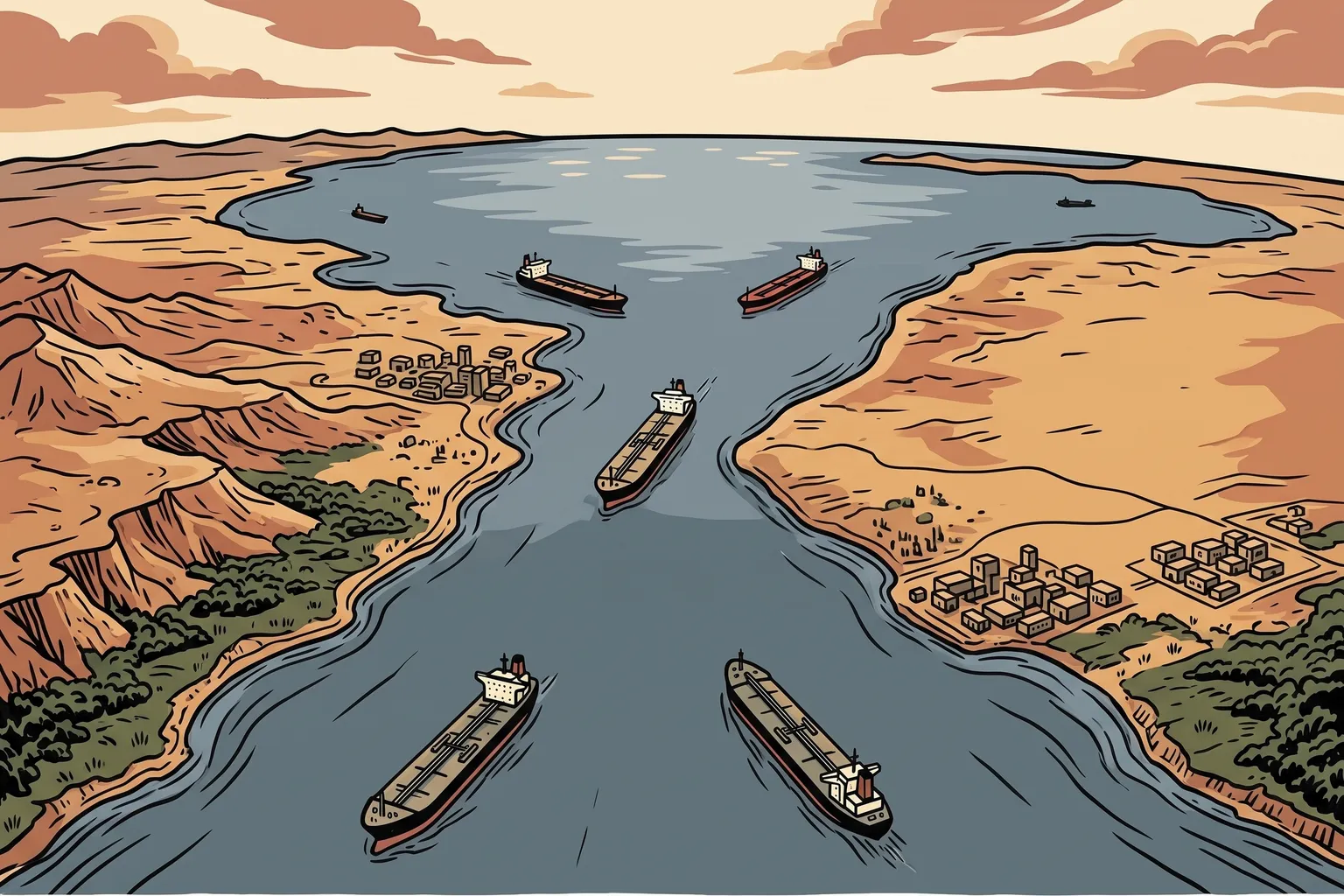
Brent crude touched $99 a barrel intraday before settling at $97.20, the benchmark’s highest point in six weeks, after U.S. Central Command destroyed five oil tankers linked to Iran’s Islamic Revolutionary Guard Corps in and around the Strait of Hormuz on Monday, according to CBS News and the Eastern Herald. Brent has risen nine percent in five trading sessions and nineteen percent over the past month. Analysts at major banks have said $120 a barrel is achievable if tanker passage through the strait remains near current levels, Al Jazeera reported Tuesday.
The International Energy Agency has declared the Hormuz blockade the largest oil supply disruption in the history of oil markets. Gulf crude exports have fallen from roughly seventeen million barrels a day in 2025 to approximately nine million barrels a day as of August. The U.S. government says the strait remains open. The IEA’s numbers say one-tenth of the normal vessel traffic is moving through it. Both statements are in the public record. They describe the same waterway.
Monday also brought a new complication. Iran’s Supreme National Security Council announced plans to establish a maritime exclusion zone outside the strait where Tehran intends to stop vessels attempting transit without Iranian permission, Al Jazeera reported. Many vessels in the region are already sailing “dark,” with their Automatic Identification System transponders switched off to reduce the risk of Iranian drone and missile targeting, according to CBS News coverage of the ongoing conflict.
A chapter from 1987 is worth keeping in mind. In July of that year, the United States began Operation Earnest Will, re-flagging Kuwaiti tankers under American colors to allow U.S. naval escort through the Persian Gulf during the Iran-Iraq War. Iran had been attacking neutral shipping throughout the conflict. The operation ran until September 1988. It protected the movement of oil through a waterway that has been contested, in one form or another, for most of the past four decades. The Iran-Iraq War ended in 1988 via UN-brokered ceasefire. The tanker campaign ended with it. The resolution of one did not cause the other, but the two were connected by a shared exhaustion with a conflict that had run out of achievable objectives for either side.
What the current situation resembles from that distance is not clear yet. What’s clear is that nine million barrels a day through a twenty-one-mile-wide choke point is the new normal until something changes, and nothing in the diplomatic picture this week suggests what that something might be.
Ukraine’s civilian death toll has reached its highest level since May 2022, NATO Secretary General Mark Rutte said this week, warning that delays in military aid are costing lives, Al Jazeera reported. In the past 24 hours, 263 combat engagements were recorded along the front lines. Russian forces carried out 79 shelling attacks on military positions and populated areas and launched one airstrike using a guided bomb. The most intense activity was in the Pokrovsk direction, with 49 Russian assaults recorded.
European diplomacy has been active. Finnish President Alexander Stubb and Italian Prime Minister Giorgia Meloni have both proposed immediate ceasefire negotiations. Russian Foreign Minister Sergei Lavrov dismissed both proposals as stalling tactics designed “solely to gain time for Kyiv,” Al Jazeera reported.
London and Berlin have delivered Patriot missile supplies to Ukraine. The gap in that sentence is the word “contracts.” Ukrainian defense officials noted that contracts for roughly 1,000 Patriot missiles are in place but that deliveries will take years, prompting urgent appeals for immediate transfers from existing allied stockpiles, according to Newsy Today. A contract and a missile on a launcher are two different things. The front line doesn’t wait for the first to become the second.
New Hampshire held its primary elections Tuesday, with results arriving in the early hours of Wednesday morning. Chris Sununu won the Republican Senate primary. Chris Pappas won the Democratic Senate primary. In the First Congressional District’s Democratic primary, Stefany Shaheen won the nomination in a race the Associated Press called at 12:35 a.m., in a closely contested contest against Maura Sullivan, NHPR reported.
November 3 is the date that matters. New Hampshire has a U.S. Senate seat, the governor’s office, both Congressional seats, all 400 state House seats, and all 24 state Senate seats on the general election ballot, according to Ballotpedia. Tuesday set the names. November tests them against the full electorate.
The First District race is worth watching specifically. The Shaheen name carries significant recognition in New Hampshire politics, and whether that transfers from one generation to the next is a question the fall campaign will answer.
The Ebola outbreak in the Democratic Republic of the Congo reached 6,686 confirmed cases and 3,226 deaths as of September 7, with 82 new cases recorded in the September 5 to 6 window alone, according to the World Health Organization. The outbreak, which began in Ituri Province in May, is caused by the Bundibugyo ebolavirus, a strain distinct from the Zaire strain for which an approved vaccine exists. Bundibugyo has no approved vaccine and no specific treatment. That distinction is part of why this outbreak has grown faster than any previously recorded, the CDC has reported.
The response infrastructure is in place. Doctors Without Borders has teams in the affected provinces. Contact tracing covers 85.3 percent of identified case contacts. Researchers are testing vaccine candidates against the Bundibugyo strain, though those results are months away.
There’s a tendency in coverage of DRC health crises to treat them as geographically remote from American concern. The 2014 West Africa Ebola outbreak reached Dallas. The path from Ituri Province to an international airport is shorter than the map makes it appear, and the Bundibugyo strain’s vaccine gap is the specific reason this outbreak requires sustained attention rather than periodic check-ins.
Colombia is four weeks out from the August 10 earthquake that killed at least 331 people, injured more than 4,600, and destroyed more than 9,200 homes. Damage is estimated at $13.4 billion, and humanitarian partners have requested $148.1 million through the UN’s 2026 Humanitarian Response Plan to address the 1.2 million people still in need of assistance, according to UN News and the Rio Times.
Recovery has shifted from emergency rescue to reconstruction and economic stabilization. President de la Espriella has announced rental subsidies and suspended utility bills and tax filings for affected families, CARE reported.
One time-sensitive development: Starlink’s free emergency satellite service in the earthquake zone ends September 12. Three days from now, communities that have used it to coordinate aid and communicate with the outside world will need alternatives. Whether those alternatives are in place is not clear from the available reporting this morning.
Tuesday: A Note from the Column
This week’s Tuesday piece comes from Ruth Ann Pemberton, whose work on family and relationships runs in the Living section. Her column today is called “The Conversation That Changes Everything.” It’s about the conversation aging parents need to have with their adult children, and adult children need to have with aging parents, and the particular difficulty of having it before circumstances force it rather than after. Ruth Ann doesn’t flinch at the uncomfortable parts of this, and she doesn’t rush past them either. It’s the kind of writing that stays with you a little longer than you expect it to.
A trial called COMPARE, the results of which were published this summer in Nature Medicine, enrolled six people with severe rheumatoid arthritis that had resisted every available treatment. They received mivocabtagene autoleucel, an autologous CAR T-cell therapy in which a patient’s own immune cells are extracted, engineered to target the harmful B cells driving the disease, and reinfused. Three of the six achieved medication-free remission. The other three remained off immunosuppressive therapy at 24 to 36 weeks of follow-up, ScienceDaily reported.
The mechanism, as researchers understand it: the therapy clears out the immune cells responsible for the disease’s damage and gives the immune system a chance to reset without the original error intact. A Phase 2 trial enrolling ten additional patients is expected to begin before the end of 2026.
Six people is a small number. A trial this size proves a direction, not a treatment at scale. But three of those six people no longer take the medications that had stopped working for them, for conditions that had run out of options. That’s what a small number looks like when it’s pointed the right way.