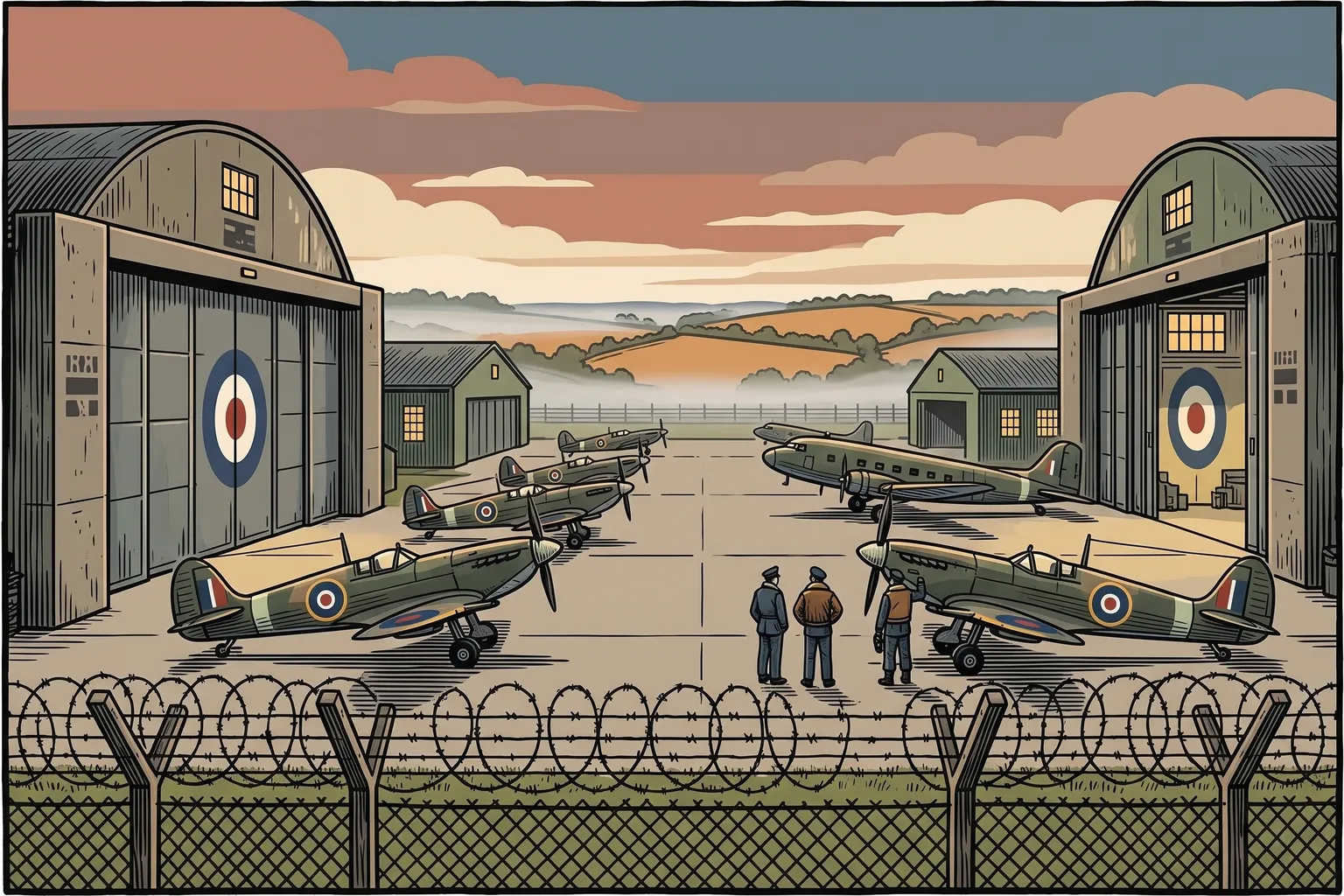
Five men were arrested in Britain on Sunday on suspicion of plotting an attack on RAF Fairford, the Royal Air Force base in Gloucestershire that the United States Air Force has been using as an operational staging point for the Iran campaign. British counterterrorism police made the arrests in the early morning hours. President Trump confirmed Sunday that American and British authorities had been working together on the case. No charges had been publicly filed by Sunday evening. The men remain in custody.
RAF Fairford has served as a forward base for American strategic bombers since the Cold War. B-52s staged from there during Operation Desert Storm in 1991. During Operation Iraqi Freedom in 2003, B-52 bombers flew long-range strikes from Fairford before forward basing options in the region became more available (Source). The base’s role in a live conflict has made it a target in a way it wasn’t during earlier decades of deployment. The Sunday arrests are, as far as can be determined publicly, the first terrorism plot against a U.S.-connected facility in Britain directly attributed to the current Iran conflict. The Anadolu Agency had early details in its Monday morning briefing.
Iran offered over the weekend to reopen negotiations over the Strait of Hormuz. Trump rejected it. “Iran overplayed their hand,” he said. He said he still expected negotiations with Iran to resume this week (Source).
The Strait handles roughly 20 percent of the world’s oil supply. It has been at the center of nearly every major confrontation between the United States and Iran since the 1980s. During the Iran-Iraq War, Iran attacked more than 200 commercial vessels in the Persian Gulf between 1984 and 1988. The Reagan administration responded with Operation Earnest Will, escorting Kuwaiti tankers under American flags. Previous crises resolved before a sustained closure materialized. The current situation is further along than those earlier episodes, and the economic pressure of restricted shipping has already sent energy prices to levels not seen since 2008. The Times of Israel has been maintaining a running account of Sunday’s developments.
Brent crude opened Monday near $107 a barrel, up roughly 2 percent after the weekend’s events (Source). That’s the number most people are watching. It may not be the most significant one from today.
A global bond benchmark exceeded 4 percent Monday for the first time since 2007. The 30-year U.S. Treasury yield is sitting near 5.52 percent, up 27 basis points in September alone. The Federal Reserve raised rates 25 basis points on September 16 (Source), and market odds of another increase on October 28 have climbed to approximately 70 percent. Gold fell about 2 percent on the day, to around $4,197, which isn’t the typical behavior for a safe-haven asset during a period of active geopolitical stress. Rising real yields increase the opportunity cost of holding non-yielding assets, and money moves accordingly.
The last time a global bond benchmark crossed 4 percent was in 2007, in the months before the financial crisis fully arrived. The conditions driving yields now are different from those that drove them then. But the psychological weight of that threshold is real, and it’s showing up in fixed-income markets in ways that matter to anyone holding a bond fund or sitting on a portfolio of long-duration assets. Tickmill’s morning market note has the details.
Saudi Foreign Minister Prince Faisal bin Farhan arrived in Washington Monday for direct talks with Secretary of State Marco Rubio. The backdrop to the meeting: Crown Prince Mohammed bin Salman had reportedly asked the United States to conduct direct military strikes against the Houthis in Yemen, who’ve been attacking Saudi infrastructure at an increasing rate. Washington declined, offering intelligence sharing and targeting assistance instead.
The gap between what Riyadh asked for and what it received shapes everything about these talks. Houthi attacks on Saudi energy infrastructure have been a persistent threat since the September 2019 drone strikes on the Abqaiq and Khurais facilities, which briefly knocked out roughly 5 percent of global oil supply and demonstrated, in a way governments had been slow to prepare for, how exposed modern energy infrastructure is to low-cost aerial weapons. The frequency and scale of attacks has increased since then. Whether American intelligence and targeting support will be sufficient to close the gap is the central question Monday’s meetings are designed to address without fully answering. The State Department’s public schedule confirmed the meeting.
A story receiving considerably less attention than the events overseas: the Protect College Sports Act is nearing a Senate floor vote. The legislation would create a federal framework for name, image, and likeness agreements and athlete compensation at the college level, replacing the patchwork of state laws that have governed things since the NCAA changed its NIL rules in 2021.
Several current U.S. senators are former college athletes, and they’ve been unusually influential in shaping the bill. That’s not decorative detail. The debate over athlete compensation has been driven largely by lawyers, administrators, and lobbyists since the Supreme Court’s unanimous ruling in NCAA v. Alston in June 2021, which struck down limits on education-related benefits for athletes and opened the current market. The result has been, by most accounts, a competitive and chaotic landscape that satisfies few parties entirely. Whether a federal standard improves on the chaos is the argument before the Senate. That Congress is actually close to a vote, five years after the court ruling set this in motion, is news in itself. ESPN has the details on the bill’s advance toward a final vote.
The financial conditions this column has been describing touch retirement accounts in ways that don’t always announce themselves. Rising Treasury yields change the math on Roth conversions, on bond allocations, on when it makes sense to take Social Security. Glenn Suttner has been working through the Roth conversion question in the Money section last month, with the 30-year at 5.52 percent and another Fed move likely in October. If you’ve been running those numbers, his framework is worth seeing. Glenn’s piece on Roth conversion strategy is in the Money section.
Kosovo formally completed its national landmine clearance program this month, twenty-seven years after the Kosovo War. The program began in 1999, when NATO’s seventy-eight-day air campaign ended and international organizations arrived to find one of the densest concentrations of mine contamination in Europe. The effort eventually cleared millions of square meters of land and enabled agricultural and economic recovery across the territory. Its conclusion received minimal international attention in a week dominated by larger events, which tells you something about how far the country has come. A place whose land was seeded with explosives during a conflict that displaced 1.5 million people has cleared its fields, rebuilt its economy, and arrived at a point where completing that work is a small story. It isn’t a small story. It’s just that it’s done. Only Good News Daily covered the milestone.
Vietnam established a new nature reserve for the Delacour’s Langur this month. The animal is a primate found only in northern Vietnam, listed as critically endangered by the IUCN, with an estimated population under 300. The new reserve was created because of what happened at a neighboring protected area set aside for the same species in 2001: that local population grew from 50 animals to 200 over twenty-five years. A fourfold increase in a quarter century isn’t the speed at which animals near extinction usually recover. Vietnam looked at the numbers and extended the protection. The Delacour’s Langur nearly didn’t survive the war era and the decades of habitat destruction that followed. There are now more of them than at any point in the last fifty years. Sometimes the thing that was supposed to work does.
Howard Fenn writes The Day, Monday through Friday.