Iran’s Foreign Minister Abbas Araghchi offered the United States a seven-day ceasefire on Friday, a proposal that included reopening the Strait of Hormuz and opening final-deal negotiations on the seventh day in exchange for Washington lifting its blockade of Iranian ports. President Trump declined, according to reporting by Bloomberg and the Wall Street Journal, and told advisers he expects to renew strikes against Iran after the November midterm elections.
Trump acknowledged his position could change but expressed skepticism that Iran would meet his conditions. The ceasefire proposal represented Iran’s most concrete diplomatic overture since the current conflict began. Its rejection doesn’t close the window for negotiation. The next political marker on the American calendar is November. That is just over five weeks from today.
The Strait of Hormuz is the transit point for roughly 21 million barrels of oil per day, approximately one-fifth of global supply. Its reopening has been a stated American condition for any ceasefire since the campaign began. Iran offering to reopen it suggests that Araghchi had the authority to make that offer, or believed he did. Whether it would have been honored is a question the rejection left unanswered.
In 1988, after eight years of the Iran-Iraq War, Ayatollah Khomeini accepted UN Security Council Resolution 598, which ended the fighting. He described accepting the ceasefire as drinking “a cup of poison.” He had resisted for years while the war consumed hundreds of thousands of Iranian lives because agreeing felt like defeat. The offer Araghchi made Friday is structurally different, and this is a different Iranian government facing a different kind of military pressure. But the underlying dynamic, a government deciding what it’s willing to accept in exchange for relief, runs through the same soil. (Bloomberg)
Hurricane Nolo remained nearly stationary south of Hawaii Island on Saturday, its pace the thing forecasters were most worried about.
A slow-moving storm over warm water intensifies. A stationary one concentrates its rainfall. The Central Pacific Hurricane Center warned of up to 35 inches in some locations and described the flooding risk as “catastrophic and life-threatening.” Tropical storm conditions were already underway Saturday morning. Nolo is the fourth tropical system to threaten Hawaii in the 2026 Pacific hurricane season.
Hawaii’s most destructive hurricane on record was Iniki, which struck Kauai on September 11, 1992, as a Category 4. Before Iniki, the last hurricane to make direct landfall on a Hawaiian island was Dot, a Category 1, in 1959. What Iniki demonstrated was not just the scale of damage a direct hit produces, but how little warning time an island chain has when a system approaches from the south. The Big Island’s geography differs from Kauai’s: Mauna Kea and Mauna Loa, both above 13,000 feet, can wring enormous rainfall totals from the windward slopes even from a system that doesn’t make landfall. Thirty-five inches of rain on volcanic terrain is not a number to hold lightly. Residents on the eastern slopes were under evacuation orders Saturday morning. (NPR)
The United States, Denmark, and Greenland signed an agreement at the United Nations General Assembly this week granting the United States expanded military access to Greenland, including two additional American military sites and a “Golden Dome” missile defense installation. The deal doesn’t transfer sovereignty. Denmark’s Prime Minister confirmed that the agreement “recognizes the sovereignty and territorial integrity” of both Greenland and Denmark.
The agreement resolves a standoff that ran for most of the year, since Trump first raised the possibility of acquiring Greenland by force. The three governments reached it through a process that was, whatever its turbulence, diplomatic: an offer, a negotiation, a signed agreement. The result is American military infrastructure in Greenland without American ownership of Greenland. That distinction matters to both Copenhagen and Nuuk.
The United States has had a military presence in Greenland since 1941, when the State Department, acting over Denmark’s occupied-by-Germany head, signed an agreement allowing American air bases on Greenlandic soil. Denmark was under Nazi occupation at the time; Denmark’s ambassador to Washington concluded the deal on his own authority. What is now called Pituffik Space Base, established under a 1951 bilateral defense agreement, has operated continuously since and remains the northernmost U.S. military installation in the world. What changed this week is scale and formality: two new sites, a missile defense installation, a signed multilateral agreement. The United States has been in Greenland for eighty-five years. Now it’s in Greenland more. (U.S. News & World Report)
Iraq closed three of its border crossings with Iran on September 12, and on Friday Najaf International Airport suspended all flights to Iran. The border closures followed pressure from Iraqi and Saudi officials linking a September drone attack on Saudi Arabia’s East-West Crude Oil Pipeline to actors operating from Iraqi territory. The flight suspension came after the United States imposed new sanctions on Iranian airlines.
The East-West pipeline carries approximately five million barrels per day and is one of Saudi Arabia’s primary oil export routes. The September attack temporarily shut it down. Iraqi officials have been caught between two pressures ever since: Washington and Riyadh calling for accountability, and Tehran noting that Baghdad’s relationship with Iranian-aligned groups isn’t something any Iraqi government can simply sever by closing a border. The crossings are a signal. Whether they hold depends on what comes next.
The Iraq-Iran relationship carries the weight of a 994-mile shared border, deep economic ties including Iranian natural gas flowing to Iraqi power plants, a Shia Muslim majority population on both sides, and the memory of a war that ran from 1980 to 1988 and killed an estimated one million people. Baghdad has spent twenty years threading that history against its relationships with Washington and Riyadh. The border closings are one form of threading. Decisions of this kind tend to be reversed quietly after a few weeks, or not, depending on circumstances that aren’t visible from outside. (Al Jazeera)
Argentina released new poverty data this week showing that 32.3 percent of the country’s population fell below the poverty line in the first half of 2026. The survey covers 31 urban areas and counts 9.7 million people in 2.5 million households; the national projection is roughly 15.5 million. Among children fourteen and under, the share in poverty was 44.5 percent. Extreme poverty, defined as inability to cover basic food needs, rose 1.2 percentage points from the second half of 2025, to 7.5 percent.
These are the official survey figures, not private estimates.
Argentina was, in the 1930s, among the ten wealthiest countries in the world by per capita GDP. The story of what happened to that wealth, across nine decades, involves serial currency crises, political instability, repeated debt defaults, and an economy that has moved between statism and shock liberalization without settling into either long enough to build on. The worst single collapse was 2001 and 2002, when the government froze bank accounts, abandoned the dollar peg, and poverty surged past 50 percent. The current government has pursued aggressive austerity as its strategy for stabilization. The poverty data released this week is what that strategy has produced so far, and what it hasn’t yet changed. (Anadolu Agency)
And then there was this.
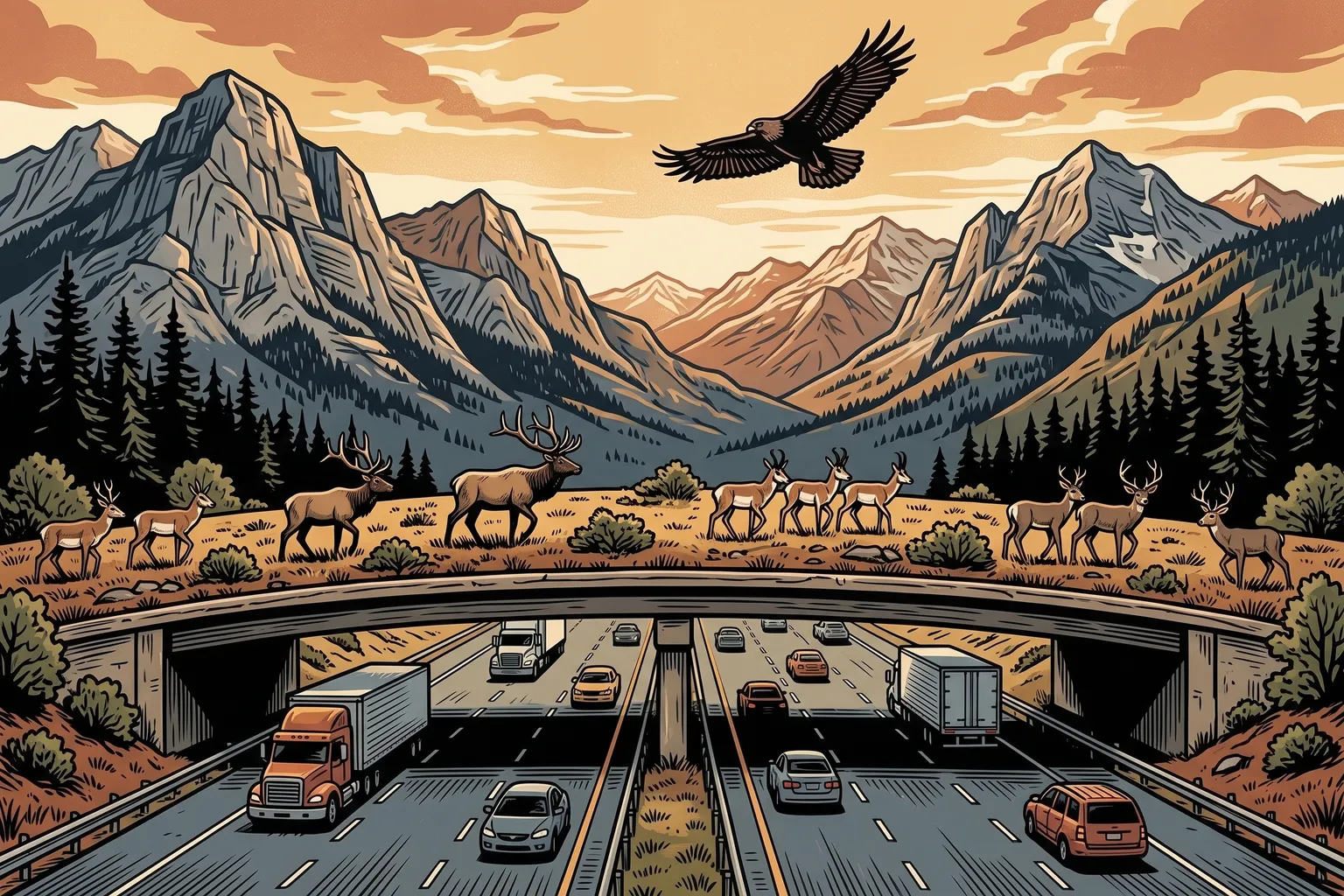
Colorado’s Department of Transportation released data this week showing that wildlife-vehicle collisions along the I-25 corridor south of Denver have dropped 91 percent since the Greenland Wildlife Overpass opened nine months ago. The overpass is 200 feet wide, spans six lanes of interstate, and is North America’s largest wildlife crossing. Before it opened, that stretch of highway averaged one animal collision per day during migration season. Elk, pronghorn, mule deer, black bears, and mountain lions are all using it.
Wildlife crossing science goes back decades. The consistent finding is that when crossings are wide enough, positioned correctly along migration corridors, and connected to intact habitat on both sides, the animals find them and learn them. The I-25 crossing was expensive. The savings in reduced insurance claims, vehicle damage, emergency response costs, and dead animals will exceed the construction cost within a few years. That calculation was available before the crossing was built. Someone ran the numbers and built the crossing. This is what it looks like when a practical problem and a workable solution reach the same table at the same time. (KYGO)