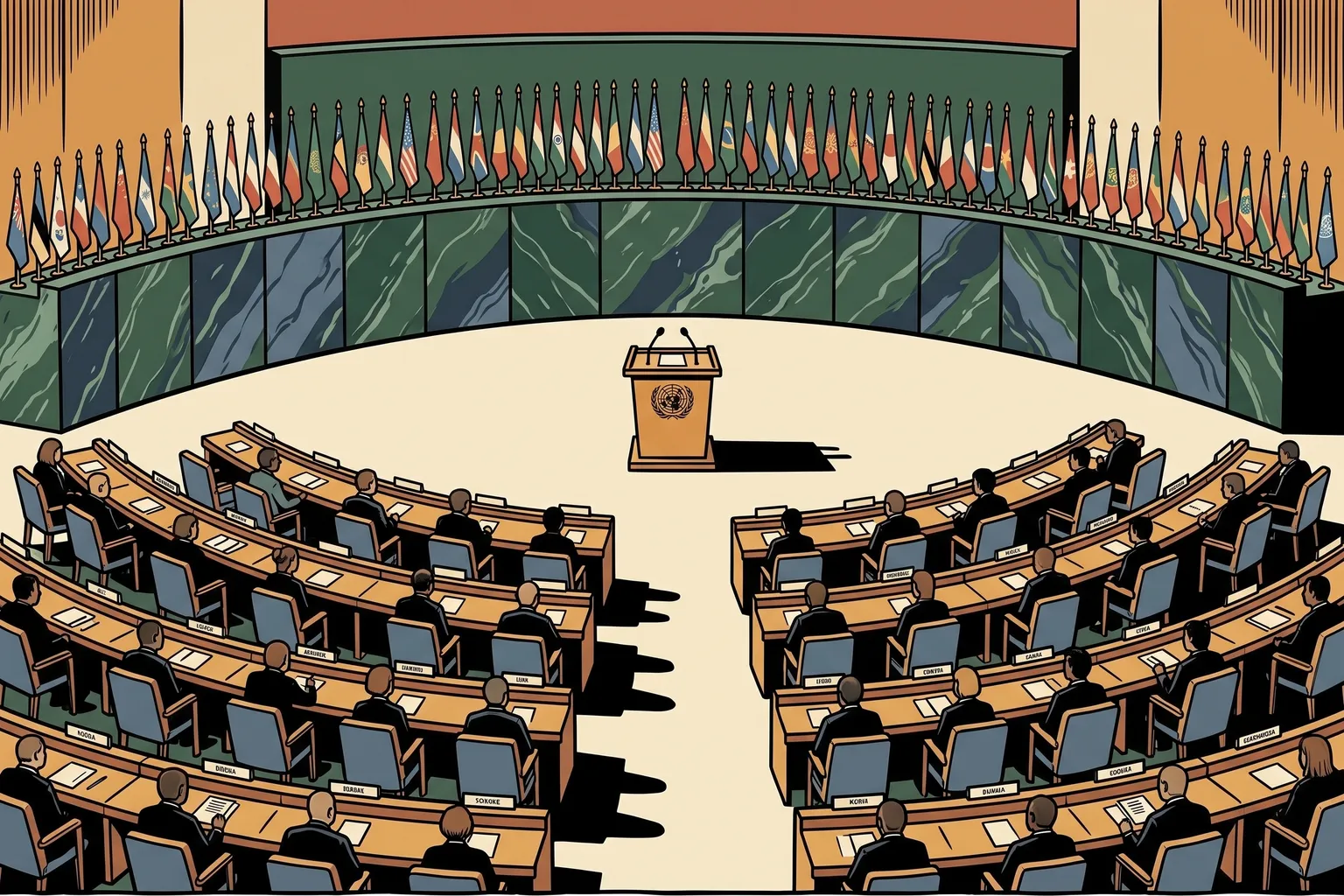
The 81st United Nations General Assembly opened its high-level general debate in New York on Tuesday morning, with nearly 130 heads of state and government scheduled to take the podium over the next six days. Sessions run through nine in the evening. The formal theme this year is “Restoring trust, managing transformation: a United Nations that delivers for all,” according to Al Jazeera’s coverage of the opening.
The gathering carries more practical weight than most. Two active conflicts are on the informal agenda: the war in Iran, now in its seventh month, and the parallel conflict in Lebanon, where more than four thousand people have been killed and more than a million displaced since fighting expanded in March. Alongside those, the formal search for a successor to Secretary-General António Guterres, whose second term ends December 31, is proceeding through the same hallways where the diplomatic conversations about Iran and Lebanon are happening. The selection requires major power agreement, which means quiet deal-making that happens before the vote, and that deal-making is underway.
The week’s official proceedings run alongside an enormous volume of bilateral meetings that the General Assembly exists to make possible. For smaller nations without the diplomatic infrastructure to arrange individual state visits throughout the year, September in New York is how their foreign ministers sit across a table from their counterparts from larger ones. This happens every September, regardless of what else is going on. In 2001, the session was interrupted by the September 11 attacks. In 2020, the high-level segment was held virtually for the first time. Both times, it resumed.
The Assembly has convened during wars before. In November 1956, during the Suez Crisis, it met in emergency special session for the first time under the Uniting for Peace procedure, which allows the Assembly to act when the Security Council is deadlocked. It called for a ceasefire and, on a proposal from Canada’s Lester Pearson, established the first United Nations Emergency Force. Pearson received the Nobel Peace Prize the following year. The Assembly didn’t end the Suez Crisis. It created a framework that gave the crisis somewhere to go. Frameworks are what the Assembly does in its better moments.
Secretary of State Rubio is in New York through Wednesday for meetings with heads of state and foreign ministers in the Shield of the Americas alliance, according to a State Department public schedule. Iran is expected to be central to those conversations.
The war entered its seventh month last month. The June memorandum of understanding that briefly halted hostilities expired in August after Iran resumed attacks on commercial shipping in the Strait of Hormuz in early July. The strait handles roughly a fifth of the world’s daily oil trade through a passage that is about 21 miles wide at its narrowest point. No new ceasefire framework has been announced. Negotiations are continuing, according to CNN’s ongoing conflict coverage.
In Lebanon, Israeli strikes have killed more than four thousand people and displaced more than a million since Hezbollah opened a second front in March and Israel launched ground operations, according to Al Jazeera’s Lebanon reporting. Diplomatic pressure at the General Assembly is being directed at both fronts simultaneously, which is a way of saying the diplomacy is very busy and the outcomes are not yet clear.
The national average for regular gasoline is around $4.48 per gallon, up from $2.98 the day before U.S. and Israeli strikes began in late February. The peak came in May at $4.56. This is the first August on record in which the national average for regular gasoline was above $4 every single day. Fuel prices are the way most Americans feel a war happening in a shipping lane on the other side of the world. The distance doesn’t change the numbers.
Today was the compliance deadline.
Under OMB Memorandum M-25-21, federal agencies were required to certify by September 22 that minimum risk management practices are in place for “high-impact” artificial intelligence systems, meaning systems whose outputs serve as a principal basis for decisions affecting people’s rights or safety, or to discontinue those systems entirely. Yahoo News reported Tuesday morning that the White House page hosting the original memo now returns a 404 error.
The memo was issued April 3, 2025, carrying over AI safeguards from the previous administration. Whether its disappearance from official government servers affects its legal standing as a binding directive is a question that hasn’t been answered. The Department of Homeland Security apparently found a path through the requirement: the agency declined to designate some of its most consequential AI tools as “high-impact” at all, a classification the agency controls. Systems not classified as high-impact aren’t covered by the memo’s requirements.
The federal government has deployed artificial intelligence to make or substantially influence decisions about immigration enforcement, benefits eligibility, criminal risk assessment, and watchlist management, among other things. The memo was an attempt to create a floor of accountability for those deployments. The deadline for that accountability arrived Tuesday morning. The governing document isn’t on the government’s website.
Here is the story that didn’t lead anything Tuesday.
President Trump announced a ban on reporters from CNN, MS NOW, and Politico on Friday, September 18. Reporters were turned away from the White House grounds on Saturday. All three outlets filed suit against the administration on Monday in federal district court in Washington, challenging the ban on First Amendment grounds, according to NPR’s coverage of the lawsuit.
Press exclusions of this scale from White House access are rare in the modern era. Courts have generally held that the First Amendment doesn’t guarantee a specific physical space to any individual reporter. But courts have also held that once the government opens a forum to the press, it can’t selectively withdraw access based on the viewpoint or content of the coverage without procedural protections. The most relevant precedent is Sherrill v. Knight, a 1977 D.C. Circuit ruling that found a Secret Service decision to deny credentials to a reporter required notice, an opportunity to rebut, and written reasons. The current exclusions haven’t gone through any of that. A hearing is set for Wednesday. The reporters aren’t in the building.
The lawsuit was filed Monday, at the opening of the UN General Assembly week, during a period when diplomatic schedules and the Federal Reserve’s rate decision were occupying the top of every news agenda. Three major news organizations don’t have access to the White House grounds, and the story has had to compete for space. That’s not a complaint. That’s how news weeks work. The constitutional question is real either way.
The Federal Reserve raised interest rates last week for the first time since 2023, ending a hold that had run nine months, according to CNBC’s coverage of the decision. Markets closed Monday with the S&P 500 and Nasdaq 100 posting their best single-day gains since early August, led by technology stocks and helped along by a drop in oil prices following cautious diplomatic signals from the opening of the UN week, according to Bloomberg. Treasury yields fell.
Consumer sentiment heading into the week remains low. Goldman Sachs cited “lower happiness” as a contributing factor to the depressed readings, which is an unusual phrase for a financial research note but an accurate description of what the numbers have reflected since the spring.
In 2004, the Federal Reserve began raising rates from 1%, a postcrisis low, and continued raising them across seventeen consecutive meetings over two years until the federal funds rate reached 5.25%. The current situation isn’t identical. That cycle followed a contained disruption; this one follows a sustained interference with a major global shipping lane that began in late February and hasn’t resolved. What is the same in both cases is the mechanism: rate changes move through the economy slowly, adding cost at each step, until they appear as a number on a car loan or a home equity line or a small business credit facility. They’ve moved now. The numbers will follow.
And then there is what NASA announced last week, on a blog that most people didn’t read.
The Nancy Grace Roman Space Telescope is now projected to operate for at least 22 years. The original design life was ten. The difference came down to a burn and a fuel margin. The mission’s first mid-course correction had been budgeted at 441 pounds of propellant. The actual burn used fewer than 10% of that, according to the NASA Science blog. The telescope also launched lighter than its maximum design weight, which meant the fuel tanks could be filled to capacity. The combination of a precise burn and a full tank produced an outcome nobody planned for: a 22-year telescope.
Roman is designed to survey the infrared sky across a field of view roughly 100 times larger than the Hubble Space Telescope’s, with the goal of advancing research into dark energy, the expansion of the universe, and the detection of exoplanets through gravitational microlensing. Ten years of that was already a significant scientific program. Twenty-two years of it is something else.
Nancy Grace Roman joined NASA in 1959, when the agency was about six months old and the idea of a telescope in orbit was still theoretical. She became the agency’s first Chief of Astronomy and spent more than two decades shaping what eventually became the Hubble program, among many other contributions. She retired in 1979. She died in 2018 at ninety-three. The telescope named for her launched this year and will apparently spend the next two decades looking at things she spent her career making it possible to see.
The engineers budgeted 441 pounds of propellant and used about 40. The margins worked out better than the plan. The machine will keep going longer than anyone expected. It’s a good piece of news on a Tuesday that had several others that weren’t.