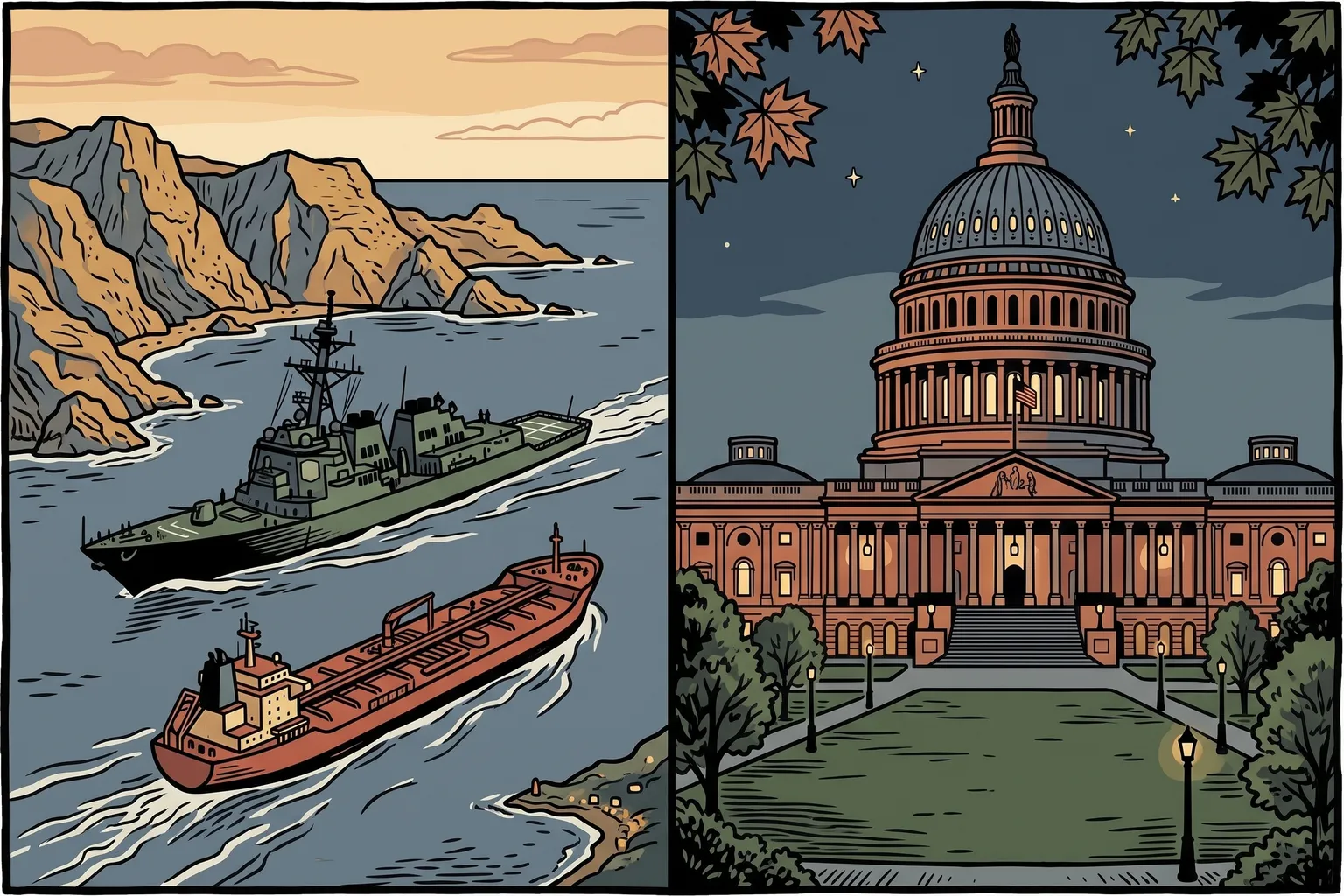
The United States carried out a new round of airstrikes on Iranian targets Tuesday, hitting sites near Bandar Abbas, Konarak, Chabahar, Qeshm, and Sirik in southern Iran, according to Iranian state media. The strikes came after Iran attempted new attacks on commercial shipping in the Strait of Hormuz and on U.S. service members in the region, the military said. President Trump warned Tehran against retaliation. The Washington Post and Bloomberg both confirmed the strikes Tuesday evening.
The timing is the thing worth sitting with. On Tuesday, Iranian President Masoud Pezeshkian told the Shanghai Cooperation Organization summit in Bishkek that Iran was prepared to return to its commitments under the Islamabad diplomatic framework if the United States would do the same. “War is not always the solution,” he said in separate remarks at home defending the memorandum, describing Iran’s path through the crisis as one of “prudence and thought.” Yesterday’s column covered that statement. The strikes the same day didn’t wait for the diplomatic track to develop. That’s not a contradiction of the statement. It’s a description of where the two governments actually are.
Energy Secretary Chris Wright announced Tuesday that 17 million barrels of crude oil transited the Strait of Hormuz on Monday, the highest daily volume since the conflict began in February, according to ABC News. The strait is open. The oil is moving. The military conflict and the economic traffic are running in parallel.
The Strait of Hormuz carries roughly 20 percent of the world’s daily oil supply. In April 1988, the United States and Iran fought a one-day naval battle in the Persian Gulf called Operation Praying Mantis, the largest U.S. naval surface engagement since World War II. The Reagan administration ordered the strikes after a U.S. frigate struck an Iranian mine. Iran lost two oil platforms, two frigates, and one gunboat. The engagement ended in a day. The underlying contest for influence in the Gulf waterways did not. What Praying Mantis demonstrated is that direct U.S.-Iran military conflict in the strait is possible to contain in the short term and impossible to resolve in any term without a political settlement that neither government has yet found a way to reach.
A day after Pezeshkian’s call for diplomacy, a Financial Times investigation reported by the Times of Israel found that Russia has been secretly helping Iran develop supersonic cruise missiles. Russia and Iran have been in an accelerating military partnership since 2022, with Iran supplying Russia with drones for use in Ukraine and Russia now reciprocating with advanced weapons technology. Supersonic cruise missiles aren’t defensive systems. The simultaneous appearance of a diplomatic opening and the transfer of offensive weapons capability from the same government is something both interpretations of Iranian intent have to account for. The diplomatic signal and the weapons program don’t disprove each other. They’re both real. What that combination means is what intelligence agencies and foreign ministries will be arguing about for the next several weeks.
The House voted 370 to 48 on Tuesday to pass a continuing resolution funding the federal government through December 11, avoiding a shutdown in the weeks before the November midterm elections, according to the Washington Post. The Senate had already passed the bill. It goes to the president’s desk. Two provisions drew less attention than the headline: the bill temporarily blocks an Office of Management and Budget rule that would have placed federal grant funding under review by political appointees, and it blocks the administration from transferring funds to Border Patrol from other programs, Roll Call reported.
The vote count is worth noting. A 370-48 margin means members who disagree on most things found common ground on not shutting the government down before an election. That’s about as durable a form of legislative consensus as exists right now, and it has a fixed expiration date of December 11.
The House has passed 3 of the 12 spending bills required to fund the government for fiscal year 2027. The Senate has passed none, Government Executive reported. The last time Congress completed all its appropriations bills before the October 1 deadline was 1997. In the twenty-nine years since, the continuing resolution has become the government’s operational norm for keeping itself funded. Every new Congress announces an intention to end that pattern. The pattern continues.
U.S. equity markets closed lower Tuesday, with the S&P 500 down 54.67 points, the Dow Jones Industrial Average down 419.02 points, and the Nasdaq down 271.12 points, according to The Motley Fool’s market recap. Technology and semiconductor stocks led the decline. The driver was a surge in crude oil prices and a rise in global bond yields, both tied to the escalation near the Strait of Hormuz. Oil markets respond to military activity near the strait quickly because the arithmetic is direct: a meaningful fraction of global supply runs through a channel where combat operations just resumed.
One number ran against the direction of the others. A separate labor report put job cut announcements in July at 33,429, down 46 percent year-over-year and the lowest monthly total in two years. The jobs picture and the market reaction aren’t telling the same story right now. That divergence sometimes resolves quickly and sometimes doesn’t.
Here is the story that didn’t lead anything this week.
Adults over 40 who used a HEPA air purifier in their home for one month performed approximately 12 percent faster on a test of executive function compared with a sham filter, according to a new study from an environmental health research team reported by ScienceDaily. The finding adds to growing evidence that reducing fine particulate matter indoors has measurable effects on cognitive performance, not just respiratory health. The intervention is relatively cheap and widely available. The implication is that indoor air quality is a daily health variable, not just a crisis variable that matters when wildfire smoke is visible from the window.
HEPA filtration dates to World War II, when it was developed to capture radioactive particles in laboratories working on nuclear weapons. The domestic version has been available since the 1960s. Its respiratory benefits have been studied for decades. The cognitive angle is newer. Researchers are beginning to understand that the lungs aren’t the only system affected by what people breathe indoors, and the brain’s sensitivity to fine particulate matter may be more significant than earlier studies captured.
Wednesday: A Note from the Column
Every Wednesday, this space takes a moment to point toward something worth reading from the Sunday Evening Review’s Living section. This week: Sylvia Chen’s “When the Group Becomes the Trip,” published August 28. Sylvia came to organized group travel reluctantly. Three years and several guided trips later, she has worked out the actual variables that determine whether strangers become the story or stay strangers, and what organized travel offers that going it alone genuinely can’t. She’s not selling anything. She’s reporting what she found. Worth the twenty minutes.
And then there is this.
The number of people worldwide requiring treatment for trachoma has dropped below 100 million for the first time in recorded history, according to public health officials. Trachoma is a bacterial infection of the inner eyelid. Repeated infections scar the tissue until the eyelashes turn inward and begin scratching the cornea. Left untreated long enough, it causes blindness. For most of recorded human history, it was the leading infectious cause of vision loss on earth.
At its peak in 2002, an estimated 1.5 billion people were at risk (WHO). The reduction to below 100 million reflects decades of coordinated international public health work: mass distribution of the antibiotic azithromycin across endemic regions in sub-Saharan Africa, South Asia, and the Middle East, combined with improvements in water access and basic sanitation. The numbers dropped steadily, year after year, without the kind of dramatic breakthrough that produces a news cycle. The people who did the work showed up and did it. The disease is losing.
Most people in the developed world don’t know what trachoma is. The people who no longer have it know what it means.