Speaking to reporters in North Carolina on Wednesday evening, President Trump described the US-Iran conflict as “hopefully toward the end” and said he has spoken with Iranian officials “directly,” adding that Tehran is “eager to reach a deal.” It was his most optimistic public statement since the war began on February 28. Today is day 203 (Source). Al Jazeera has the full remarks.
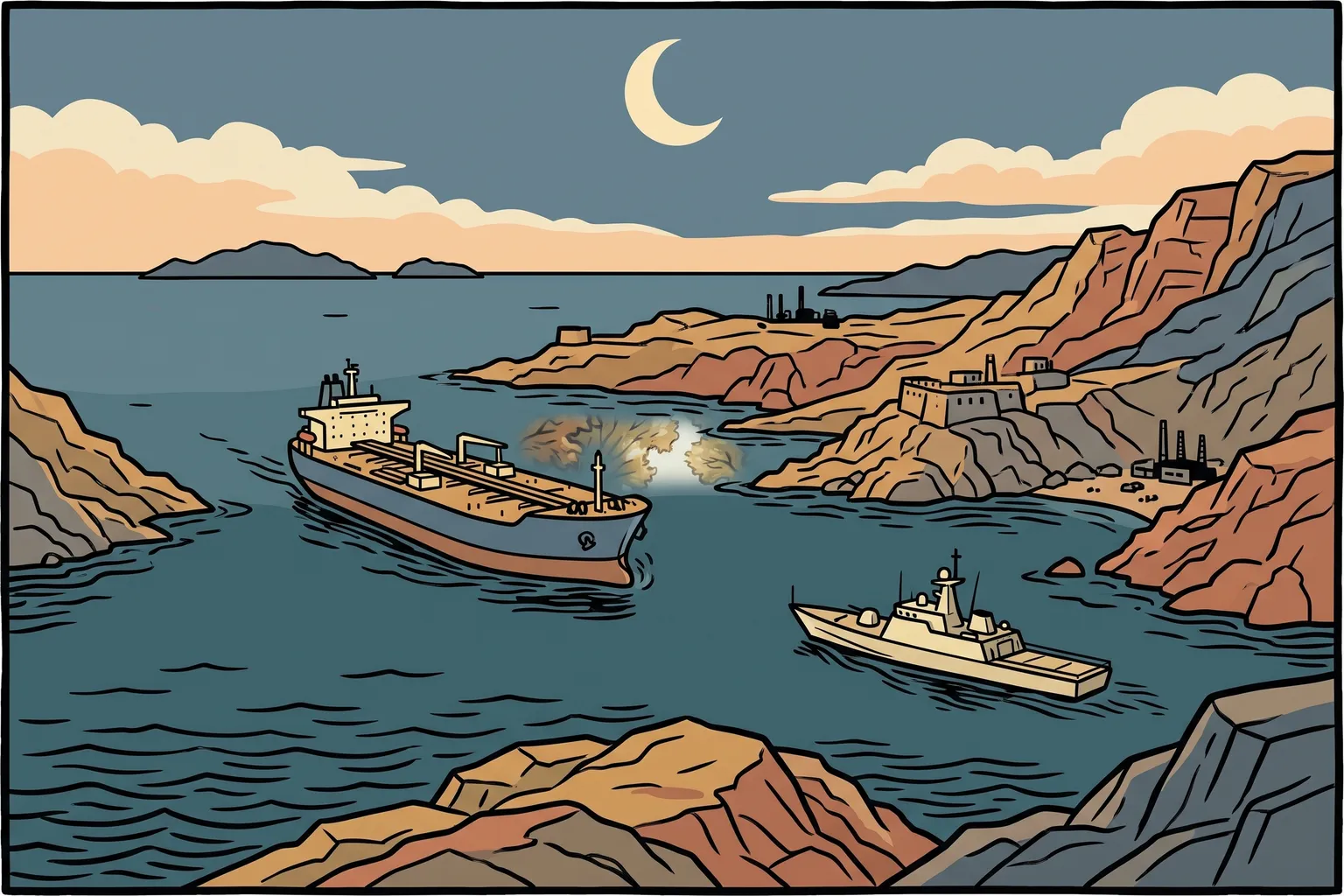
Iran’s National Security Chief Mohsen Rezaei responded the same day. Tehran does not trust the United States “at all,” Rezaei said, and any progress would require the US to take “practical steps” to earn Iranian confidence (Source). Iranian Foreign Minister Abbas Araghchi was in Beijing meeting with Chinese Foreign Minister Wang Yi, who called on both sides to “engage in substantive consultations on issues of mutual concern” and urged an early reopening of the strait (Source). The Strait of Hormuz remained at threat level “SEVERE.” Three vessels were struck in the strait in the most recent 72-hour window. CNBC has the Hormuz update.
The day after Trump expressed optimism about an end to the conflict, a UN-backed independent fact-finding mission released a report concluding it has “reasonable grounds” to believe the United States committed war crimes in Iran on the opening day of the war. The report focused on two strikes from February 28.
The first targeted a primary school in the town of Minab. Investigators said photographs and videos showed “readily identifiable features” of an educational facility for young children. More than 150 people were killed, approximately 120 of them children. The panel found the US had “failed in its obligation to do everything feasible to verify that it was a military objective.” The second strike hit what investigators described as a “clearly identifiable” sports complex and residential area in Lamerd, killing 22 civilians through the dispersal of tungsten pellets. The formal finding: “The mission found reasonable grounds to believe the United States committed the war crime of launching indiscriminate attacks resulting in the loss of life or injury to civilians or damage to civilian objects.” The Washington Post has the full report. NPR has a summary.
The finding is non-binding. It can be cited in future international proceedings, but it requires a court with jurisdiction to act on it. The United States has never joined the International Criminal Court. American forces have operated under that reality since the Rome Statute entered into force in 2002. What’s different here is the specificity: named locations, photographs, casualty figures tied to particular strikes. That kind of documentation is harder to dismiss on procedural grounds alone. Trump is expected to meet Gulf leaders on the sidelines of the UN General Assembly in New York on September 22 to discuss next steps.
Buried beneath the Iran war coverage this week is something worth pausing over. The United States and Iraq have reaffirmed that all remaining US military forces will withdraw from Iraqi territory by September 30. That date marks the close of an American military presence in Iraq that has lasted more than twenty-three years.
US forces entered Iraq on March 20, 2003. They withdrew under a Status of Forces deadline in December 2011, returned in 2014 after the Islamic State seized large portions of the north and west, and have operated in a reduced advisory and counter-terrorism capacity since the caliphate lost its territorial control in 2019. The September 30 deadline ends the final chapter. Wikipedia’s withdrawal timeline has the full sequence.
The context isn’t cleanly separable from the war next door. Iran-aligned militias in Iraq stepped up attacks on US forces throughout the conflict. The withdrawal closes the window for those attacks. It also ends a US presence in territory that has been contested, at various intensities, since the invasion. The security agreements that outlast the troop presence will determine what comes next. Those agreements are still being finalized.
Ukrainian forces retook the settlement of Serednie in Donetsk Oblast on Wednesday. On Thursday, Ukraine’s long-range drone campaign reached targets across a wide geographic band: Bryansk Oblast in Russia, where two S-400 air defense launchers were destroyed; Saky airbase in Crimea, where a Su-24M bomber was struck; the Yaroslavl oil refinery in central Russia; and a military airfield in Rostov Oblast. Poland scrambled fighter jets and briefly closed airports at Lublin and Rzeszow on Wednesday morning after Russian drones crossed near Polish airspace. Warsaw announced Thursday it will provide “up to 50 million euros worth of F-16 ammunition for Ukraine to shoot down Russian drones.” The Ukraine war timeline on Wikipedia has the running update.
A Ukrainian general reported this week that Russia has recruited more than 28,000 foreign mercenaries since the start of the full-scale invasion. An estimated 8,000 North Korean troops are currently positioned in Russia’s Kursk Oblast, with officials indicating that number could grow to 50,000. The Korean War armistice was signed in July 1953. North Korean military forces haven’t operated in significant numbers outside the Korean Peninsula in the seven decades since. These circumstances are different from 1953 in nearly every respect. The deployment to Kursk is one of the more consequential pieces of information in this war that hasn’t received the attention it probably warrants.
The Federal Reserve raised its benchmark interest rate by a quarter point on Wednesday, bringing the federal funds rate to a target range of 3.75 to 4 percent. The Federal Open Market Committee voted 12-0. CNBC has the FOMC statement.
Fed Chair Kevin Warsh said inflation has been “too high for too long” and that the Fed “must be confident that underlying inflation is moving to our objective clearly and at sufficient speed.” The Fed’s own projections put 2026 headline PCE inflation at 3.7 percent and core PCE at 3.4 percent. The labor market added 162,000 jobs in August. The unemployment forecast was revised down to 4.1 percent. Markets are pricing in one additional hike before year’s end.
President Trump has publicly called on Warsh to cut rates ahead of November’s midterms, not raise them. Warsh, whom Trump appointed, voted with the full committee for the increase. The last time a Fed chair raised rates over sustained White House objections was in 1994, when Alan Greenspan hiked six times in twelve months under Clinton, who kept his frustration private, despite Treasury skepticism (Source). The economy absorbed it. Whether this one absorbs another hike before November is the live question.
Chinese President Xi Jinping is scheduled to arrive in Washington on September 24 for a formal state visit. The two leaders met in Beijing in May, where the main product was an agricultural purchase pledge to restore US-China farm trade to pre-tariff levels. This visit’s primary agenda is AI governance and trade friction. Both governments have announced dedicated preparatory talks on artificial intelligence ahead of Xi’s arrival. CSIS has the full diplomatic background.
Chinese Foreign Ministry spokesman Lin Jian has said that “head-of-state diplomacy plays an irreplaceable role in providing strategic guidance for China-U.S. relations” (Source). The visit is proceeding despite an August exchange of sanctions and Trump’s July address alleging Chinese electoral interference. Secretary of State Marco Rubio said the interference issue wouldn’t derail the summit. The last Chinese state visit to Washington at this protocol level was in 2015, when Xi came under Obama. In the eleven years since, the two leaders have met in Beijing and on multilateral sidelines, but Xi hasn’t been received in Washington at that level. Both sides appear to have concluded that a managed relationship is worth more than a breaking point.
Forty-six days until the November 3 midterms. Democrats are at their strongest position of the 2026 cycle. The New York Times/Siena poll shows Democrats leading the generic congressional ballot by 8 points. The YouGov/Economist survey puts the margin at 12 points among likely voters. The Silver Bulletin forecast gives Democrats a 59 percent chance of retaking the Senate, the highest probability all year. Democrats need three net House seats to reclaim that majority. Silver Bulletin has the current forecast.
The issues most correlated with the Democratic position, according to polling, are tariff-driven inflation, Iran war costs, and immigration enforcement. Republicans are defending narrow margins in both chambers. All 435 House seats and 35 Senate seats are on the ballot. Forty-six days is enough time for the picture to shift significantly. That’s also true in the opposite direction.
Something good, to end the day.
Chile has become the first country in South America to eliminate dog-transmitted rabies as a public health threat. The Pan American Health Organization confirmed the milestone this week. The result of five decades of sustained vaccination campaigns, annual mass dog immunization drives maintained even in remote rural areas, and the kind of surveillance infrastructure that keeps working long after the political urgency fades. Chile began its systematic rabies elimination program in the early 1970s and kept at it (Source). Fifty years is a long time to keep doing the same thing carefully. The outcome is that this particular way of dying no longer exists there. Tens of thousands of people are still killed by dog-transmitted rabies globally each year. In Chile, that number is now zero. Positive News has the story.
Howard Fenn writes The Day, Monday through Friday.