Twenty-five years.
Family members gathered at Ground Zero beginning at 8:30 this morning to read aloud the names of the 2,977 people killed in the attacks of September 11, 2001. The first moment of silence fell at 8:46 a.m., the time American Airlines Flight 11 struck the North Tower. Ceremonies ran simultaneously at the Pentagon memorial in Arlington, Virginia, and at the Flight 93 National Memorial in Shanksville, Pennsylvania, where United Flight 93 went down at 10:03 a.m. after passengers and crew rushed the cockpit. Former Presidents George W. Bush, Bill Clinton, Barack Obama, and Joe Biden attended the gathering at Ground Zero. The 9/11 Memorial and Museum organizes the New York ceremony.
For the first time in the ceremony’s history, a seventh moment of silence was observed. It honored the approximately 9,000 people who have died since 2001 from cancers, respiratory illness, and other diseases caused by the toxic cloud released when the towers fell. They aren’t in the original count. They died more slowly, in hospitals and at home, over the years, and they are as dead as the people who died that morning. CNN reported on the addition of the seventh silence.
I was filing from the bureau in Kansas City that day. I’ve written about September 11 every year since and I haven’t found the definitive thing to say, which is probably appropriate, because the definitive thing about September 11 is that it hasn’t finished producing consequences. Twenty-five years is long enough to take an accounting. It isn’t long enough to close one.
Here is what twenty-five years has produced.
One hundred million Americans alive today have no direct memory of September 11, 2001, according to Beth Hillman, CEO of the National September 11 Memorial and Museum. Thirty percent of the U.S. population was born after the attacks. Among adults ages 18 to 24, sixty percent say they first learned about September 11 in a classroom. Sixteen percent learned from family or friends. Eight percent learned through their own reading. The attacks are history to a third of the country. They’re something else to the rest of us. Pew Research Center published its 25-year memory survey on September 3.
The post-9/11 wars in Afghanistan, Iraq, Syria, and elsewhere have cost an estimated eight trillion dollars, not including future interest. Between 4.5 million and 4.7 million people have been killed directly or indirectly in those conflicts, including roughly 940,000 direct deaths and more than 432,000 civilian deaths. Nearly 15,000 U.S. military personnel and contractors died in the wars. Thirty thousand one hundred seventy-seven American service members and veterans of post-9/11 wars died by suicide over the first twenty years of those conflicts, at least four times the number killed in combat. The United States now conducts counterterrorism operations in 78 countries. The figures come from Al Jazeera’s anniversary accounting, which draws on the Costs of War Project at Brown University.
The Department of Homeland Security, created by the Homeland Security Act of 2002, opened officially in 2003 and became one of the largest cabinet department reorganizations in American history. The Transportation Security Administration now operates on an annual budget of approximately eight billion dollars. Since July 2025, for the first time since TSA was created, passengers at U.S. airports no longer need to remove their shoes at security checkpoints (source). A classified inspector general’s report reportedly found that many body scanners cannot reliably detect what the shoe policy was designed to prevent. RAND published a full review of 25 years of homeland security adaptations. The security architecture built in the weeks after September 11 is still being revised, argued over, and sometimes quietly walked back. The negotiation between security and normality hasn’t ended. It probably won’t.
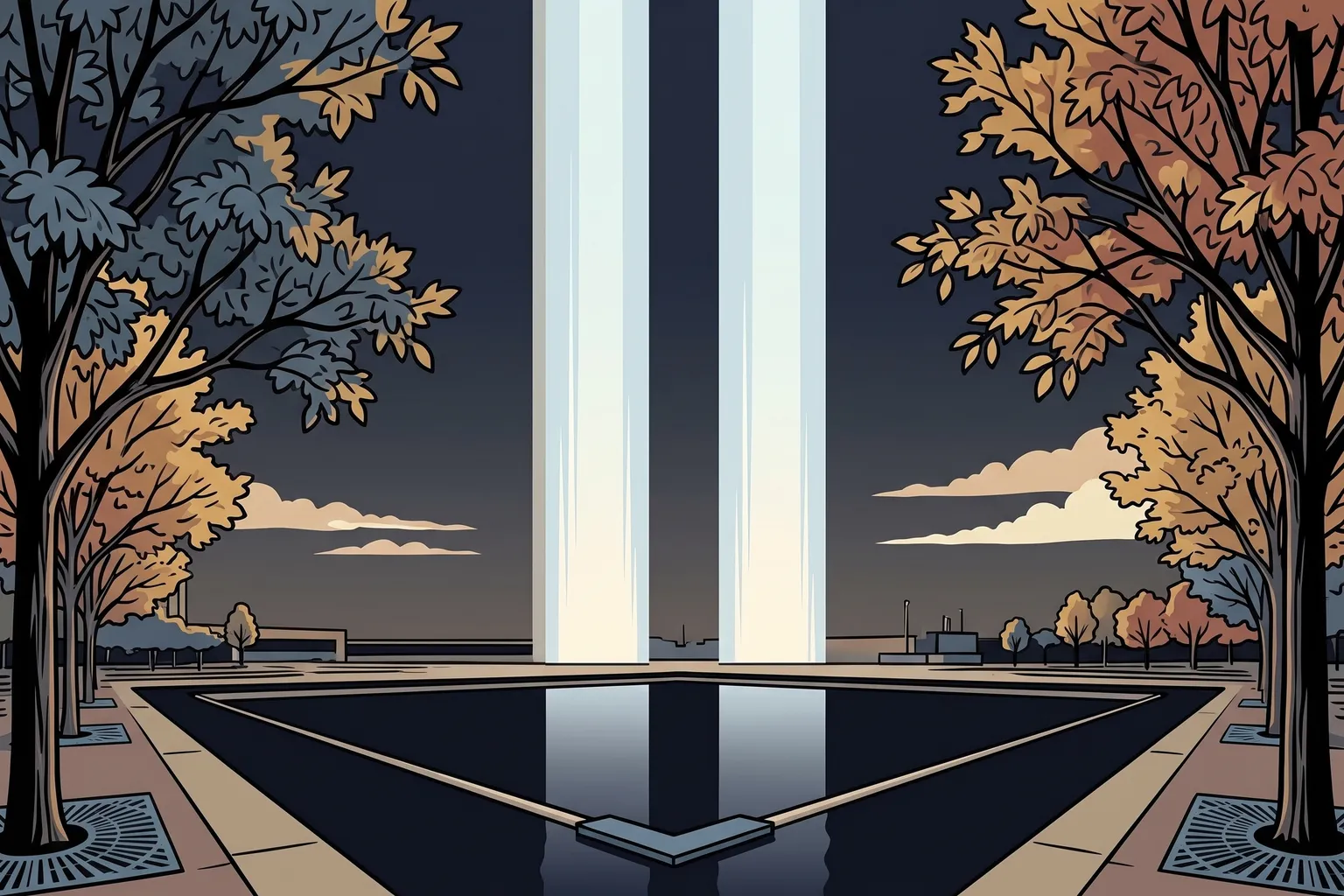
Tonight, the Tribute in Light will rise over Lower Manhattan: two columns of 44 xenon bulbs each, visible from 60 miles away, reaching four miles into the sky. The installation has run every September 11 since 2002. It goes dark at dawn (source). Disney and the 9/11 Memorial will broadcast it live beginning at 8 p.m. Eastern.
Iran attacked ten ships near the Strait of Hormuz on Wednesday, announcing the strikes as retaliation for the U.S. sinking of five Iranian oil tankers on Tuesday. At least one seafarer was killed and another is missing. American military aircraft at Muwaffaq Salti Air Base in Jordan sustained damage in separate overnight strikes. Time has been tracking the latest developments.
Support for the conflict stands at 31 percent, according to Reuters/Ipsos polling, down from 37 percent in March (source). No active framework for ending it exists. President Trump said Wednesday at a campaign event that the war would end “immediately” after the November 3 midterm elections, explicitly attaching the resolution of a military conflict to an electoral calendar rather than to military or diplomatic conditions.
The historical parallel most often cited right now is October 1968, when President Johnson announced a complete halt to the bombing of North Vietnam on October 31, five days before the presidential election. The backchannel negotiations had been underway for weeks before the announcement. The relationship between war decisions and election timing runs across administrations and across parties and across conflicts. Whether the current situation follows that pattern will take time and documents to determine. What’s clear is that the timing has been stated publicly, and governments and energy markets are pricing it.
Brent crude oil reached $107.86 a barrel on Thursday, approaching the $110 threshold that analysts have identified as the level at which fuel costs begin materially affecting household budgets across income ranges. Tickmill’s daily market note tracked the move. The national average price of gasoline hit $4.27 a gallon, according to AAA, up more than 30 percent from a year ago.
A hotter-than-expected producer price index report added pressure on the Federal Reserve ahead of its rate decision next week, pushing market expectations toward a September hike. The European Central Bank raised its deposit rate 25 basis points to 2.50 percent on Thursday. ECB President Christine Lagarde said inflation risks “remain tilted to the upside.” Asian markets fell overnight on the combined weight of oil prices and rate signals. Charles Schwab published its morning market report.
The story this week that’s getting less attention than it deserves.
Scientists working with observations of interstellar comet 3I/ATLAS, only the third object from outside our solar system ever detected passing through it, reported this week that the comet contains exceptionally high concentrations of methanol. The composition suggests it formed under conditions very different from those that shaped comets native to our solar system. 3I/ATLAS moves at approximately 58 kilometers per second relative to the sun (source), fast enough to rule out a local origin. The first interstellar object detected in our solar system was ‘Oumuamua in 2017, which passed through without yielding a confirmed chemical composition because researchers spotted it on its way out. The second was comet 2I/Borisov in 2019, which gave scientists the first confirmed interstellar molecular data. 3I/ATLAS is the third. Each one arrives from a different direction and with a different composition. ScienceDaily has the findings. We’re seeing one interstellar visitor roughly every four years now. At some point that stops being a coincidence and becomes a data set.
A large real-world study published this week found that semaglutide, the active ingredient in Ozempic and Wegovy, was associated with nearly 40 percent fewer asthma attacks in patients with obesity, and approximately 20 percent fewer flare-ups of chronic obstructive pulmonary disease. The drugs were approved for type 2 diabetes and weight management. The mechanism isn’t fully established. Researchers believe the drug’s effect on systemic inflammation may be the pathway. The pulmonology community is paying attention. ScienceDaily reported the study’s findings.
Congress designated September 11 as the National Day of Service and Remembrance in 2009. The push came from families of people killed that day, who believed the most fitting memorial wasn’t grief held in private but work done in public. This year, millions of Americans participated in volunteer events across all 50 states, according to the 9/11 Day organization.
Tomorrow, the 9/11 Memorial and Museum opens a new exhibition: “In Their Honor: 25 Years of 9/11-Inspired Service.” It documents what a quarter-century of grief-driven action has built: nonprofits, scholarship programs, first-responder support organizations, community rebuilding efforts, volunteer networks that didn’t exist before 2001. The Washington Times described the new exhibit. It’s a catalogue of people who decided to do something with what happened to them, and with what happened to people they loved.
The two reflecting pools at Ground Zero drain downward, into a void at the center of each. The water falls and keeps falling, into something you can’t see the bottom of. The memorial opened in 2011. In fifteen years, millions of people have stood at the edge and watched the water go. That seems like the right response. Not answers. Presence.
Howard Fenn writes The Day, Monday through Friday.