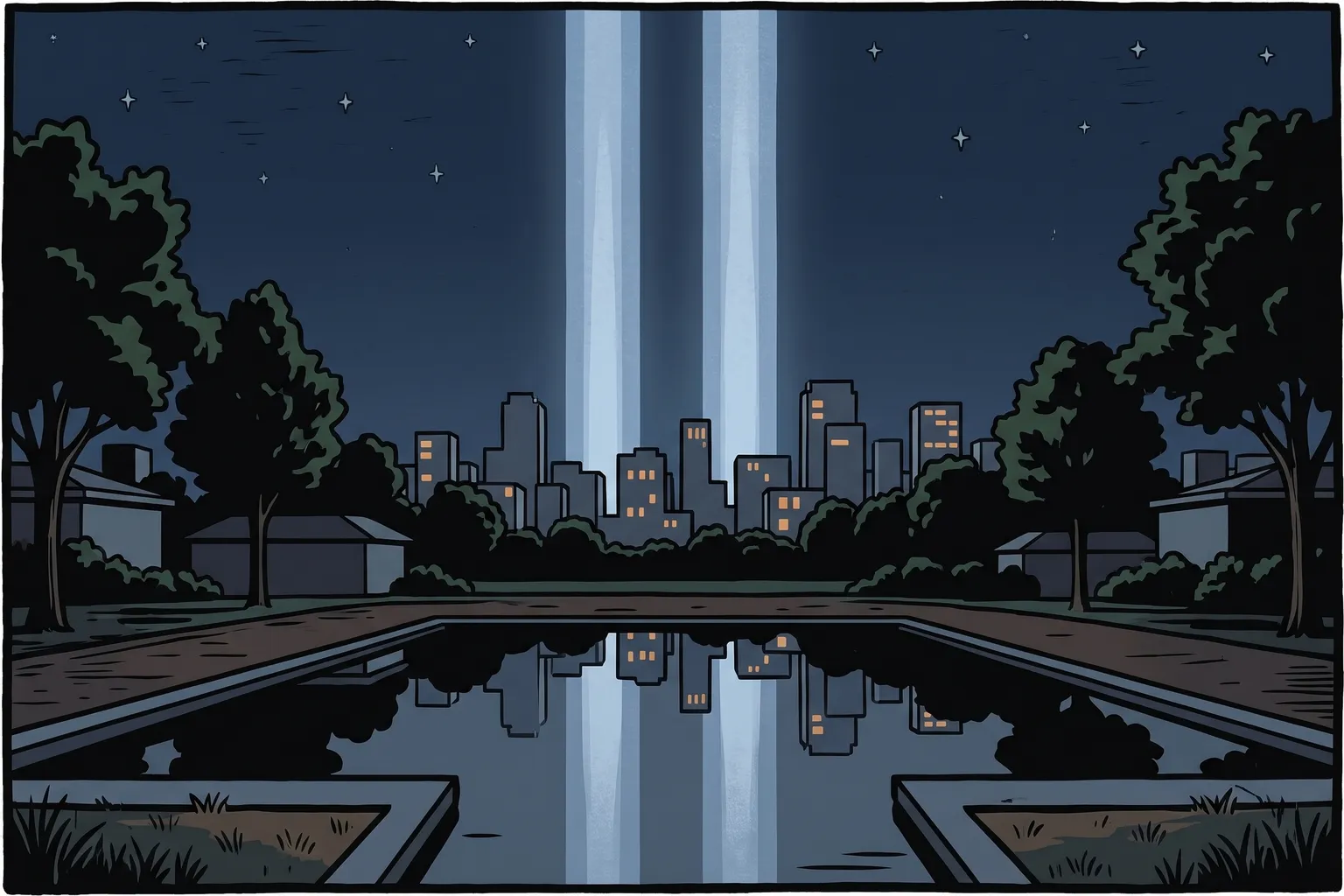
Tomorrow is September 11, 2026. The nation will mark twenty-five years.
At the Memorial Plaza in Lower Manhattan, families will gather starting at 8:46 a.m. to read aloud the names of the 2,983 people killed in the 2001 attacks and in the 1993 World Trade Center bombing. The reading takes several hours. Disney and the 9/11 Memorial & Museum will broadcast the Tribute in Light live beginning at 8 p.m. ET, a first-of-its-kind broadcast. The full day’s commemorations are organized by the 9/11 Memorial & Museum. The FDNY’s official anniversary ceremony was held Wednesday at FerryHawks Stadium on Staten Island for the families of the 343 members who died that day and the more than 400 who have since died from World Trade Center-related illnesses, per the department’s announcement. The 9/11 Day organization expects millions to participate tomorrow in the nation’s largest annual day of charitable service.
I was filing that morning from Kansas City. The details of September 11 have been written about by people better suited to do it than I am, and I’ll leave it to them today as I have every year since. What I’ll say is this: I drove home late that night. The highway was empty. The sky had no planes in it. I’ve spent a career covering emergencies, disasters, and wars across four decades, and what I’ve learned is that the most disorienting things aren’t always the things that happen. Sometimes they’re the things that aren’t there anymore. Twenty-five years is a long time. Most of the children who died that day have now been gone longer than some of today’s readers have been alive.
President Trump said Wednesday that the Iran war will end “immediately” after the November 3 midterm elections. He made the statement at a campaign event, saying Iran was “desperate to try and affect the election,” suggesting Tehran was prolonging the conflict to keep fuel prices elevated through November. He added that energy prices would fall after the election. The National News has the full statement.
Brent crude reached $101.25 a barrel on Wednesday, per Trading Economics, its highest price since May. U.S. benchmark crude gained 2.4 percent on the day to $95.25. Diesel climbed to a national average of $5.94 a gallon. Fortune attributed the surge to Houthi attacks on Saudi oil facilities and on an alternative shipping route that Riyadh had relied on after Strait of Hormuz traffic collapsed earlier in the war.
The Islamabad Memorandum, signed June 17 and brokered by Pakistan to structure a 60-day peace negotiation, expired August 17 without an agreement. Al Jazeera reviewed the breakdown. Washington said the ceasefire framework was finished. Iran said the memorandum never contained a formal deadline. Neither side has produced a successor agreement. The situation as of Wednesday is low-intensity ongoing conflict with no active framework for ending it, other than the timeline the president announced Wednesday at a campaign event.
There’s a pattern in American military conflicts and election calendars that runs back further than most people remember. In October 1968, President Johnson announced a complete halt to the bombing of North Vietnam on October 31, five days before Election Day. The halt had been in private negotiation for weeks before the announcement. The relationship between war decisions and electoral timing is not a new phenomenon, and it isn’t specific to one party or one conflict. Whether the current situation resembles 1968 or something else is too early to say. What’s clear is that Trump has attached the war’s resolution explicitly to the electoral outcome, and that attachment is now part of what governments and energy markets are pricing.
The Republican National Committee held what it’s calling the first midterm convention in American political history this week at the American Airlines Center in Dallas. President Trump spoke on night one. Vice President Vance headlines tonight. The program listed 53 speakers on the first evening and 56 on the second. CBS News has covered the convention. Al Jazeera has context on the convention’s purpose and structure.
On November 3, all 435 House seats and 35 of 100 Senate seats are up. The convention is framed as both a rally and a fundraiser for candidates in competitive races, with the goal of nationalizing a set of local elections into a single party message.
The closest historical parallel may not be a convention at all. In September 1994, Republican House candidates signed the Contract with America on the Capitol steps, committing to ten specific legislative priorities and effectively turning 435 separate congressional races into a single national referendum. Republicans gained 54 House seats that November, at the time the largest midterm swing for either party since 1946. The Dallas convention is a different mechanism aimed at a similar goal. Whether it works the same way is something historians will assess in December.
There’s a story this week that deserves more attention than it’s gotten.
The surface transportation authorization established by the 2021 Infrastructure Investment and Jobs Act expires September 30. That’s twenty days from today. Legis1 has been tracking the deadline. The House Transportation and Infrastructure Committee passed the BUILD America 250 Act by a bipartisan vote of 62-2 on May 22, a five-year, $580 billion reauthorization package. What hasn’t happened is a floor vote in either chamber.
Congress has rarely managed to reauthorize surface transportation programs on time. When it doesn’t, state transportation departments lose the ability to commit to long-term projects. Construction contracts can’t be signed. Bridge rehabilitation schedules slip. The money doesn’t vanish immediately, but the planning paralysis at the state level is real and cumulative. The 2021 act was the largest federal infrastructure investment since Eisenhower signed the Federal-Aid Highway Act of 1956, which created the Interstate Highway System. It expires in twenty days, and the replacement isn’t through the floor of either chamber. Most of the country isn’t watching. The people running state transportation departments are watching very carefully.
Ukrainian President Zelensky was departing Moldova on Tuesday, bound for Oslo for the state funeral of King Harald V of Norway, when Moldovan authorities closed the country’s airspace because of a drone incursion. ABC News reported the delay. Fragments recovered by Moldovan ordnance experts showed propulsion characteristics consistent with the Geran-type drone Russia has used extensively against Ukrainian targets. The drone landed and detonated approximately 160 kilometers from Chisinau International Airport.
King Harald V died on August 28 at the age of 89. His state funeral on September 9 at Oslo Cathedral drew monarchs from eight countries, Prince William, Japan’s Crown Prince Akishino, and political leaders from more than 20 nations. CNN covered the service.
Moldova isn’t a NATO member. It isn’t a party to the conflict. Its territory has no formal role in the Russia-Ukraine war. Moldova’s ambassador to the United States said the incident was likely “not an accident,” telling reporters: “We do not believe in jet-propelled drones just flying into Moldova’s territory for surveillance purposes while the Ukrainian president’s airplane is on the ground at the airport.” CNN reported the ambassador’s statement. Norwegian Prime Minister Støre described it publicly as a near-hit to Zelensky’s aircraft. The drone didn’t reach the airport. But it established something about the geographic range and intent of the weapon that neutral countries near the conflict are now formally noting.
Bob Whitfield published “The Weight of the Chair” in Ideas last Sunday, and it’s worth finding before the week is out. It’s here. Bob’s subject is Federal Reserve Chairman Kevin Warsh, whom Trump installed this spring expecting a different monetary posture than Jay Powell had maintained through the inflation years. What Warsh did instead, at the Jackson Hole conference on August 28, was signal that the Fed may have “work to do” on inflation. Market odds for a September rate hike moved from roughly a third to above sixty percent within days. Trump, per public statements, wasn’t pleased. Bob isn’t writing about monetary policy in isolation. He’s writing about what the office does to the person who holds it, and how the institutional logic of the Federal Reserve has a way of asserting itself regardless of the political calculation that produced the appointment. Nixon installed Arthur Burns in 1970 expecting accommodation. Burns accommodated, and the result was an inflation problem that required a decade and a painful recession to resolve. Bob’s piece is careful and well-sourced. It’s the kind of context the moment calls for.
Howard Fenn writes The Day, Monday through Friday.