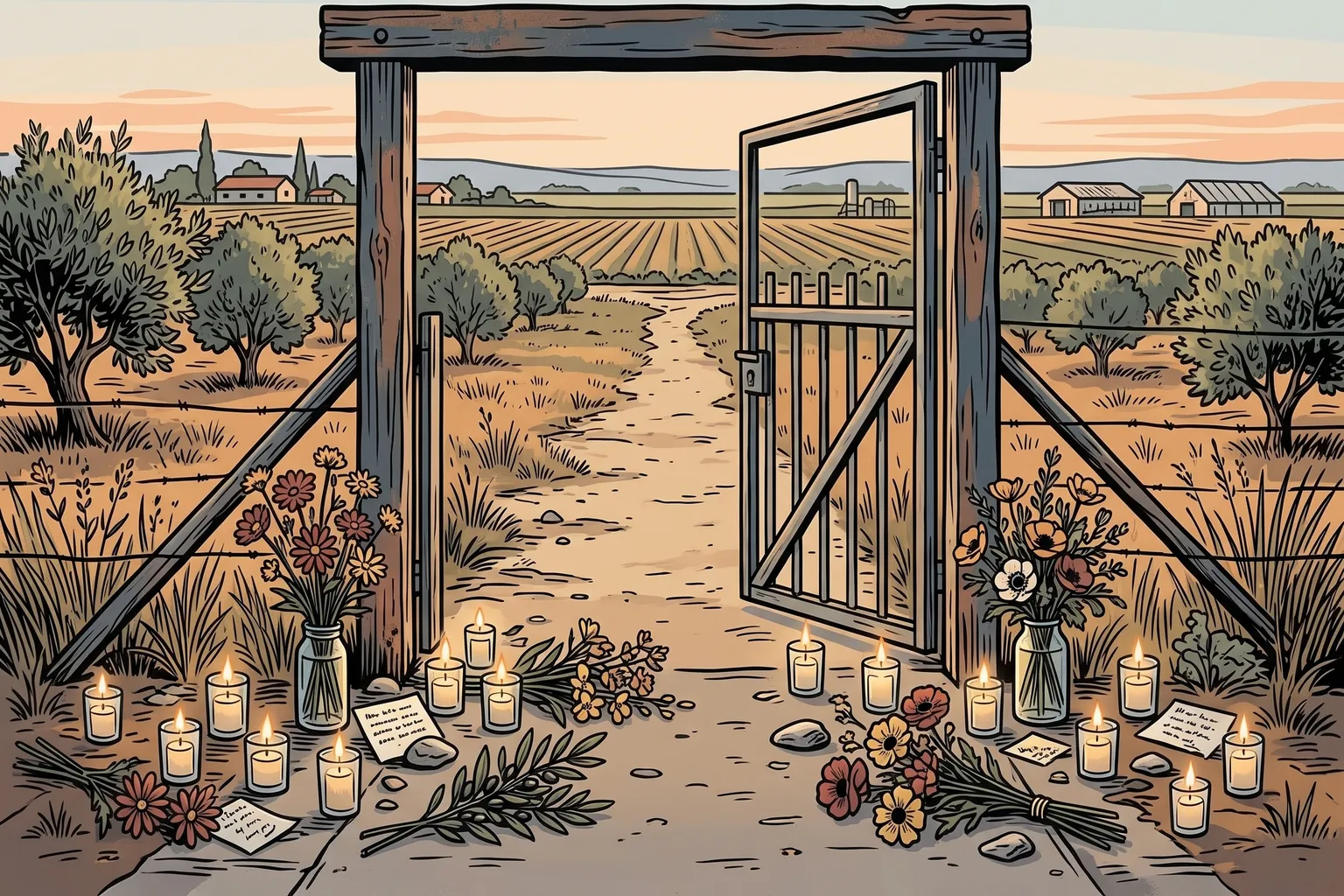
Three years ago this morning, Hamas-led forces broke through the fence separating Gaza from Israel’s southern communities and killed approximately 1,200 people in what became the deadliest single day in Israeli history. Two hundred and fifty-one people were taken into Gaza as hostages. Forty-one of those hostages died in captivity. The rest came home through negotiations that took the better part of two years to conclude.
This is the first October 7 anniversary marked with all the surviving hostages returned. That fact changed the shape of the day. The grief isn’t smaller. It’s different. One released hostage from the Nova music festival, who spent 738 days in Gaza, used the past eleven months to write a book, begin a speaking career, and celebrate the holidays he missed. He is marking this anniversary in Israel. There are others like him, for whom the math of survival is something they will spend the rest of their lives working out. NPR reported on the third anniversary and its particular character Wednesday morning.
In southern Israel, families gathered at kibbutz intersections, bomb shelters, and on the field outside Re’im where the Nova music festival was overrun. The ceremonies were organized by the October Council, a coalition of more than 1,500 bereaved families, hostage survivors, and massacre survivors. The October Council has been sharply critical of the government’s failure to prevent the attack and of Prime Minister Netanyahu’s continued refusal to form a state commission of inquiry. It held the ceremonies anyway. Grief doesn’t wait on accountability.
For Palestinians, the date marks the beginning of a war that hasn’t ended. More than half of Gaza’s territory remains under Israeli military control. A ceasefire deal reached nearly a year ago hasn’t stopped Israeli strikes from continuing almost daily. Palestinian health authorities in Gaza have recorded more than 74,000 deaths since October 7, 2023. Israeli troops continue to occupy portions of southern Lebanon from their campaign against Hezbollah, which began firing on Israel in support of Hamas. Three years on, neither side has returned to anything resembling the world before it. ABC News Australia covered the full commemorations Wednesday.
The Yom Kippur War began on October 6, 1973, fifty-three years ago yesterday, when Egypt and Syria launched a coordinated surprise attack on Israeli positions on the holiest day of the Jewish calendar. The intelligence failure that allowed it became known in Hebrew as the Mechdal, meaning the failure or the default. A state commission of inquiry, the Agranat Commission, convened afterward. Its findings led to the resignation of the chief of military intelligence, the head of the southern command, and, shortly after, Prime Minister Golda Meir. The Mechdal became the standard against which all subsequent Israeli intelligence failures are measured, and the reason there was a process for measuring them. The question of whether that process exists for October 7, 2023 isn’t settled.
On September 8, the Haaretz newspaper in Israel reported that UAE President Mohamed bin Zayed Al Nahyan spoke directly to Prime Minister Netanyahu approximately ten days before the October 7 attack and warned him that Hamas was planning a major operation. According to the Haaretz account, the UAE leader said Hamas’s military chief in Gaza, Yahya Sinwar, had told an intermediary he was planning what he described as a terrifying operation. Netanyahu’s office denied it: “No warning was given to the Prime Minister from the United Arab Emirates before Oct. 7th.” Al-Monitor covered the report and the denial on September 8.
The UAE and Israel established formal diplomatic relations under the Abraham Accords in September 2020. The communication channel between the two governments has been among the more significant products of that normalization. Whether that channel also produced a warning that was received and disregarded is the factual question the Haaretz report raises. Netanyahu’s office says no such warning was given. The two accounts can’t both be true.
On the third anniversary, the warning report has become a central issue for the Israeli opposition. Yashar party leader Gadi Eisenkot has pledged that a state commission of inquiry would be the first act of any government formed under his leadership. The commission, in the opposition’s framing, would investigate not only the tactical failures of October 7 but the decade-long policy of building up Hamas as a counterweight to the Palestinian Authority. The question of who bears responsibility for the strategic conditions that made October 7 possible isn’t the same question as who bears responsibility for the tactical intelligence failure on the morning itself. Both questions are open. NPR reported on the commission question and the anniversary context Wednesday.
Tropical Depression 9 was strengthening in the Gulf of Mexico Wednesday morning and is forecast to become Hurricane Isaias by Thursday, with landfall expected along the Gulf Coast on Friday night. If that holds, Isaias would be the first named Atlantic hurricane of the 2026 season. Governor Ron DeSantis declared a state of emergency for twenty-five Florida counties Wednesday. The storm’s projected track runs from southeastern Louisiana to the Florida Panhandle. Forecasters are warning of three to six inches of rain across the impact zone, with localized totals up to ten inches and flash flooding possible. The Insurance Journal reported the full alert Wednesday.
The 2026 Atlantic hurricane season has been unusually quiet. Had it run to completion without a named hurricane, it would have been only the third such season on record, the other two being 1907 and 1914. That record won’t stand now. What will be recorded is how late in the season the first hurricane arrived. The Gulf remains warm enough to support development in October, and Tropical Depression 9 found the water temperature it needed. The National Shrimp Festival in Gulf Shores, Alabama, which typically draws more than 300,000 visitors in early October, is tracking the storm.
The Federal Reserve publishes the minutes of its September 15-16 Federal Open Market Committee meeting today at two o’clock Eastern time. The September meeting was where the committee raised the federal funds rate for the first time in three years, voting 12-0 to move the target range from 3.5%-3.75% to 3.75%-4%. Inflation has remained above the Fed’s 2% target in an economy that grew at 2.2% in the second quarter, and the committee decided the economy was strong enough to absorb dearer money. Today’s minutes will provide the detailed record of how members reasoned their way to that unanimous decision. Kiplinger covered the release schedule and context Tuesday.
Because September is one of four FOMC meetings each year that includes the Summary of Economic Projections, the minutes are likely to be more detailed than usual. The September dot plot showed sixteen of eighteen committee members expecting at least one more rate increase before year’s end. The minutes will show how those individual projections were built and what range of views the unanimous vote contained. The Fed raised rates through 2022 and 2023, from near zero to 5.25%-5.5% in sixteen months, then cut them in stages through 2024 and 2025. The September 2026 hike isn’t a return to that campaign. It is a single quarter-point move made in response to an economy that has stayed warmer than the cuts assumed it would. The transcript of how the committee talked about this arrives at two o’clock.
Three years ago Wednesday morning, Kibbutz Be’eri in the Eshkol region of southern Israel was attacked. More than one hundred members of the community were killed, more than ten percent of its population. For most of the three years since, the kibbutz has existed in displacement, its residents scattered to temporary housing while the destroyed structures stayed where they fell. By mid-2026, the last of the ruined homes had been cleared. One house was left standing, a single structure preserved as a memorial to what happened. Everything else has been leveled.
The reconstruction plan is called Be’eri Plus, and it is built on a $150 million budget: $113 million from the Israeli government, $23 million from private donors. The design standards are intended as a national model, incorporating trauma-informed architecture and advanced security into every public structure. Be’eri was founded in 1946, two years before the state of Israel existed. Its founders built it on what was then uncertain ground, in a region that has never fully left that condition. The generation doing the rebuilding now knows more than the founders did about what can happen. They are building anyway, and they are building to last. CBN News reported on the three-year rebuilding effort Wednesday.
Howard Fenn writes The Day, Monday through Saturday.