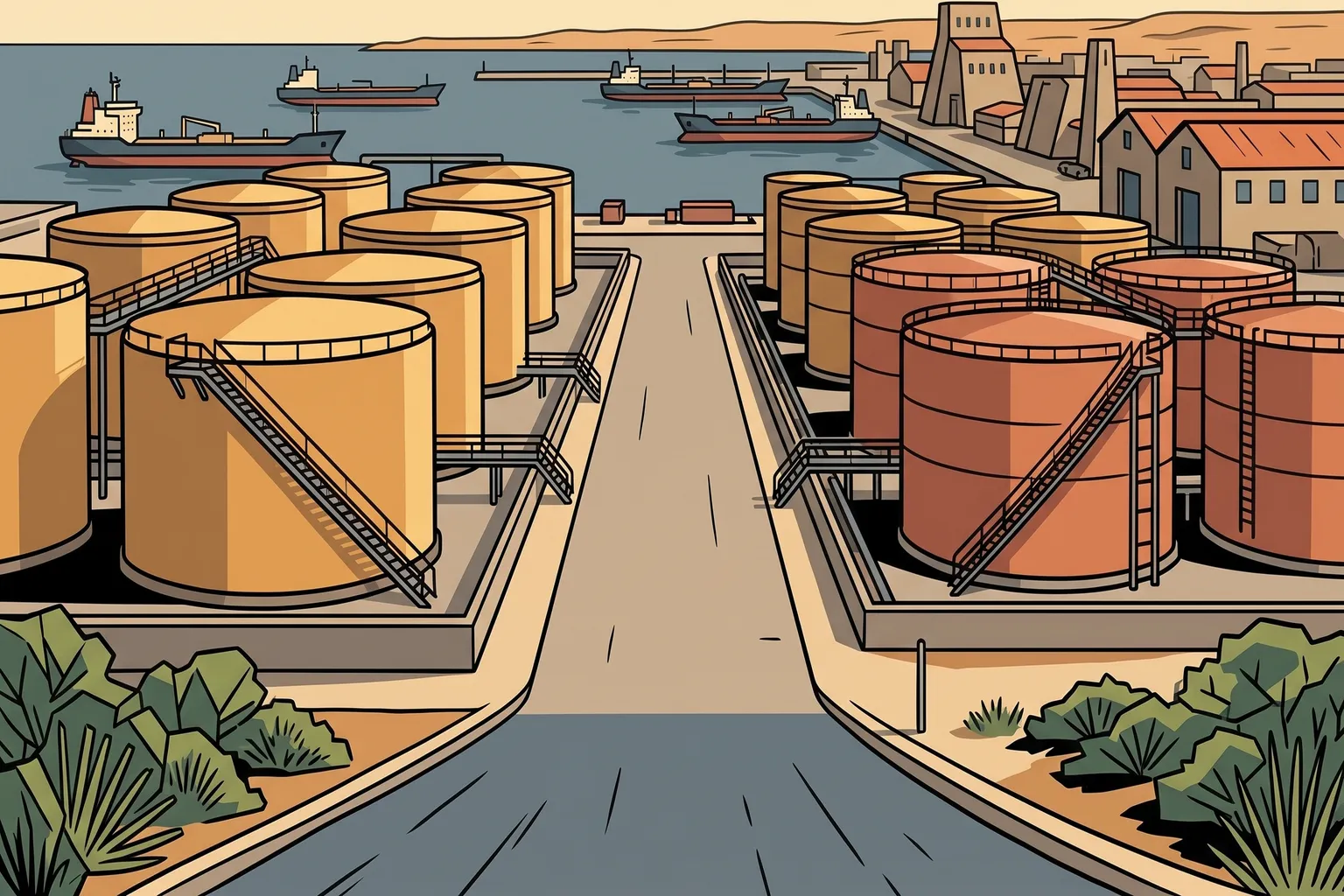
The International Energy Agency announced Friday that its member countries have released 325 million barrels of oil from strategic reserves, with 75 million still in transit. That makes this the largest emergency drawdown in the IEA’s fifty-two-year history. The previous record was 182.7 million barrels, released in 2022 after Russia’s invasion of Ukraine. The IEA’s announcement is here.
The release is a response to two simultaneous disruptions. The ongoing conflict in the Middle East, which has constricted shipping through the Strait of Hormuz since February, has raised crude prices to levels that threaten the global economic recovery. Simultaneously, Ukrainian strikes on Russian refineries have removed refined product capacity from European markets. G7 leaders, under direct American pressure, coordinated a release of 100 million barrels of diesel and crude as part of the total. Euronews reported the full breakdown of member contributions on Friday.
The IEA was created in 1974 because of what happened in October 1973. The Arab members of OPEC placed an embargo on oil exports to the United States and other nations that had supported Israel in the Yom Kippur War. Gas lines formed in American cities that winter. The economy contracted. The industrialized world discovered, in approximately ninety days, that its energy infrastructure was a vulnerability its adversaries could exploit. The emergency reserves being drawn down this week exist specifically so that what happened in 1973 can’t happen again at the same speed. They are a form of time, bought and stored.
Whether the reserves are sufficient depends on how long the disruption continues. At current consumption rates, 325 million barrels represents roughly three days of global oil demand. The IEA’s original mandate was to hold enough reserves to cover sixty days of net imports. What that means in practice, when two wars are simultaneously affecting supply, is a question the IEA has been working through in real time. For readers trying to understand what this kind of supply shock means for interest rates and the Fed’s response, Bob Whitfield wrote recently about the institutional constraints that shape those decisions.
Supreme Court Justice Samuel Alito confirmed in an interview with CBS News, published Friday, that he’s thought about retiring. “I thought that I could still make a valuable contribution,” Alito said, explaining why he didn’t step down after the last term. He indicated he’ll weigh the question again in 2027. CNBC reported the Alito comments on Sunday.
Alito is seventy-six. The timing of the disclosure matters because it lands five weeks before the November 3 midterm elections, in which control of the United States Senate is competitive. Republicans currently hold a 53-47 majority. Polling models show Democrats with a path to a 51-49 Senate majority, with competitive races in Ohio, Maine, and Alaska. A justice confirmed by a Senate controlled by one party is likely to reflect that party’s judicial philosophy. The math is well understood by both parties, and it’s why the question of when Alito might retire has been closely watched since the 2024 presidential election.
The modern pattern of strategic judicial retirements dates roughly to Lewis Powell’s decision in 1987 to retire when Ronald Reagan was still in office, ensuring a Republican appointment. Sandra Day O’Connor’s retirement in 2005 and Anthony Kennedy’s in 2018 both occurred under Republican presidents. Ruth Bader Ginsburg’s decision not to retire during the Obama administration, when she was in her eighties and battling cancer, ultimately resulted in Amy Coney Barrett’s 2020 appointment. Alito’s comments suggest he’s aware of the calculation, even if he isn’t yet certain of its resolution.
New details emerged this weekend in the investigation of an attack aboard a Flydubai flight from Dubai to Tel Aviv. The co-pilot, identified in media reports as Hamam Al-Hammami, attacked the aircraft’s Indian captain, Smit Machchhar, with a crash axe in a premeditated attempt to seize control of the plane and crash it into Ben Gurion Airport. Al-Hammami told investigators that he had specifically sought employment with Flydubai because the airline operates flights to Tel Aviv. “I searched and checked which airline flies to Tel Aviv, and because of that I chose Flydubai,” he told investigators, according to Israeli media reports. Al Jazeera reported the investigation findings on Saturday.
Machchhar survived. The flight was diverted to Tabuk, Saudi Arabia, where Al-Hammami was arrested and subsequently transferred to UAE custody, which is leading the criminal investigation. The UAE called the incident a “terrorist act.” ABC News in Australia published a fuller account of the plot on Sunday.
This is also the incident the Trump administration cited last week as partial justification for deploying a third aircraft carrier to the Middle East, though the administration’s description at the time was limited in its specifics. The Germanwings co-pilot who deliberately flew an Airbus A320 into the French Alps in March 2015, killing all 150 people aboard, prompted the aviation industry to adopt rules requiring two crew members in the cockpit at all times. The UAE investigation will determine whether such a rule applied here and whether it was followed.
Seventy thousand people marched through Madrid on Saturday to protest the housing crisis, according to Spanish government figures. Demonstrations also took place in Barcelona, Seville, and other cities. The protests came a day after Spain’s parliament rejected two emergency housing decrees from Prime Minister Pedro Sanchez’s government. AP reported the protests on Saturday.
The symbolic center of the protests is Maricarmen Abascal, an eighty-seven-year-old woman who was carried out of her Madrid apartment on a stretcher on September 23. She had lived there for roughly seven decades. The eviction, captured on video and shared widely, became the image the housing movement attached itself to. The two decrees parliament rejected would have stopped evictions of vulnerable people, restricted short-term tourist leases, imposed real estate speculation limits, and made residential leases automatically renewable. France 24 reported the legislative defeat and its aftermath.
The Spanish housing crisis has structural origins that predate the current government. Spain overbuilt housing aggressively between 1998 and 2008, then watched the market collapse during the financial crisis, producing a decade of foreclosures, abandoned developments, and deeply scarred household finances. What’s happened since is a different problem: the cities, particularly Madrid and Barcelona, have recovered, and housing costs have risen fast enough that workers with ordinary incomes can’t afford to live near the jobs. The tourist flat market has absorbed supply that might otherwise be available to long-term renters. Sanchez is reported to be considering calling a snap election for November. The seventy thousand people in the streets on Saturday were telling him something about the political weight of this question.
Russian health authorities placed 197 people under medical isolation this week after a researcher at the Irkutsk Anti-Plague Institute in Shelekhov, Siberia, died of pneumonic plague. The researcher was identified as Daria Shipilova, twenty-seven years old. She died after either returning from a field trip near the Mongolian border or after a laboratory accident involving live bacteria. Russian media reports offered both explanations at different points. CNBC reported the isolation figures on Sunday.
Russia’s public health watchdog, Rospotrebnadzor, described the situation as “stable” and classified Shipilova’s diagnosis as “pneumonia of unknown etiology.” More than 100 of the 197 under observation were placed in hospital wards. The White House said it is monitoring the situation. The Moscow Times reported the isolation order and official statements earlier in the week.
Pneumonic plague is the rarest and most dangerous form of Yersinia pestis infection. It spreads person to person through respiratory droplets, unlike bubonic plague, which requires a flea bite. The survival rate drops steeply without antibiotic treatment within the first twenty-four hours of symptoms. The Irkutsk Anti-Plague Institute exists specifically to monitor and contain plague outbreaks in the region. That the institute’s own researcher may have died of the pathogen it was designed to contain is the detail that will interest epidemiologists most. The global health community has been watching Russian public health disclosure since the COVID years, when a pattern of limited transparency became a recurring subject of concern among outside experts.
The United Nations General Assembly approved a resolution on September 24 on rising sea levels. The unusual thing about the vote is that it was unanimous. AFP reported the vote on September 24.
The resolution does two things. It affirms that a country’s exclusive economic zones and territorial waters remain legally valid even if the coastline that established them recedes beneath rising seas. And it states that the disappearance of land doesn’t automatically end a nation’s legal standing as a state. This matters most to the low-lying Pacific and Indian Ocean island nations, places like Tuvalu, Kiribati, and the Maldives, that face the real possibility of losing their land mass to rising ocean water before the end of this century. Until September 24, the legal framework for what happens to a country when its land disappears didn’t exist. Now it does.
Global sea levels rose nearly six millimeters in 2024, the largest single-year increase on record. Projections from the Intergovernmental Panel on Climate Change estimate a rise of one meter or more by 2100 if emissions reductions don’t accelerate. Grist reported the resolution’s legal implications for island nations.
The 1982 United Nations Convention on the Law of the Sea took nine years to negotiate and another twelve to achieve the sixty ratifications required for it to enter into force. It established the framework of exclusive economic zones, the 200-nautical-mile limit within which a nation has sovereign rights over the sea floor and its resources, that the September 24 resolution now protects from the effects of sea level rise. The nations that will benefit most from that protection contributed the least to the conditions that required it. The September 24 vote was unanimous. That doesn’t happen often. It happened last month.
Howard Fenn writes The Day, Monday through Saturday.