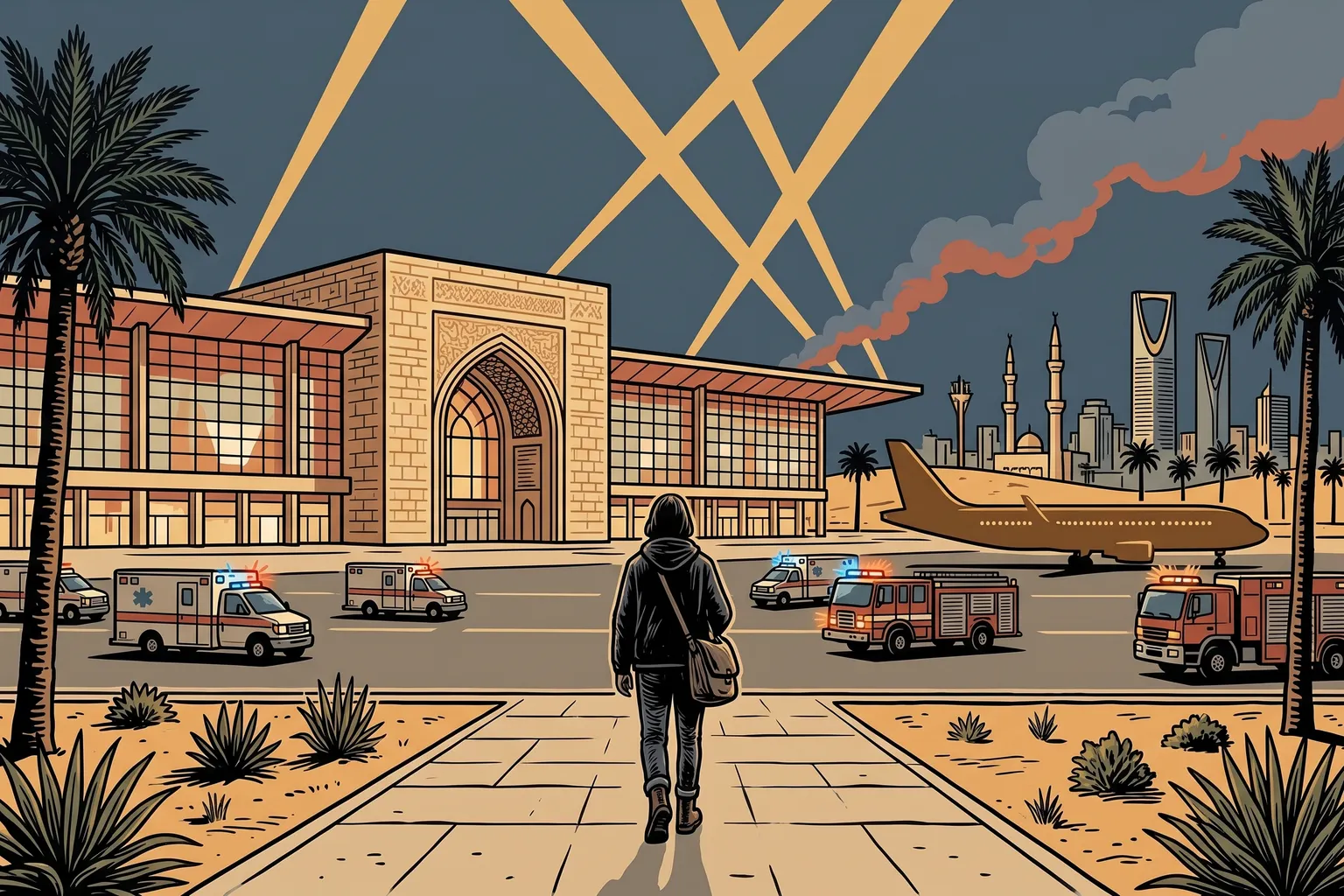
A missile fired by Houthi forces struck King Khalid International Airport in Riyadh on Saturday, killing at least 13 people and injuring more than 300. Among the dead was a United States citizen. Secretary of State Marco Rubio confirmed the American fatality Sunday. Saudi civil aviation authorities identified the other victims as four Saudi nationals, two Bangladeshi nationals, an Egyptian, a Jordanian, a Palestinian, a Syrian, and one Sudanese national. An Indian national injured in the strike died Sunday, according to the Indian Embassy (Al Jazeera). The Houthis claimed responsibility. It was the deadliest attack on Saudi Arabia in more than a decade. NBC News reported Sunday on the second strike and what the administration is weighing.
The airport remained closed Sunday when a follow-up strike hit Terminal 4, killing one Pakistani resident and injuring eleven others. The Saudi-led coalition said it also intercepted a cruise missile in the same attack. Condemnations came from Egypt, Qatar, Germany, Canada, and United Nations Secretary-General António Guterres. Saturday’s strike followed a separate Houthi attack at the same airport on Thursday that killed three Saudi nationals, including Captain Hamoud Ali al-Kalthami, a Saudia airline pilot, and was covered in this column Saturday. In the span of four days, the airport had been hit four times (Al Jazeera).
Asked Sunday whether the United States would join Saudi military operations against the Houthis in Yemen, President Trump said: “We may. We’re gonna look at it.” He added that the U.S. would “make a decision” quickly. The administration has so far declined to return to direct combat operations against the group, a reluctance analysts have tied in part to the ongoing Iran war and the failure of an earlier U.S. campaign to force a Houthi stand-down. Earlier in the fall, Trump said the Houthis had told the U.S. they didn’t want a fight with it. That communication appears to have not been accompanied by a halt in operations against Saudi Arabia.
The Houthis have been firing on Saudi targets since 2015, when the kingdom entered the Yemen civil war on the side of the government fighting the Iran-backed group. In the decade since, their weapons have grown in range and sophistication considerably. Saudi Arabia has spent tens of billions of dollars on Patriot and other missile defense systems. A strike that reaches a crowded passenger terminal on a Saturday afternoon, kills people from nine countries, and shuts down the kingdom’s main international airport is a different kind of statement than a strike on a fuel depot or a warehouse. The Houthis chose the location and the timing deliberately, and the images traveled.
A magnitude 7.7 earthquake struck central Panama on Friday afternoon, collapsing the tower of a historic cathedral, partially bringing down a hotel, and opening large fissures along roadways across three provinces. As of Sunday, Panamanian authorities had not confirmed any deaths.
The quake hit at approximately 12:56 p.m. local time, centered near the rural community of Pitaloza Arriba in Herrera Province, about 200 kilometers southwest of the Panama Canal. The USGS initially reported the quake at magnitude 8.0 before revising it. In Penonome, the tower of the San Juan Bautista cathedral collapsed. A section of the Hotel Dos Continentes fell. Large fissures opened along roadways in Veraguas province. Panama City’s Metro suspended service on two lines for safety checks. Flights at Tocumen International Airport were suspended for several hours and resumed Friday evening. Seismologists at the University of Panama recorded more than 45 aftershocks on Friday, and the count passed 200 by Sunday (U.S. News/Reuters). The Panama Canal was not affected and shipping continued uninterrupted. The National reported Friday on the initial damage assessments.
In April 1991, a 7.7 magnitude earthquake centered near Limón, Costa Rica, struck Panama’s Bocas del Toro province and killed 28 people in Panama (USGS). Building codes, emergency preparation, and public evacuation procedures have changed in the thirty-five years since. As of Sunday, the difference in outcome was the difference between 28 and zero. The cathedral tower was on the ground. Nobody had died. That is not a small thing.
Pope Leo XIV told worshippers gathered in St. Peter’s Square on Sunday, after the Angelus prayer, that he will undergo surgery in the coming days to remove a nodule found in his lung during a recent medical examination. “It was detected at a very early stage and is well localized,” the pope said from the window of the Apostolic Palace. The Vatican said the operation would take place early this week at Rome’s Gemelli Polyclinic, with recovery expected to take approximately one week. Neither the pope nor the Vatican disclosed whether the nodule is malignant. UPI reported Sunday on the announcement and the Vatican’s statement on the surgical timeline.
Leo XIV, born Robert Francis Prevost and elected pope in May 2025, is the first pontiff born in the United States. He is seventeen months into his pontificate. Sunday’s announcement is the first significant health event of his tenure. His predecessor, Pope Francis, underwent colon surgery at Gemelli in July 2021 and was hospitalized repeatedly through the final years of his papacy, with the Vatican managing information about his condition in ways that drew sustained criticism. The decision to announce Sunday’s procedure publicly, from the Apostolic Palace window, before the operation rather than during it, reflects a different approach. The pope said, “I entrust myself to your prayers” (UPI).
The Defense Department confirmed last Thursday that the firing squad execution of Nidal Malik Hasan will take place at Fort Hood on December 3 and will be livestreamed. Defense Secretary Pete Hegseth confirmed the date and method in an interview with a media outlet. Hasan was convicted of the November 2009 Fort Hood attack that killed 13 people and wounded 32. It will be the first execution carried out by the United States military since Private John A. Bennett was hanged at Fort Leavenworth, Kansas, in 1961, sixty-five years ago. The Federal News Network reported on the announcement, the legal questions surrounding a potential delay, and the Pentagon’s plans for broadcast.
Bob Whitfield wrote yesterday in this publication about what the scheduling of the event reveals. Hasan killed 13 people on a Thursday afternoon. December 3 is a Thursday. The execution is set for 1 p.m. Whether those calendar choices were deliberate, Whitfield argues, is almost beside the point. A government that turns an execution into a scheduled broadcast has decided something about what justice is for, and the argument is worth reading before December gets here.
Two knife attacks at Polish schools in forty-eight hours killed one person and injured more than a dozen, prompting police to check almost 35,000 schools across the country (Reuters). On October 7, a 19-year-old student wounded at least seven people at a vocational school in Ostroleka, northeast of Warsaw, using a machete. Officers who responded found a homemade explosive device in his backpack. The following day, a 15-year-old former pupil attacked a primary school in the village of Leszczydol-Nowiny, killing a 37-year-old school employee and injuring two others. Reuters reported on both attacks and the scope of the government’s response.
Poland doesn’t have the mass shooting problem of the United States, in part because civilian firearm ownership is tightly restricted, but school knife attacks have occurred in recent years in neighboring Germany and in France, where the government deployed security forces to schools in 2023 after a series of stabbings. Prime Minister Donald Tusk vowed a direct response to what he described as a pattern that could not be accepted. Polish police investigated an online claim that a “Bloody Friday” challenge had been encouraging copycat attacks. They found no evidence the challenge was real and detained 59 people, mostly teenagers, for threats posted online.
Emergency workers in Herrera and Los Santos provinces were still moving through the rural interior over the weekend, cataloguing what the earthquake had taken. The cathedral tower was down. A hotel section had collapsed. Roads were cracked open. More than 200 aftershocks had rattled the region since Friday afternoon. And as of Sunday evening, the confirmed number of lives lost stood at zero.
That number can still change as assessments reach more remote areas. But what was already established by Sunday was that a magnitude 7.7 earthquake had struck a populated country on a weekday afternoon, caused significant structural damage across three provinces, and, in the early accounting, hadn’t killed anyone. In 1991, the last time Panama absorbed a quake of that magnitude, 28 people died in Panama. Something changed in the thirty-five years between then and now, built into building codes and emergency protocols and preparation that the region didn’t have before. On Friday, it held. The ground shook. The tower fell. The count was zero.
Howard Fenn writes The Day, Monday through Saturday.