Three days after the midterms, the most consequential story isn’t about seats or margins. It’s about oil.
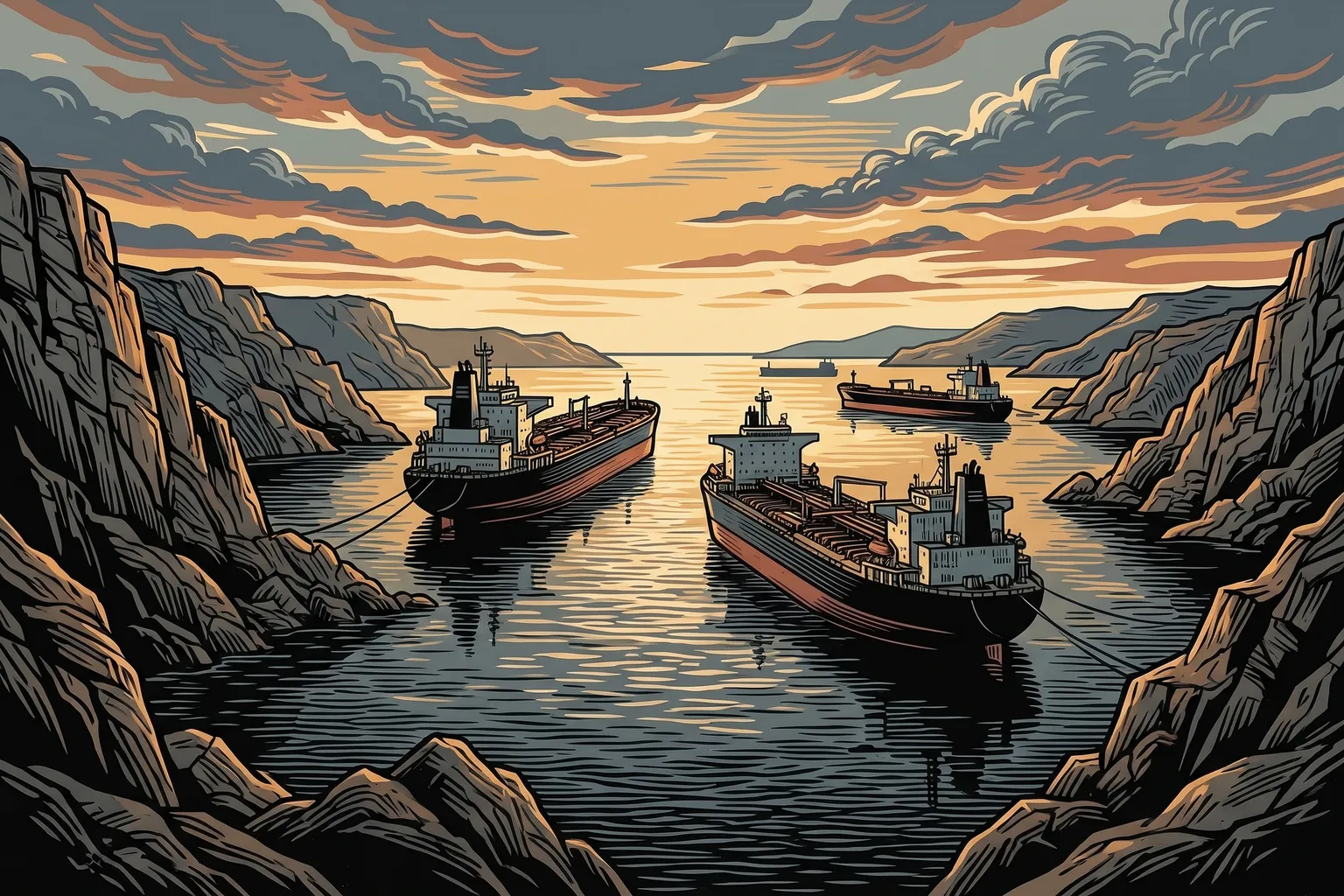
Brent crude fell more than 8 percent on Wednesday, the day after Democratic victories in the House and Senate. Markets read the results as an increased likelihood that the administration would pursue a negotiated end to the conflict with Iran, which would reopen the Strait of Hormuz and restore the flow of roughly 20 percent of the world’s oil supply that moves through it. Brent dropped to its lowest level since August.
By Thursday it was heading the other way. CBS News’s live update on Friday morning carried this headline: more ships attacked in the Persian Gulf, oil prices rebound slightly after post-midterm plunge. West Texas Intermediate was holding at about $90.50 a barrel on Friday morning, according to FXStreet. That’s roughly 35 percent above where crude was trading before the conflict began in February (Barchart), when U.S. and Israeli strikes killed Supreme Leader Ali Khamenei.
Iran’s Revolutionary Guard claimed Thursday that its forces brought down two American MQM-170 reconnaissance drones over Qeshm Island using electronic warfare systems, bringing Iran’s total claimed tally of downed U.S. drones during the conflict to more than 70 (Press TV). A U.S. official disputed the claim. The pattern has been consistent through the conflict: Iran announces downed drones, the U.S. disputes it, and the numbers on each side bear little resemblance to each other. What isn’t in dispute is that the Strait of Hormuz remains a contested zone and that tankers are still taking fire.
Trump told the Financial Times on Tuesday that he has no immediate plans to order new strikes on Iran. He also said that if Iran doesn’t make a deal, the United States is “definitely ready to finish the job.” Qatar is seeking backing for a draft agreement that could restart negotiations within days, according to Gulf News. Vice President Vance has been pushing internally for a negotiated settlement.
The 1973 Arab oil embargo is the standard reference point for Middle Eastern conflict and energy prices, and in one respect the analogy fits: when OPEC cut production in October 1973, oil prices quadrupled from roughly $3 to nearly $12 a barrel within months, and the disruption ran long enough to reshape American energy policy for a generation. Congress passed the 55-mile-per-hour speed limit. The Strategic Petroleum Reserve was created in 1975 specifically because of what 1973 demonstrated about supply concentration risk. The more precise comparison for traders right now may be January 1991, when the Gulf War air campaign started and Brent fell roughly $10 a barrel in a week because markets decided the war would be short. That calculation proved correct. The question today is whether markets are right that this one is ending. They were pricing it that way on Wednesday. By Friday, they weren’t so sure.
(CBS News has been tracking the Iran war and its economic consequences. Gulf News reported Thursday on the diplomatic picture and WTI price movements.)
One of the two uncalled Senate races from Tuesday has been resolved.
Sen. Cindy Hyde-Smith won the Mississippi Senate race, news organizations reported Thursday, as remaining vote counts confirmed her lead over Democrat Scott Colom. The race had been too close to call on election night, with a margin that shifted between dozens and roughly a thousand votes depending on which counties had reported at a given moment. It resolved in Hyde-Smith’s favor as affidavit ballots and outstanding precincts were counted. Mississippi hasn’t elected a Democrat to the Senate since 1982. That was John Stennis, who first won the seat in 1947. The race Colom ran was the closest Democrats have come in this state in more than four decades.
Alaska remains uncalled. Democrat Mary Peltola held a lead over Republican incumbent Dan Sullivan in early returns, but Alaska’s vote count takes weeks. In 2022, the state’s Senate race wasn’t called until November 23. Election officials have described the extended timeline as standard practice. The race will get called when there are enough counted ballots to call it.
France held a nationwide general strike on Thursday. Five major union confederations called the action jointly: the CGT, CFDT, FO, UNSA, and FSU, citing wages, pensions, budget cuts, and the cost of living. France’s four main rail unions added their own call, disrupting TGV, intercity, and regional train service across the country. Schools and public services were also affected.
The strike came after a meeting between the unions and Prime Minister Sebastien Lecornu on October 21 ended without an agreement. Sophie Binet, the CGT’s general secretary, said the unions left disappointed and called for November 5 to go further than a one-day action. In Lyon, police used tear gas after demonstrators clashed with officers, according to Anadolu Agency’s Friday morning report. Large marches were reported in Paris and other cities.
What the unions are demanding isn’t complicated: higher wages, protection of pension benefits, and a reversal of budget cuts that they say fall hardest on public services. Those are the same demands that drove the gilets jaunes movement of 2018 and 2019, which began as a protest against a diesel fuel tax and grew into a months-long mobilization that pulled in workers, students, and rural communities together. That movement remained largely outside union structures. November 5 was explicitly union-coordinated, which puts it closer to the 2023 pension reform protests that drew more than a million people on their peak days. Those protests ultimately failed to stop the reform. What they demonstrated is that France’s threshold for large-scale labor action is lower than it looks from the outside, and that the gap between a one-day strike and an extended mobilization depends almost entirely on whether the government makes any move toward the unions in the days after.
(Euronews covered the unions’ decision to call the November 5 action.)
Passenger flights across Europe faced a new round of suspected bomb threats on Thursday and Friday. Anadolu Agency’s Friday morning briefing reported at least 18 affected flights. No devices were found. An EU transport official said it was too early to determine whether the threats were linked. This follows a wave that struck at least seven European flights on November 3, also with no devices found, affecting flights to and from London, Manchester, Sofia, Warsaw, and Rome (La Voce di New York), among other cities. Some of those flights were escorted by military jets. Passengers were evacuated at several airports for security searches.
Investigators haven’t publicly identified any suspects or determined whether the threats originate from a single source. Security officials in several countries have described the pattern as consistent with low-cost disruption tactics, in which the goal is economic and logistical disruption rather than actual violence. The November 3 wave alone affected hundreds of passengers. The scale this week, across multiple countries and multiple days, has prompted calls within the EU for a coordinated response.
(ITV News covered the November 3 bomb threat wave across European airports.)
Something good.
On October 30, the World Health Organization announced that Barbados has eliminated mother-to-child transmission of HIV as a public health problem. The Pan American Health Organization, which oversaw the certification process, confirmed that no new HIV infections from mother to child were recorded among infants born in Barbados in 2022, 2023, or 2024.
Barbados is now the 23rd country or territory in the world certified for this achievement. Fifteen of those 23 are in the Americas. The program that got Barbados to this point isn’t complicated in concept: free HIV testing and treatment for all pregnant women, early infant testing, and consistent follow-up care for exposed children. A pregnant woman with HIV who receives antiretroviral medication during pregnancy and delivery, and whose infant receives preventive treatment, can reduce the transmission rate to under 1 percent. That science has existed for decades. Cuba became the first country certified by WHO for eliminating mother-to-child HIV transmission in 2015. Since then, the program has expanded across the Caribbean, Latin America, and beyond. What the certification measures isn’t a scientific breakthrough. It measures whether a country has built the sustained health infrastructure to consistently apply what is already known.
Barbados did that. Officials said maintaining the status requires continued investment, updated guidelines, and stronger health information systems. The work isn’t finished. What the numbers from 2022 through 2024 show is that for children born during those three years, the gap between what was possible and what actually happened is zero. That’s what an infrastructure does. It closes the gap.
(The Pan American Health Organization announced the certification on October 30, 2026.)
Howard Fenn writes The Day, Monday through Saturday.