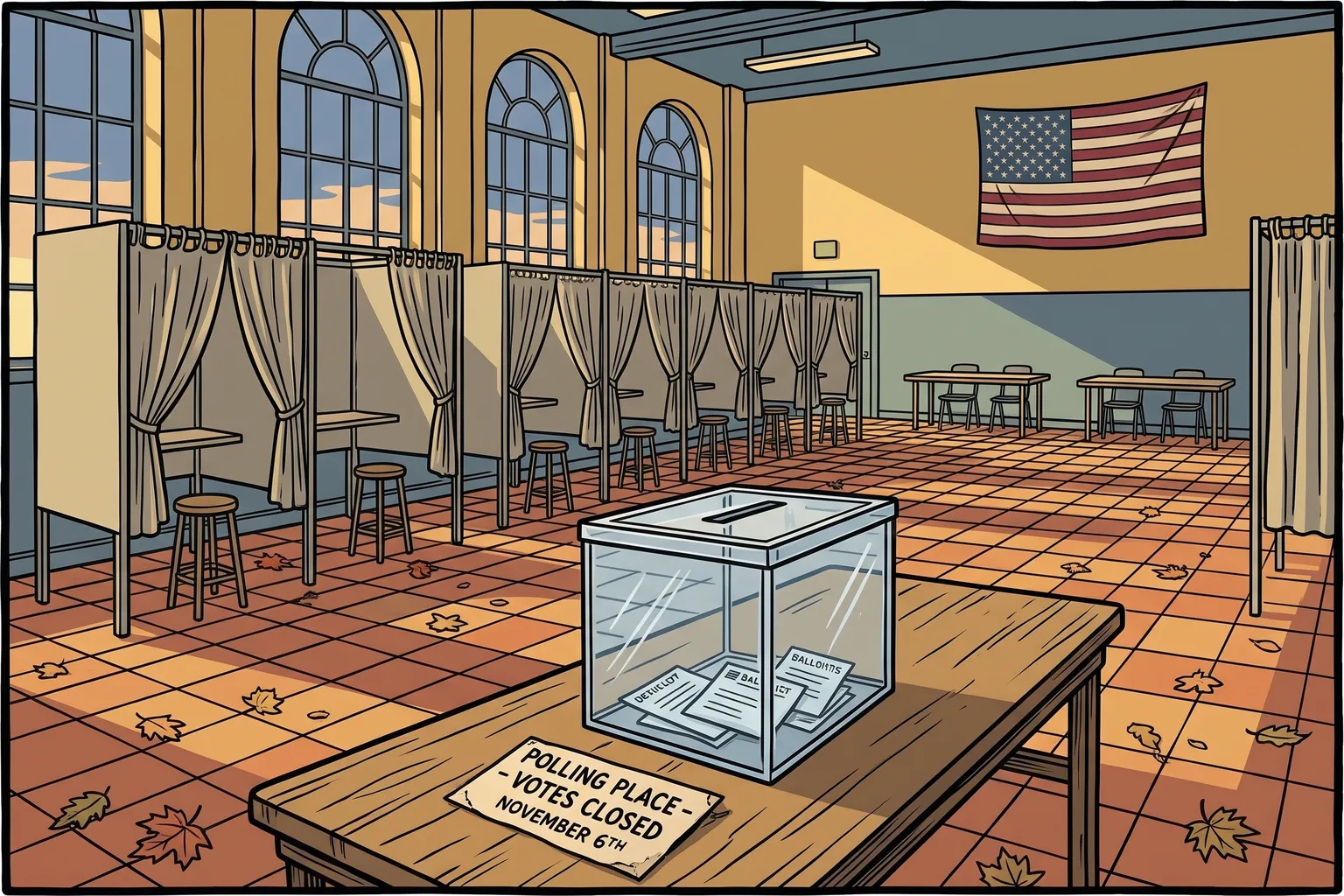
The Associated Press called the House of Representatives for Democrats in the early hours of Wednesday morning, and by the time most of the country woke up, the shape of the next Congress was clear. Democrats will control both chambers when the 120th Congress convenes in January.
The Senate was called first. Republicans had held it 53 to 47 going into Tuesday. Democrats needed a net gain of four seats to take the majority. By midnight, the AP and major networks had called enough races to put them there. Among the seats that changed hands: Maine, where Democrat Troy Jackson defeated incumbent Susan Collins, who had held the seat since January 1997. Iowa, where Democrat Josh Turek beat Republican Ashley Hinson for the seat Joni Ernst vacated after announcing her retirement. Ohio, where former Senator Sherrod Brown, who lost his seat in 2024, returned to win the state’s other Senate seat in 2026. North Carolina, where former Governor Roy Cooper defeated Republican Michael Whatley. Texas, where Democrat James Talarico became the first Democrat elected to the Senate from Texas since Lloyd Bentsen won reelection in 1988.
Additional races were called through the night, and several Senate and House contests hadn’t been called as of early Wednesday morning. The final seat count in both chambers was still being tabulated. An early projection from one outlet estimated Democrats would win at least 245 House seats out of 435; the AP hadn’t confirmed that figure as of this column’s filing. Numbers in close districts will continue to come in through the week.
Since 1946, every midterm election has cost the president’s party seats in the House. The two exceptions were in 1998 and 2002. In 1998, Democrats gained five House seats as voters responded to the Republican-led impeachment of President Clinton. In 2002, fourteen months after the September 11 attacks, Republicans gained eight House seats on the strength of approval ratings that were still near historic highs. Each of those exceptions had a specific, identifiable driver.
Turnout had already set records before Election Day arrived. More than 53 million Americans voted early. Texas passed 7.7 million early ballots. Minnesota set a midterm early-voting record as of October 29. Final national turnout figures won’t be certified for weeks, but the early indicators pointed toward one of the higher-participation midterms on record. (CBS News and the Associated Press tracked Election Night results live.)
On Election Day, President Trump announced in a Fox News interview that the United States will stop providing Israel with its annual military aid by the end of 2026 (Source). Trump said he and Prime Minister Netanyahu had worked out the arrangement months ago, and that Israel no longer needs the payments. He described it as a voluntary transition that the two leaders had agreed to together.
The aid in question totals approximately $4 billion annually and is governed by a memorandum of understanding signed in 2016 that runs through fiscal year 2028 (Source). The memorandum was designed to provide Israel with predictable, multi-year security assistance commitments. It was negotiated by the Obama administration and carried forward under subsequent administrations without interruption.
The constraint on Trump’s announcement is a straightforward one: Congress appropriates the money. The executive branch does not have unilateral authority to end congressionally appropriated military aid. Legal analysts quoted in coverage of the announcement noted that any actual cutoff would require congressional action, and that the existing framework doesn’t expire until 2028. The Republican Jewish Coalition said the transition away from foreign military assistance wasn’t unexpected. Critics argued Israel’s security interests would be harmed. Netanyahu’s office didn’t immediately respond to major media requests for comment on the terms of the arrangement Trump described.
The timing of the announcement, on a day when voters in several competitive congressional districts were deciding House races in which Israel policy had been an issue, was noted but not explained by the White House. (ABC News reported on the announcement.)
A billboard appeared in Enghelab Square in central Tehran on Tuesday reading “We will kill Trump.” It shows President Trump behind prison bars with his head bowed. A second nearby billboard depicts Trump alongside Vice President JD Vance, special envoy Steve Witkoff, and Prime Minister Netanyahu, all with bloodied faces.
Billboards and murals with messaging aimed at American and Israeli leaders have been a fixture of Iranian public spaces since the Islamic Revolution in 1979. The state has long used them to signal political commitments to both domestic and foreign audiences. The displays have increased in frequency since February 28, when U.S. and Israeli strikes killed Supreme Leader Ali Khamenei and the ongoing conflict with Iran began.
What makes Tuesday’s billboard notable is the context in which it appeared. Indirect diplomatic contacts between Washington and Tehran were described by both governments as ongoing. Trump told reporters last week the talks were “going fine.” Vice President Vance said no deadline had been set and that any deal would require Iran to commit to not reviving its nuclear program. Iran’s foreign ministry said a framework proposal was “condensed and can be implemented within two days.” Qatar and Pakistan are facilitating.
A government that is simultaneously pursuing a ceasefire framework and erecting threats to the American president’s life in a central public square is communicating something complicated. What exactly that is, is worth watching. (IBTimes and Tribune Online covered the Enghelab Square billboard.)
Russian forces struck a humanitarian aid distribution site in the Zaporizhzhia region of Ukraine on Monday, killing at least 31 people (Source). Dozens more were still missing as of early Wednesday, buried under rubble. The dead included four police officers and two rescue workers. President Zelensky said in a public address that 50 people remained trapped.
The attack was part of a broader overnight campaign that Ukrainian officials said involved 289 attack drones, 17 ballistic missiles, and 59 cruise missiles across nine regions. Power was knocked out for roughly 370,000 people. In the Dnipro area, one person was killed and 17 were wounded. Ukraine’s energy ministry reported strikes on electrical infrastructure in ten regions.
The bombing came as Russian and U.S. officials were framing the week before the Abu Dhabi talks as a diplomatic moment. U.S. envoy Steve Witkoff announced those talks on Monday for November 10 and 11. The agenda covers post-war security arrangements, de-escalation, and humanitarian issues. American diplomats also planned meetings this week in Brussels with representatives from France, Germany, the United Kingdom, the European Union, and NATO on Ukraine’s postwar reconstruction (Source).
The armistice talks that ended the Korean War ran from July 1951 to July 1953. Fighting continued on the peninsula throughout. An agreement to show up and negotiate has never been the same thing as an agreement to stop. The question heading into Abu Dhabi is the same question that has stalled every version of this negotiation: whether either party arrives with terms the other can accept. The signals from Moscow before Tuesday’s bombardment were mixed. The bombardment itself was not. (PBS NewsHour and ABC News reported on the Ukrainian aid site strike.)
Something good.
On Monday, November 2, Karl Bushby arrived at his mother’s house in Hull, in northern England. He had been walking since November 1998. Twenty-eight years. Roughly 50,000 kilometers. The route went from the southern tip of South America, north through the Americas, across the Bering Strait on foot during winter, through Russia and across Europe, and home to Hull.
Bushby, 57, is a former British paratrooper. He set out with two rules: use no form of transport to move forward, and don’t come home until it’s finished. He kept both. He was detained by Russian authorities at one point. He kept going. A crowd packed Hull’s city centre to watch him walk the last stretch on Monday morning. Hull Mayor Maria Coward called it an incredible achievement and said the city took pride in what he had done.
Filmmaker Werner Herzog followed Bushby’s final months for a documentary called “Walk of Life.”
Bushby told reporters he had mixed feelings at the finish. The world he left in 1998 isn’t the world he returned to. He isn’t the person who left it, either. Twenty-eight years of walking will do that.
The feat has no practical application. It solved no problem and produced no product. It was a man who said he would do something extraordinary, and then did it, one step at a time, without stopping, for twenty-eight years, until he was done.
That’s something. (Al Jazeera and NBC News reported on Bushby’s arrival in Hull.)
Howard Fenn writes The Day, Monday through Saturday.