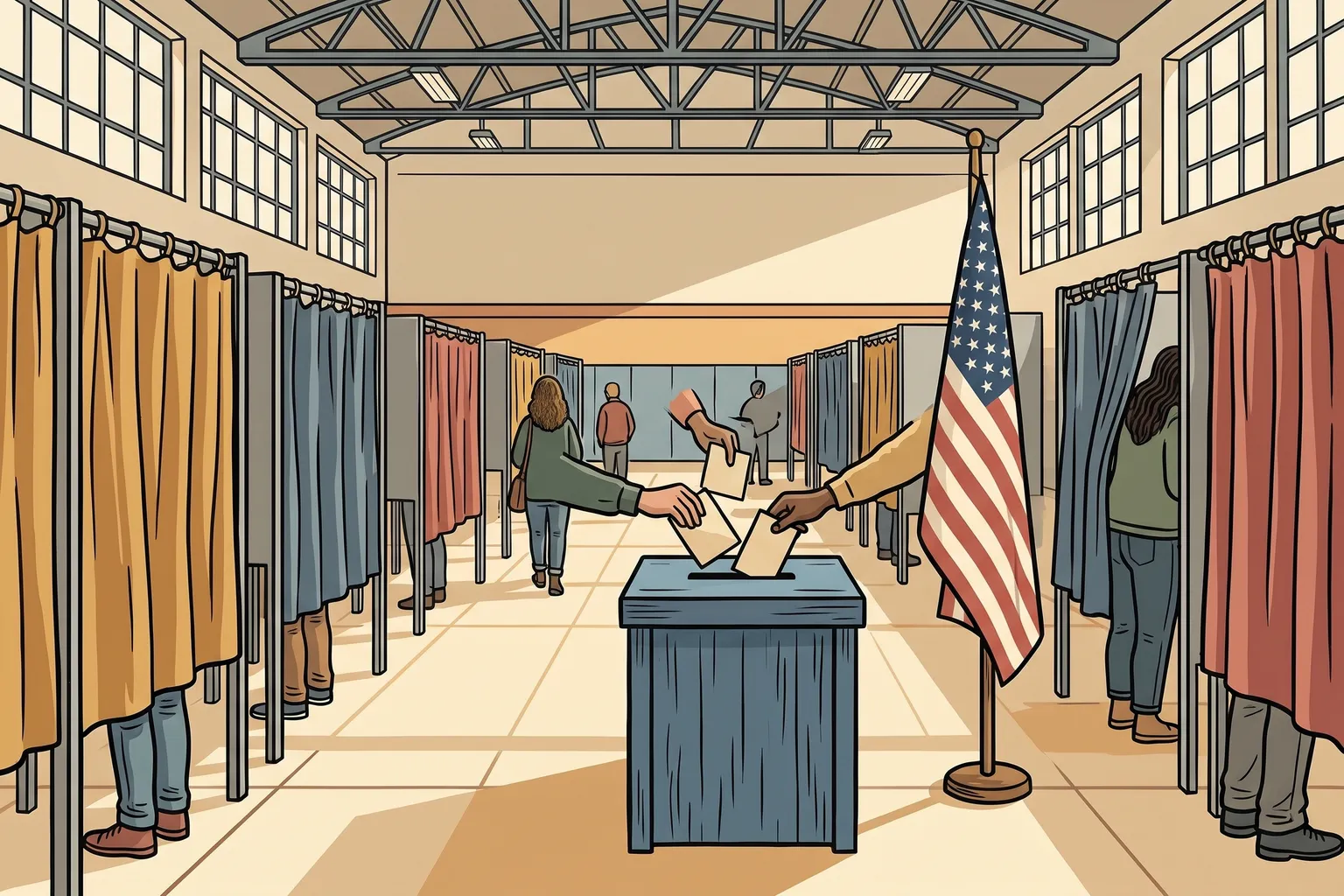
Polls are open across the United States today. All 435 seats in the House of Representatives are on the ballot, along with 35 Senate races, a number of gubernatorial contests, and hundreds of state legislative seats. In several states, voters are also deciding ballot measures on abortion access, minimum wage, and state constitutional amendments. This is how the country does it: at gyms and churches and public library meeting rooms, one person at a time, on the first Tuesday after the first Monday in November.
More than 53 million Americans cast ballots before today. A University of Florida analysis tracking early votes through Sunday put the national total at 53.14 million out of approximately 210 million registered voters. A separate tracker reported 54.5 million ballots across 47 reporting states by Monday evening, with 26.2 million returned by mail and 28.3 million cast in person at early voting sites. Texas set a state record: more than 7.7 million early ballots at a 40.5 percent turnout rate, according to preliminary figures from the Texas Tribune, topping the state’s 2018 midterm high. Ohio passed 1.7 million early ballots, above the 1.46 million cast during the early period four years ago. Kansas reported early voting up 34 percent from the same point in 2022.
The Senate is the chamber where control is most genuinely in question. Republicans hold it 53 to 47. Democrats need a net gain of four seats. Analysts have rated Michigan, Maine, Georgia, and Iowa among the most competitive. Maine’s Susan Collins is running in a state Kamala Harris carried in 2024 (Source). Michigan pits Democrat Abdul El-Sayed against Republican Mike Rogers, a seat that last changed hands in 1978 (Source). Georgia’s Jon Ossoff is in a competitive reelection in a state that determined Senate control in its January 2021 runoffs (Source). In the House, Republicans hold a narrow majority. Decision Desk HQ’s final model gave Democrats an 84 percent chance of winning the House and a 64 percent chance of winning the Senate. Silver Bulletin’s model put Democratic House odds at roughly 95 percent.
Those are probabilities. Today is when the actual numbers are counted.
The weather in parts of the Southwest was making things harder this morning. Heavy rain and flash flooding in areas of Colorado, Arizona, and New Mexico made it harder to reach some polling places, the Associated Press reported. Election officials in affected counties said they were monitoring conditions. No widespread polling-place closures had been announced as of mid-morning.
Since 1946, every midterm election has cost the president’s party seats in the House, with two exceptions. In 1998, voters responding to the Republican-led impeachment of President Clinton gave Democrats a net gain of five House seats. In 2002, fourteen months after September 11, Republicans gained eight seats on the strength of approval ratings that were still near historic highs. Whether 2026 joins the pattern or becomes a third exception is a question that’ll begin to have an answer later tonight. (ABC News and the Associated Press are providing live Election Day updates.)
The Justice Department is sending approximately 1,000 monitors to polling places in all 50 states today. That’s the broadest federal election monitoring deployment in modern midterm history.
The announcement came in August from Harmeet Dhillon, head of the DOJ’s Civil Rights Division, who said monitors would go to jurisdictions with concerns about language access, disability access, or voter fraud. In the 2024 general election, the department sent monitors to 86 jurisdictions across 27 states. The difference in scale between that deployment and today’s is substantial. Specific jurisdictions have been notified in advance. Pennsylvania officials were told that counties including Philadelphia, Allegheny, Luzerne, and Lehigh would have monitors at polling places. Maine’s Secretary of State confirmed monitors in South Portland, Lewiston, and Portland. Iowa officials announced DOJ poll watchers statewide.
The monitors are civil rights attorneys. They’re instructed to observe and report. They can’t enter most polling places under state law, and they don’t have authority to intervene in the voting process. Campaign Legal Center distributed factsheets in October explaining those limits and noting that states retain their own observer regulations.
Federal authority to monitor elections goes back to the Voting Rights Act of 1965, which authorized the DOJ to send observers to jurisdictions with documented histories of discrimination. That program was designed with a specific and narrow target. A deployment covering all 50 states is something different in both scale and rationale, and the questions it raises about federal authority, state control, and the proper role of DOJ attorneys at polling places aren’t questions with settled answers today. (NewsOne and the Washington Examiner both reported on the monitor deployment and the responses to it.)
The United States and Iran remain in indirect talks with no agreement and no ceasefire holding. The central obstacle hasn’t moved.
Tehran is pushing for a compressed timeline. Iran’s foreign ministry spokesman said this week the current proposal was “condensed and can be implemented within two days,” down from a seven-day framework in earlier drafts. The terms include reopening the Strait of Hormuz, lifting the U.S. naval blockade, repealing sanctions, guaranteeing an end to American strikes, and achieving a broader regional ceasefire. Qatar and Pakistan have been facilitating the indirect contacts. Trump told reporters the talks were “going fine.” Vice President Vance said no deadline had been set and that any deal would require Iran to commit to not reviving its nuclear program.
Iran has publicly refused to include its nuclear program in the current negotiations. That is where the talks have been stuck.
The 2015 Joint Comprehensive Plan of Action, negotiated under the Obama administration, was built around Iran accepting enrichment limits and inspections in exchange for sanctions relief. The U.S. withdrew from it in 2018. Since then, Iran has steadily expanded its enrichment capacity, and there has been no functioning nuclear accord between Iran and the West. Whether the current talks end in a framework that addresses the nuclear question or produce only a temporary pause while the underlying issue stays unresolved is the central question. It’s the same question that has stalled every version of this negotiation for years. (Al Jazeera and CBS News reported on the state of the Iran talks.)
The next round of trilateral U.S.-Russia-Ukraine peace talks is scheduled for Abu Dhabi on November 10 and 11. U.S. envoy Steve Witkoff announced the dates on Monday, saying the sessions would cover post-war security arrangements, de-escalation, and humanitarian issues. American diplomats are also planning meetings in Brussels this week with representatives from France, Germany, the United Kingdom, the European Union, and NATO on the question of security guarantees for Ukraine.
The announcement came while Russian forces were still striking Ukrainian cities. Zelensky’s office said Monday that Ukrainian intelligence had assessed a large-scale Russian strike on energy and logistics infrastructure was being planned. Russian attacks killed 26 people over the weekend before what the Russian government was framing as a diplomatic week. Zelensky said Ukraine was ready for a deal, and that Ukraine had to be at the table for any negotiation over its territory and future. Russia’s apparent concession heading into November 10 is agreeing to show up.
The Korean War armistice talks at Kaesong and Panmunjom ran from July 1951 to July 1953 while fighting continued on the peninsula (Source). Wartime negotiating sessions and active combat aren’t mutually exclusive, and they weren’t then either. An agreement to negotiate isn’t an agreement to stop fighting. Whether the Abu Dhabi sessions produce anything different from the prior rounds depends on whether either party arrives with terms the other can accept. The signals from Moscow on that question have been mixed at best. (The National News and Axios reported on the Abu Dhabi talks announcement.)
Something good.
On October 22, Allegheny County Executive Sara Innamorato signed an ordinance that makes Allegheny County, which includes Pittsburgh and about 1.2 million residents, the first county in the United States to require paid parental leave countywide.
The Allegheny County Council voted 11 to 4 to pass the measure. Under the law, employers with 15 or more workers must provide 12 weeks of paid parental leave to both birthing and non-birthing parents in the first year after a birth, adoption, foster placement, or stillbirth. The ordinance takes effect one year from signing, giving businesses time to adjust.
The campaign that got it there was led largely by nurses at a Pittsburgh hospital who were bargaining for their first contract. They organized. They showed up at council meetings. They testified. The council voted. The county executive signed it.
The United States has no federal paid parental leave requirement. The Family and Medical Leave Act of 1993 guarantees 12 weeks of unpaid, job-protected leave for eligible workers. That law passed the Senate 71 to 27 and was signed by President Clinton. In the 33 years since, Congress hasn’t passed a paid parental leave mandate. States have moved. Cities have moved. Now a county in western Pennsylvania has moved, and it’s the first county in the country to do it. Sometimes that’s how policy changes: not from the top, but from the place where someone decided not to wait. (HRDive and Good Good Good reported the Allegheny County ordinance and the campaign behind it.)
Howard Fenn writes The Day, Monday through Saturday.