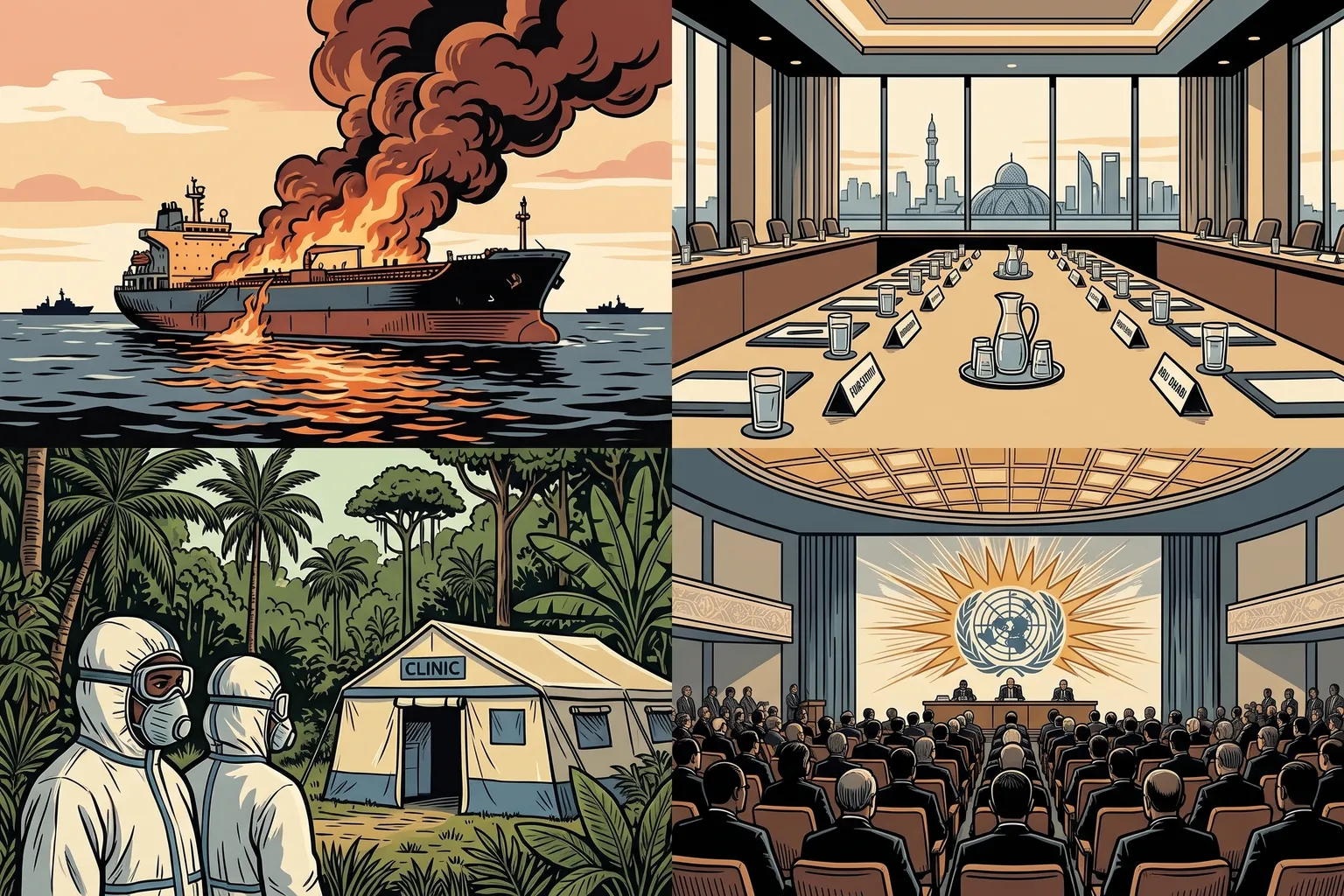
The fourth round of US-brokered peace talks between Russia and Ukraine concluded in Abu Dhabi on Wednesday with an agreement to conduct a large prisoner-of-war exchange, the most concrete result to emerge from two days of meetings.
Vladimir Medinsky, the head of Russia’s delegation, confirmed the exchange agreement and said negotiators had made progress on “practical matters,” including mechanisms to monitor a ceasefire, though no ceasefire was reached. Medinsky said “some issues had mutual understanding” and that additional talks would follow. Ukraine’s side called the swap the main outcome of the session.
A Russian General Staff official said the exchange could be among the largest of the conflict and could happen within two to three weeks. The exact scale hasn’t been confirmed by both sides.
US envoys Steve Witkoff and Jared Kushner, who led the American mediation team, were preparing to travel to Moscow. Kushner said they would travel on Thursday to meet with Russian President Vladimir Putin.
An earlier Abu Dhabi round, in February, produced a swap of 314 prisoners, 157 from each side. The pattern of these rounds has been consistent. Each one ends with a prisoner exchange and a commitment to more talks. The ceasefire that both sides say is the goal hasn’t materialized. What’s changed between February and now is the scale of the fighting, the shape of the front lines, and the composition of the American delegation. What hasn’t changed is the distance between Russia’s demand for territorial recognition and Ukraine’s refusal to provide it.
Iran’s Revolutionary Guard Corps said Wednesday that two tankers carrying more than four million barrels of oil caught fire after what it described as an “accident” on an unauthorized route in the Strait of Hormuz. The British maritime monitoring center reported something different: a vessel was hit by a projectile in the eastern strait on Tuesday evening. Those two accounts aren’t reconcilable.
The Strait of Hormuz is 21 miles wide at its narrowest point. Roughly 20 percent of the world’s oil moves through it in ordinary times. Iran has effectively blocked commercial tanker traffic through lanes it doesn’t control since August. That blockage is what the United States’ Operation Economic Outcast, its sanctions campaign on Tehran, is designed to force open.
Treasury Secretary Scott Bessent and his family moved to a military base in recent weeks because of threats from Iran, the New York Times first reported, confirmed by ABC News and others. A Treasury spokesman said Bessent “will not be deterred” and remains committed to the pressure campaign. He isn’t the first cabinet officer to make this move. Defense Secretary Pete Hegseth and Secretary of State Marco Rubio live on military bases as well. Iran’s state media has posted a video targeting Bessent specifically.
In the 1980s Tanker War, Iranian and Iraqi forces attacked more than 450 ships in the Persian Gulf between 1984 and 1988. By 1987, the United States was reflagging Kuwaiti tankers as American vessels and providing naval escorts under Operation Earnest Will. The basic geometry is similar now: shipping lanes as a pressure point, military assets as the response, and a question about where the escalation ends.
(CNBC reported Bessent’s relocation on November 11.)
Democrat Scott Colom was projected the winner of the Mississippi Senate race Wednesday, defeating Republican incumbent Cindy Hyde-Smith in one of the more improbable results of the midterm cycle.
NBC News and CBS News both projected Colom the winner after Hyde-Smith called Colom to concede. With an estimated 99 percent of votes counted, Colom led Hyde-Smith 49.18 to 48.72 percent. The race was decided by roughly 4,400 votes at the point of projection. Mississippi must certify the result by November 13.
Colom is the first Democrat elected to the United States Senate from Mississippi since 1982. He would be the first Black senator from Mississippi since Reconstruction. The state’s last two Black senators were Hiram Revels, who served in 1870 and 1871, and Blanche Bruce, who served from 1875 to 1881. Both were elected during the federal occupation of the South after the Civil War. Both were Republicans. The Democratic Party of Hiram Revels’s Mississippi and the Democratic Party of Scott Colom’s Mississippi aren’t the same institution, but the name is the same.
His projected win gives Democrats at least 55 Senate seats in the next Congress, pending the Alaska result. Democrats haven’t held more Senate seats since 2009 and 2010, when the party’s supermajority made it possible to pass the Affordable Care Act.
(NBC News projected Colom’s win and reported Hyde-Smith’s concession.)
The Ebola outbreak in the Democratic Republic of the Congo has reached 10,990 confirmed cases and 5,354 confirmed deaths, according to CDC figures from November 8. It’s the second-largest Ebola outbreak ever recorded.
The only larger one was the 2014-2016 epidemic across West Africa, which produced 28,616 cases and 11,310 deaths in Guinea, Liberia and Sierra Leone. This outbreak, caused by the Bundibugyo strain of the virus, surpassed the previous DRC record, the 2018-2020 Kivu epidemic’s 3,470 cases, in its first 76 days. There’s no approved vaccine or treatment specifically for the Bundibugyo strain. The epicenter is Ituri province, which accounts for roughly 84 percent of reported cases. The World Health Organization declared a public health emergency of international concern in May.
Containment has been disrupted by repeated attacks on health workers and facilities. A UN OCHA update from November 6 described civilians fleeing an Ebola observation center in North Kivu after an armed attack in the area, with response teams forced to suspend operations. The Red Cross has counted more than 260 attacks on health workers in the DRC over six months. Eight workers have been killed.
The public health architecture that holds in a stable country is harder to operate in eastern Congo, where multiple armed groups have been fighting for years, where health workers travel into contested territory, and where distrust of outside responders has accumulated over decades. The 2018-2020 DRC outbreak was the first in which a WHO emergency was declared during active conflict. This one is the second.
(The CDC’s Ebola situation summary was updated November 8.)
The COP31 World Leaders’ Summit is meeting in Antalya, Turkey today, the second day of the two-day session for heads of state and government. About 102 leaders are expected. The broader climate conference runs through November 20.
The United States isn’t among them. The Trump administration formally withdrew from the Paris Agreement at the start of this year and hasn’t sent an official delegation to COP31.
This summit falls a week after the tenth anniversary of the Paris Agreement’s entry into force. When the agreement entered into force on November 4, 2016, more than 55 countries representing more than 55 percent of global emissions had ratified it. The goal was to limit warming to 1.5 degrees Celsius above pre-industrial levels. That threshold has since been crossed. The central argument at COP31 isn’t about whether the target will be met. It’s about climate finance: how much money wealthy nations will commit to help developing ones adapt, and who controls how that money moves. At COP29 in Baku in 2024, the agreed figure was $300 billion annually by 2035. Developing nations said then that it wasn’t enough. They’re making the same argument here.
(The United Nations’ COP31 page and NBC News covered the summit and the US withdrawal.)
Something good.
On November 2, the FDA granted tentative approval to the first generic version of lenacapavir, a twice-yearly injectable HIV prevention drug. The generic is expected to cost about $40 per person per year. The brand-name version is priced considerably higher in the United States.
Tentative approval means the generic can’t be sold in the US while the brand-name patent holds, but it makes the product eligible for purchase by the US government for distribution abroad, and it clears the path for use in the 120 lower-income countries where the drug is targeted. A major clinical trial found lenacapavir reduced HIV infection risk by 96 percent. The first generic supplies are expected to reach some countries by the end of this year.
A twice-yearly injection removes the daily pill requirement that has historically been one of the biggest barriers to consistent HIV prevention, particularly in places where stigma or logistical access make daily adherence difficult to sustain. PEPFAR’s scale-up of AIDS treatment in the early 2000s relied on FDA tentative approvals of generic antiretrovirals manufactured in India, which made the cost per patient accessible at a scale that hadn’t been possible before. The mechanism is the same now. An FDA approval doesn’t create the medicine. It creates the conditions for the medicine to reach the people who need it.
(Hawaii News Now and LGBTQ Nation reported the FDA’s tentative approval on November 2.)
Howard Fenn writes The Day, Monday through Saturday.