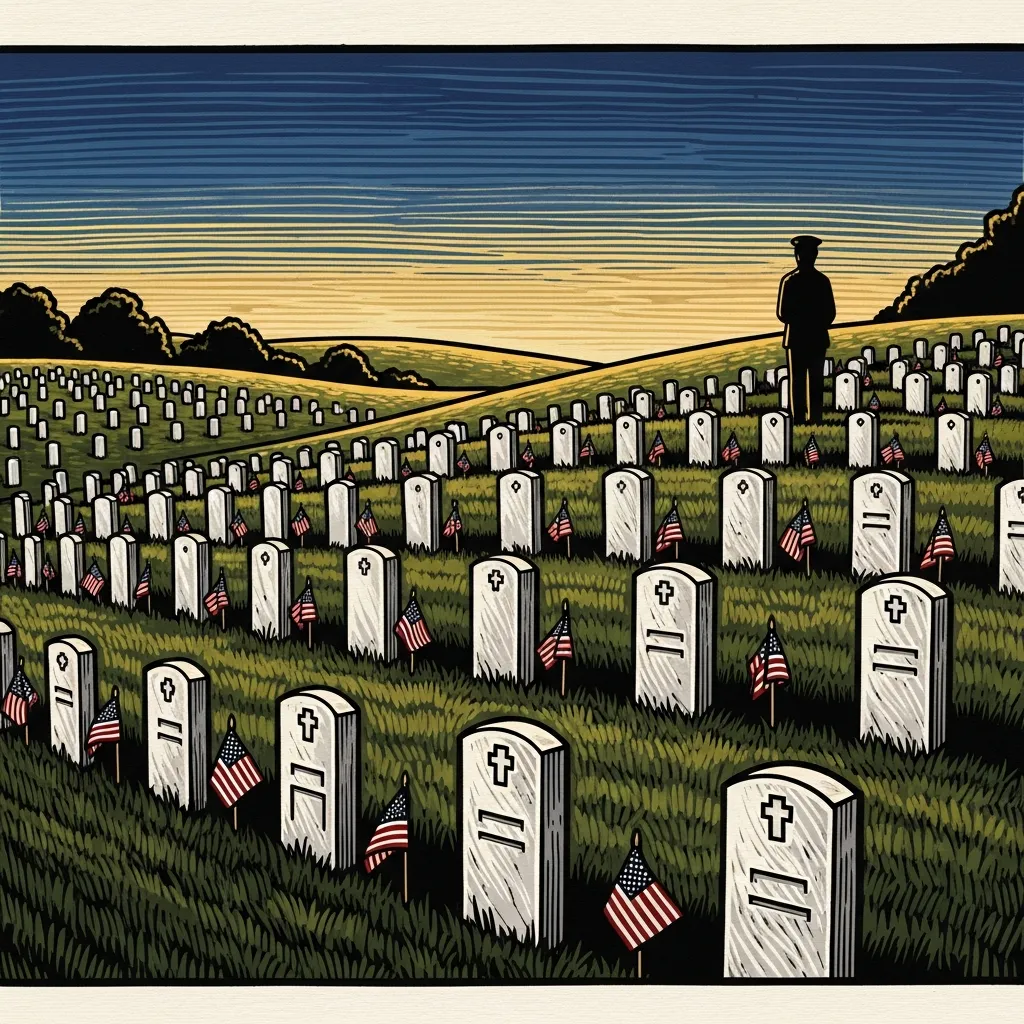
President Trump laid a wreath at the Tomb of the Unknown Soldier at Arlington National Cemetery this morning as the nation observed Memorial Day, the 158th national observance of a tradition that began in the aftermath of the Civil War. Vice President JD Vance, Defense Secretary Pete Hegseth, and Joint Chiefs Chairman Gen. Dan Caine stood with him at the Memorial Amphitheater. UPI covered the ceremony.
Speaking after the wreath-laying, Trump said: “With reverent hearts, we honor those who fell so that our republic might stand, those who died so that our nation could live, those who gave up their sacred light on earth so that the sublime light of American freedom would shine forever and ever.” Trump addressed the thirteen US service members killed during the Iran war over the last three months, calling them “incredible men and women.”
The first formal national observance came on May 30, 1868. Gen. John A. Logan, commander of the Grand Army of the Republic, issued a proclamation calling for flowers to be laid on the graves of Union soldiers who had died in the Civil War. Logan chose May 30 because flowers would be in bloom across the country by then. He called it Decoration Day and said he hoped it would be kept up from year to year.
Before Logan’s proclamation, others had already begun. On May 1, 1865, weeks after the Confederate surrender at Appomattox, freed Black residents of Charleston, South Carolina, exhumed the bodies of Union soldiers from a mass grave at a Confederate prison camp, gave them a proper burial, and held a ceremony above the graves. Historians have since identified that observance as one of the earliest Memorial Day commemorations on record. It was decades before it was widely acknowledged in histories of the holiday.
Decoration Day became Memorial Day after World War I, when Congress broadened it to honor the fallen from all American wars. It became a federal holiday in 1971, when the Uniform Monday Holiday Act moved the observance from May 30 to the last Monday in May. That change gave the country a three-day weekend. Whether it cost the day something is a question Americans have been arguing without resolution ever since.
On Sunday, hours before the Arlington ceremony, US Central Command reported what it called defensive strikes against Iranian targets in the Strait of Hormuz. US forces targeted Iranian missile launch sites and boats attempting to lay mines in the waterway. Trump said the ceasefire remains in effect, according to CBS News.
The strikes came hours after Iranian negotiators met with Qatari mediators in Doha for talks coordinated with Washington. US and Iranian officials are working toward a memorandum of understanding, but disputes over language concerning Iran’s nuclear program and sanctions have held up an agreement. CBS News reported that US officials say obstacles remain. The Strait of Hormuz remains effectively closed for most commercial shipping, with Iran limiting passage and charging reported fees exceeding one million dollars per vessel.
Prime Minister Benjamin Netanyahu announced Monday that Israel will intensify its operations against Hezbollah in Lebanon. Netanyahu said he had ordered “an even greater acceleration of our operations” and added: “We will intensify our blows, increase our firepower, and we will crush them.” US News reported the announcement came hours after Netanyahu’s phone call with Trump on Saturday night.
A draft of the potential US-Iran peace agreement, as reported by Axios and cited by multiple outlets Monday, includes language requiring an end to the Israel-Hezbollah fighting in Lebanon. Iran has made a Lebanon ceasefire a condition of any deal with Washington. After the Saturday call, Netanyahu said Trump “reiterated Israel’s right to defend itself against threats on all fronts, including in Lebanon.” At least 3,185 people have been killed and 9,633 wounded in Lebanon since the current fighting began, the Japan Times reported. How the US reconciles its commitments to Israel with the terms Iran is demanding is the central question in the region this week.
Iranian President Masoud Pezeshkian ordered the restoration of global internet access on Sunday, ending a blackout that had kept most Iranians cut off from the international web for approximately 87 days, Your News reported. Authorities had imposed the shutdown following protests tied to the February US and Israeli military strikes that launched the current conflict. It wasn’t clear how quickly access would be fully restored. Analysts told Your News that broader censorship measures are unlikely to be dismantled as part of the rollback.
Democrats heading into the midterm elections have been building their campaign around an anti-corruption message, and they’re running into a complication: members of their own party trade stocks. The Washington Post reported Sunday on a Democratic primary runoff in a Dallas-area congressional district where challenger Colin Allred has targeted Rep. Julie Johnson’s trades in companies including Palantir. Johnson’s response: “The sum total I made on that trade was only $90.” In California, Rep. Brad Sherman is facing primary challengers over his holdings. Sherman told the Post: “I only own three individual stocks which I inherited from my mother when she passed away.”
A bipartisan bill to ban congressional stock trading stalled this year despite receiving Trump’s endorsement during his State of the Union address. About 90 Democratic challengers and seven sitting Democratic lawmakers have signed a party pledge to stop trading stocks. None of the signers are Republicans. The dynamic is consistent with how this issue has moved for years: reform is more attractive in opposition than it is with a hand on the levers.
The inaugural Enhanced Games wrapped up over the weekend in Las Vegas, completing a one-night competition where athletes openly used performance-enhancing substances that are banned under Olympic and other major sports rules. Forty-two sprinters, swimmers, and weightlifters competed at Resorts World Las Vegas. Greek swimmer Kristian Gkolomeev beat the non-drug-assisted world record in the 50-meter freestyle. TEG reported twelve athletes broke personal records. NPR previewed the event Friday, noting the games are backed financially by Donald Trump Jr.’s venture capital firm and tech investor Peter Thiel.
Travis Tygart, CEO of the US Anti-Doping Agency, called the games “a dangerous clown show that puts profit over principle.” The International Olympic Committee described them as “a betrayal of everything that we stand for.” Organizers say the substances used must be FDA-approved and medically supervised, and that participation in the enhancement program isn’t mandatory. The games are scheduled to return.
And one more thing worth reading.
Glenn Suttner’s “Best Part Time Jobs for Retirees” publishes in Money tomorrow, a practical look at which jobs, pay ranges, and schedules fit people who want income without a full-time commitment.
It is Monday, Memorial Day. The US carried out fresh strikes in the Strait of Hormuz while negotiating with Iran, Israel pledged to intensify attacks in Lebanon as a draft peace deal would require a ceasefire there, Iran ended 87 days of internet blackout, Democrats were divided over stock trades ahead of the midterms, and Las Vegas hosted the first Enhanced Games. That’s the day.