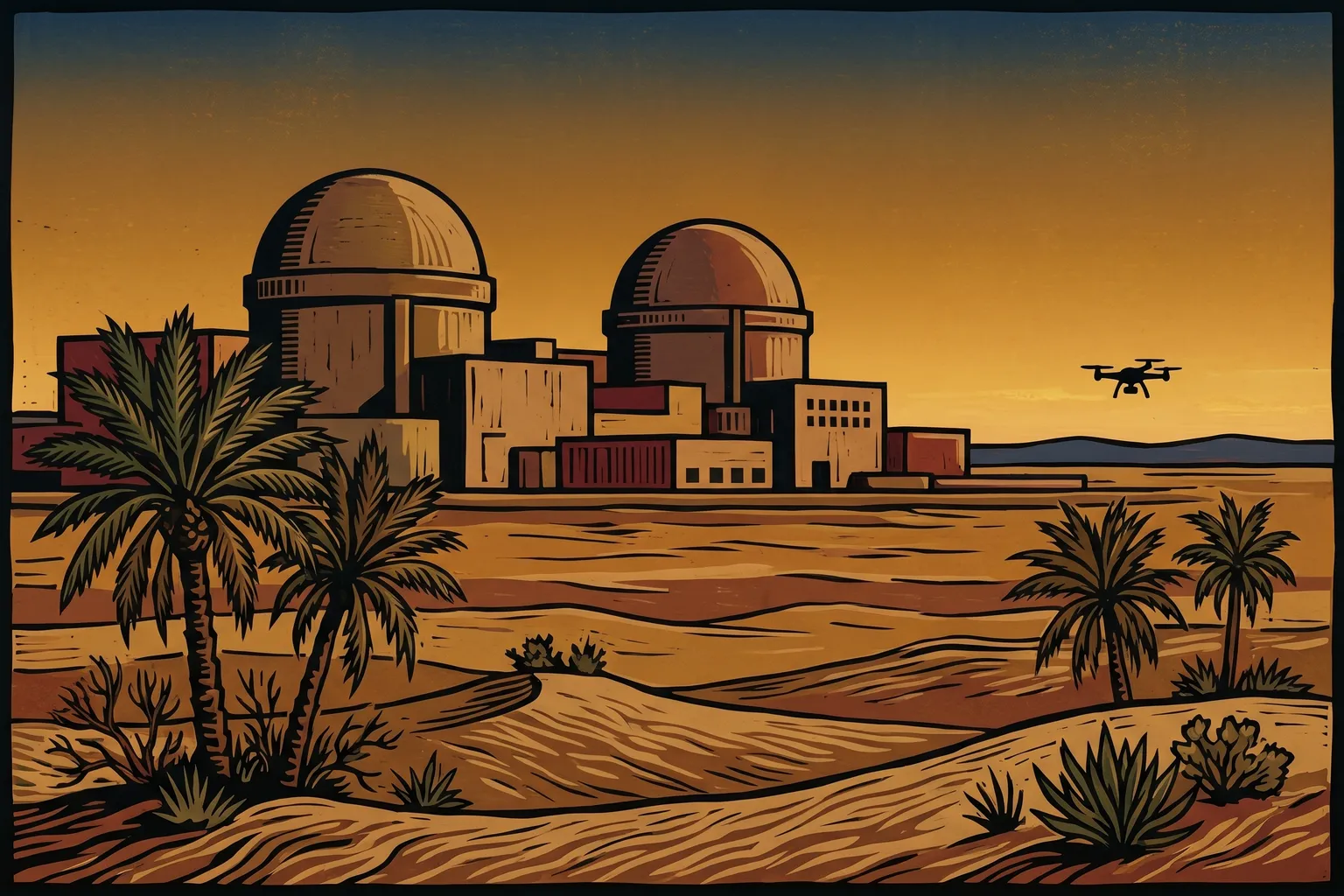
A drone struck the perimeter of the Barakah Nuclear Power Plant in Abu Dhabi on Monday, igniting a fire in an electrical generator and prompting an immediate response from UAE authorities. The National reported that three drones crossed into UAE airspace from the western border; two were intercepted, and one reached the facility. The UAE’s nuclear regulator confirmed that radiation levels remained normal, all four reactor units continued operating as expected, and no injuries occurred.
The International Atomic Energy Agency expressed grave concern about military activity targeting civilian nuclear infrastructure, calling on all parties to avoid strikes that could compromise the safety of nuclear plants.
Barakah opened in 2021 as the first commercially operating nuclear power station in the Arab world. The four-unit facility sits roughly 53 kilometers west of Ruwais in Abu Dhabi’s western desert region and is designed to supply about a quarter of the UAE’s electricity when all units are at full capacity. Monday’s event marks the first time a nuclear facility in the Gulf has been struck by a drone since the regional conflict expanded.
The IAEA was established in 1957 with the explicit mandate to promote peaceful nuclear energy and guard against threats to civilian infrastructure. After Chernobyl in April 1986, member states worked toward binding safety commitments, adopting the Convention on Nuclear Safety in 1994. The convention requires signatory nations to maintain civilian plants at the highest standards of safety and security. It has no enforcement mechanism for drones. The Barakah attack is part of a broader pattern in the regional conflict, where desalination plants, oil terminals, and electrical infrastructure have all come within range of drone warfare over the past year. A nuclear facility is a different order of concern.
Ukraine conducted one of its largest drone attacks on Moscow in the war’s history overnight Sunday, the Washington Post reported, with Russia’s defense ministry stating it destroyed 556 drones across Russian territory during the overnight hours. At least four people were killed and twelve wounded, including one Indian national in the Moscow region. Strike targets included the Moscow Oil Refinery, a fuel depot, and what Russian officials described as microelectronics facilities. Debris fell near Russia’s largest airport but caused no damage there.
President Volodymyr Zelenskyy confirmed Ukraine’s responsibility for the attack, describing the strikes as “entirely justified.”
Russia has used the same logic against Ukrainian infrastructure since the early months of the invasion, targeting electrical grids to put pressure on Ukrainian civilians through winter. What Monday’s overnight exchange represents is that the strategy has moved in both directions, at growing scale. A Ukrainian drone reaching Moscow’s oil refinery is no longer exceptional. The fact that it can be described that way is.
Amnesty International reported Monday that confirmed executions worldwide reached at least 2,707 in 2025, the highest total since 1981. Arab News reported on the Amnesty findings, attributing the increase almost entirely to Iran. Iran executed 2,159 people last year, more than double its 2024 figure, a count Amnesty described as “staggering.” The organization said the government intensified its use of capital punishment following the June 2025 conflict with Israel, using the death penalty as a tool of political control.
In 1981, the last year confirmed executions reached comparable levels globally, Iran was again the central factor. The country had completed its revolution two years earlier and was in the early phase of executing political opponents in large numbers. Independent investigators at the time struggled to document the full scope. The 2025 figure sits in the same range. The machinery is more systematic.
China doesn’t publish execution data. Amnesty’s 2,707 is a confirmed minimum. The actual total is certainly higher.
A newly discovered asteroid made a safe close pass by Earth on Monday, coming within 91,572 kilometers at its nearest point, roughly one-quarter the distance from Earth to the moon. Live Science reported that asteroid 2026 JH2, identified by the Mount Lemmon Survey in Tucson on May 10, measures between 15 and 35 meters in diameter and presented no threat. It briefly reached apparent magnitude 11.5, visible through a small telescope under dark skies.
The Chelyabinsk meteor that exploded over Russia in February 2013 was estimated at roughly 20 meters across and injured about 1,500 people from the shock wave alone. Nobody detected it before it arrived. NASA’s Planetary Defense Coordination Office, established in 2016 under a congressional mandate, focuses its tracking on objects 140 meters and larger, the ones with potential for regional or global damage. The Mount Lemmon Survey spots the smaller ones anyway. The team found 2026 JH2 eight days before closest approach. Eight days isn’t much. It’s more than Chelyabinsk got.
The S&P 500 closed above 7,500 last week for the first time in the index’s history, extending a seven-week winning streak. Crestwood Advisors’ May market update reported that 84 percent of S&P 500 companies beat first-quarter 2026 earnings estimates, the strongest beat rate since the second quarter of 2021. Technology stocks led the rally. The seven-week run has come against a backdrop that includes elevated oil prices, ongoing conflict in the Middle East, and continued uncertainty about the Federal Reserve’s path on interest rates. None of it has moved the index off its trajectory, at least not yet.
In the late 1990s, the Nasdaq climbed through the Asian financial crisis in 1997, the Russian debt default in 1998, and the Kosovo conflict in 1999, all within roughly eighteen months. The correction arrived in March 2000 and erased about 78 percent of the index’s value over the following two and a half years. Markets and the events surrounding them aren’t always synchronized. Then they are.
And one more thing worth reading.
Glenn Suttner wrote about a retirement savings rule most couples don’t know exists in “The Spousal IRA Contribution”. The piece explains that a working spouse can legally fund an IRA for a non-working partner, up to $8,000 this year for spouses over fifty, even if the receiving spouse has earned no income. Glenn traces the rule to a 1996 law, runs the math on what a couple loses by skipping it for seven years, and identifies why the information stays invisible: nobody in a position to tell people gets paid to do it. “This is the part that makes me angry,” he writes, “in the quiet, controlled way I get angry about financial information being technically public and functionally invisible.” The rule has been in the tax code since 1997. A lot of couples still don’t know it’s there.
It is Monday. A drone reached a nuclear power plant in Abu Dhabi. Ukraine struck Moscow on a scale that has grown large enough to seem almost routine in a war now in its fifth year. Amnesty counted 2,707 confirmed executions in 2025, the most since Ronald Reagan’s first term. An asteroid passed safely at one-quarter the distance to the moon. The market hit a record. That’s the day.