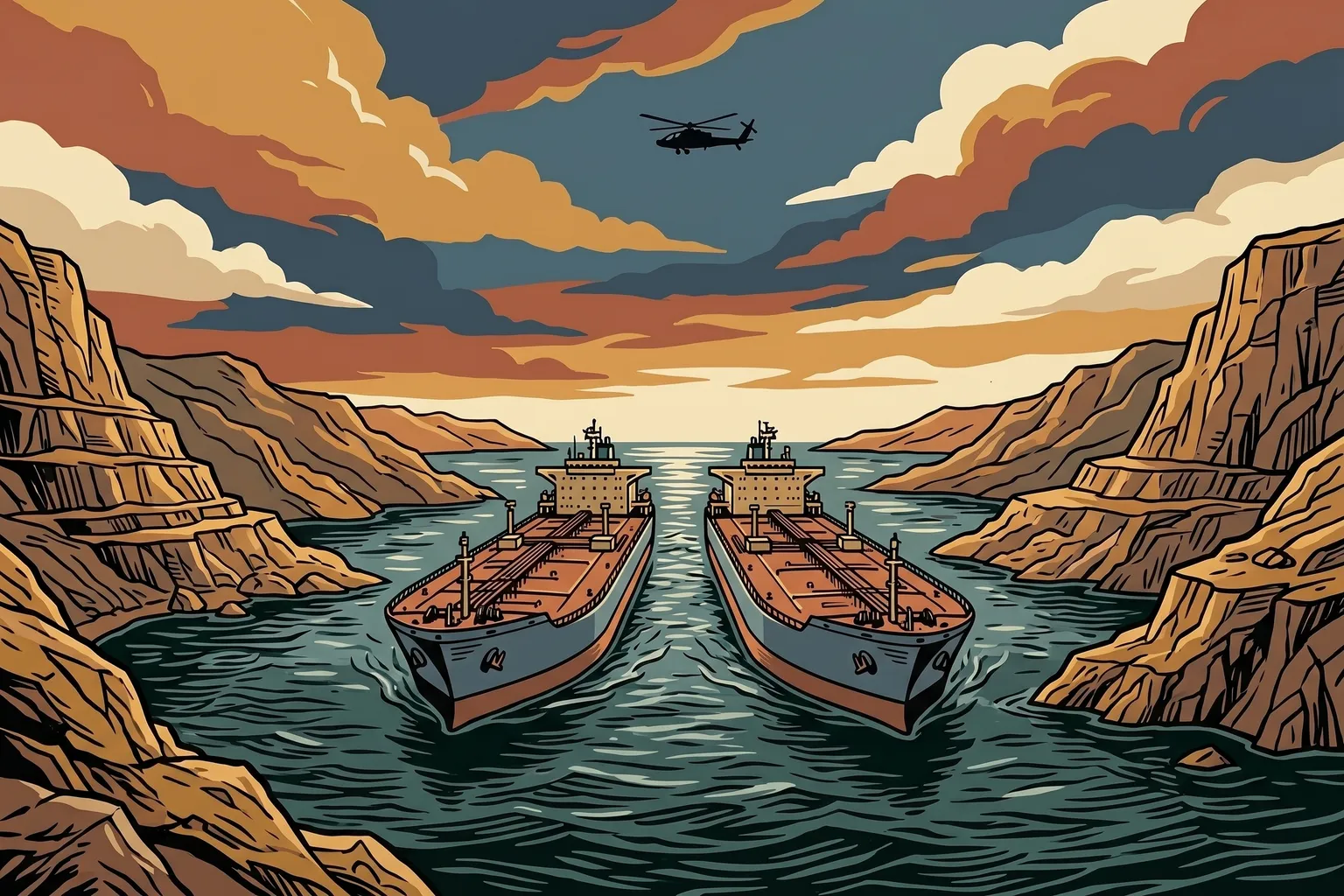
On Sunday, Iran fired multiple barrages of missiles toward Israel, the first such exchange since a fragile ceasefire had taken hold in April. Israeli warplanes had struck the southern suburbs of Beirut earlier in the day, hitting what the Israeli military described as Hezbollah weapons storage. Iran’s response came within hours. By Monday morning, both sides had stopped.
Israeli Prime Minister Benjamin Netanyahu said Israel was halting its strikes. An Iranian official communicated through the Trump administration that Tehran wanted the same. Trump said separately that he had warned Netanyahu that the United States might step back from its support if Israel continued to escalate. “If Iran makes the mistake of resuming attacks on us, we will respond with overwhelming force,” Netanyahu said in a statement.
That’s not a ceasefire in any formal sense. The April agreement was itself preliminary, a pause that neither side converted into something durable. What Monday looks like is a mutual decision to stop, for now, driven partly by military exhaustion and partly by American pressure. Whether it holds depends on Beirut, on domestic politics in both countries, and on what happens in the waters between them.
On Monday morning, a U.S. Army Apache attack helicopter crashed near the Strait of Hormuz. Both crew members were rescued. Trump posted on social media that the pilots were “fine.” The cause of the crash was not known by Monday afternoon. The Pentagon is investigating whether the helicopter was brought down by Iranian fire or by mechanical failure. Apache helicopters have been the primary American asset in enforcing the oil blockade on Iranian crude shipments, patrolling the chokepoint through which roughly 20 percent of the world’s oil supply moves each day.
The Strait of Hormuz has a history of containing confrontations that, by the logic of escalation, should have become wars and didn’t. In April 1988, after an Iranian mine badly damaged the USS Samuel B. Roberts in international shipping lanes, the United States conducted Operation Praying Mantis, the largest American surface naval engagement since World War II. Iran lost two oil platforms and several naval vessels. The operation lasted one day. Neither government declared war. Neither government described it as a war afterward. The confrontation was absorbed, and the Iran-Iraq War ended four months later. The parallel isn’t a prediction. It’s context for how these situations have been contained before, and what containing them required from both sides.
Sweden’s Uppsala University released its annual conflict report Monday, and the numbers warrant careful reading. The Uppsala Conflict Data Program found that eight interstate conflicts were active simultaneously in 2025, the highest number since World War II. That count was two in 2023. It doubled in 2024. It doubled again in 2025. UCDP also tracked 65 total state-involved conflicts during the year, the highest in the data set’s history going back to 1946. Approximately 244,600 people were killed in organized violence, making 2025 the second-deadliest year on record since the Rwandan genocide.
The Russia-Ukraine war accounted for roughly 62 percent of all battle-related deaths, with at least 94,700 fatalities recorded by UCDP. The other interstate conflicts included Israel and Iran, India and Pakistan, Thailand and Cambodia, and Israel’s separate operations in Syria and Yemen.
UCDP researchers said Monday they see no evidence 2026 will be different.
For perspective: after the Cold War ended, the number of active conflicts peaked in the early 1990s as proxy conflicts erupted and post-colonial borders cracked under pressure that had been held in place by superpower competition. Many analysts at the time called that a peak and assumed it would decline as the post-Cold War order stabilized. It did decline, through most of the late 1990s and the following decade. Conflicts began rising again around 2014. The 2025 total is now above the post-Cold War peak. The researchers aren’t saying the world is worse than it has ever been. They’re saying it’s worse than it has been in eighty years. Those are different statements, and both matter.
A federal judge in Boston struck down the Trump administration’s $100,000 fee on new H-1B visas Monday, ruling it an unlawful tax.
U.S. District Judge Leo Sorokin issued the ruling in a case brought by 20 state attorneys general. The fee, announced by the administration last September, raised the cost of sponsoring a foreign skilled worker on an H-1B visa from roughly $2,000 to $5,000, depending on employer size, to a flat $100,000. The administration’s stated rationale was protecting American workers from foreign competition for high-skilled jobs. Judge Sorokin’s ruling was direct on the central issue: “The President has no authority to levy a tax unless such a power is delegated by Congress through statute.”
The H-1B program was created by the Immigration Act of 1990. It allows U.S. employers to hire foreign workers in specialty occupations requiring at least a bachelor’s degree. The annual cap is 65,000 regular visas, with an additional 20,000 available for holders of advanced degrees from American universities. Demand has outpaced the cap in most recent years, and slots are distributed by lottery. The $100,000 fee, had it stood, wouldn’t have changed the cap or the lottery. It would have made the program functionally usable only by the largest technology companies, which had the resources to absorb the cost. Most smaller and mid-size employers did not. At least three separate lawsuits challenged the fee. Monday’s ruling is the first to produce a decision.
Sweden announced Monday that it will ban mobile phones from primary and lower secondary schools beginning this fall. The policy covers students ages 7 through 16. Phones are to be collected at the start of each school day and held until dismissal. The ban extends to breaks and after-school activities, not just classroom time. School principals may grant exceptions under specific circumstances.
The Swedish government also committed 555 million kronor, roughly $59 million, to purchase new textbooks and teachers’ guides. Sweden’s education officials linked both moves to falling reading scores, describing the phone ban and the back-to-books investment as responses to the same underlying problem: students in Swedish schools are reading with less sustained focus than they were a decade ago, and digital-only classrooms didn’t reverse the trend.
France banned phones from K-9 classrooms in 2018. Finland enacted school phone restrictions last August. Denmark is working on comparable legislation. Sweden’s version is more comprehensive than most, extending through the full school day rather than only instructional periods. The argument for these bans has been fairly consistent across countries: fewer distractions, more direct social interaction during unstructured time, better classroom concentration. The counter-argument, that sequestration doesn’t teach students to manage the devices they’ll use everywhere else, has also remained consistent. What Sweden and its neighbors have concluded is that the sequestration question can wait until high school. That’s a judgment call, but it’s now a judgment call backed by law in several countries.
It is Monday, June 9. Israel and Iran have stopped trading direct strikes for now, with American pressure helping produce a mutual standdown whose durability is unknown; an Apache helicopter crashed near the Strait of Hormuz with crew recovered and the cause under investigation; global conflicts reached their highest level since World War II in 2025, according to the Uppsala Conflict Data Program; a federal judge in Boston ruled that the Trump administration’s $100,000 H-1B fee exceeded the president’s authority and threw it out; and Sweden announced it will collect students’ phones from ages 7 through 16 for the full school day beginning this fall. That’s the day.
In the money section today, Glenn Suttner has published a piece that belongs on the reading list of anyone with a house, a retirement account, or a relative who assumes the will handles everything it needs to handle. “How to Avoid Probate” opens with a man named Roger who drove hours to sit with an estate attorney after his wife died, documents organized and in hand, and discovered that the house and a brokerage account were both going to court anyway. The will was fine. The titling of the assets was the problem. Eleven months later, the estate was settled at a cost of $13,500 in attorney fees. Glenn walks through the four tools that let an estate skip probate entirely, living trusts, beneficiary designations, TOD and POD accounts, and joint ownership, with enough specificity that you can take action this week without scheduling an attorney first. The piece is built on decades of those conversations, and it shows. If you’ve been meaning to sort out your estate planning and haven’t, this is a good place to start.