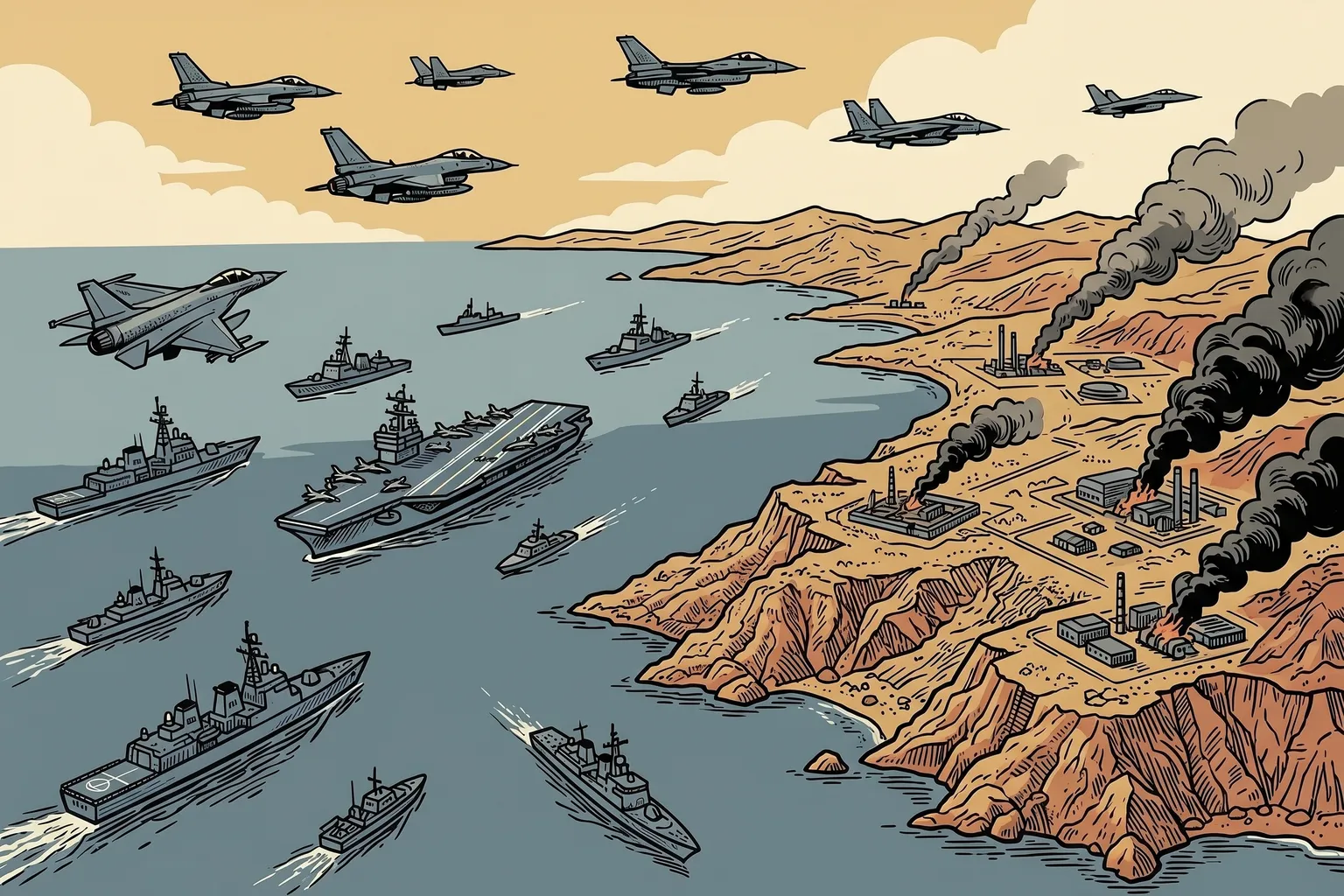
The United States struck Iranian radar and drone sites on Saturday and Sunday, NPR reported, targeting positions near Goruk and on Qeshm Island in the Strait of Hormuz. U.S. Central Command said the strikes came after Iran shot down an American MQ-1 drone operating over international waters. Among the targets were air defense systems, a ground control station, and two one-way attack drones that CENTCOM said threatened ships transiting the region.
Iran answered Monday by launching missiles at a U.S. military base in Kuwait. The U.S. said it shot them down. On Truth Social, President Trump wrote that “Iran really wants to make a deal” and told Americans to “just sit back and relax, it will all work out well in the end,” NPR reported. Ceasefire negotiations between the two countries are running in parallel with the military exchanges. The existing framework, which has survived two extensions since April 8, is still nominally in place.
Strike, retaliation, and more strikes. It’s a pattern with a long history in the Persian Gulf. On April 18, 1988, U.S. naval forces struck Iranian oil platforms and military vessels in Operation Praying Mantis, the largest American surface naval engagement since World War II. The trigger was an Iranian mine that damaged the USS Samuel B. Roberts. Qeshm Island was among the targets that day. Iran’s naval forces were largely destroyed within hours. What followed wasn’t peace but an extended ceasefire, in a conflict that had been running since 1980. The question going into this week is whether the parallel negotiations produce something different this time, or whether the pattern holds.
Israeli forces captured Beaufort Castle in southern Lebanon on Saturday, seizing the 12th-century Crusader fortress in what the Israeli army described as its deepest incursion into Lebanon in more than 26 years, NPR reported. The castle sits on a ridge near the city of Nabatieh, about nine miles from the Israeli border, and gives Israeli forces an observation position over much of southern Lebanon and northern Israel.
Israeli Defense Minister Israel Katz said in a statement: “Our brave soldiers have captured the Beaufort once again — and they will remain there as part of the security zone in Lebanon.” Lebanon’s Prime Minister Nawaf Salam responded: “Israel must know that its scorched-earth policy, collective punishment and expropriation of villages and towns will not achieve security and stability but will instead deepen the divide with the Lebanese people.” France requested an emergency session of the United Nations Security Council.
Israel first captured Beaufort Castle in 1982 during its invasion of Lebanon, a campaign aimed at driving out the PLO. Israeli forces held the hilltop position for eighteen years before Prime Minister Ehud Barak ordered a full withdrawal from southern Lebanon in May 2000. Hezbollah took control of the castle the following morning. Twenty-six years later, Israel is back on the same ridge. The military logic isn’t hard to follow. The path toward a durable outcome has resisted explanation for four decades.
Iran executed two men Sunday whom authorities identified as leaders of the January 2026 protests, Euronews reported. Mehrdad Mohammadinia and Ashkan Maleki were put to death after Iran’s Supreme Court upheld their sentences. Iranian authorities said the men were “among the main perpetrators of an attack on the Jafari Mosque in Tehran’s Gisha neighbourhood” during the unrest that swept Iran in late 2025 and January of this year.
Amnesty International has documented at least 78 protesters, dissidents, and people with perceived connections to banned opposition groups who remain under sentence of death, including 41 arrested in connection with January’s protests. Iran has rejected international criticism, saying those executed were convicted of serious crimes following due process. Sunday’s executions aren’t the first to follow the January uprising. They’re unlikely to be the last.
Federal health authorities met a June 1 deadline set by Congress to issue implementation guidance to states on Medicaid work requirements, KFF reported. The requirements, included in the One Big Beautiful Bill, will oblige most adults with low incomes and without dependents to document at least 80 hours per month of work, education, or related activities to keep their coverage. The rules are scheduled to take effect January 1, 2027, in the 40 states and the District of Columbia that expanded Medicaid under the Affordable Care Act.
The Congressional Budget Office estimated that 4.8 million people will lose Medicaid specifically because of the work requirements, with total coverage losses from the broader legislation reaching 11.8 million over the next decade. The Robert Wood Johnson Foundation projected a wider range for work-requirement losses alone: between 4.9 and 10.1 million people by 2028. The gap in the estimates reflects uncertainty about enforcement. Research on earlier work-requirement experiments found that most coverage losses didn’t come from people failing to meet the rules, but from documentation failures among people who were already working.
The last major federal work-requirement experiment came in 1996, when the Personal Responsibility and Work Opportunity Reconciliation Act added work requirements to what became the Temporary Assistance for Needy Families program. Welfare caseloads fell significantly in the years that followed. What actually happened to the people who left the rolls was contested in research for the next twenty years without a clean resolution. January 1, 2027 will start a similar experiment, applied to a program covering nearly 80 million Americans.
Rep. Mike Collins and former University of Tennessee football coach Derek Dooley are headed to a June 16 runoff in Georgia’s Republican Senate primary, NBC News reported, after neither candidate cleared the majority threshold in the May 19 primary. Collins, a trucking company owner who has served in Congress since 2022, took 40.5 percent of the vote. Dooley finished second at 30.1 percent. A third candidate, Chris Carter, was eliminated with 25.2 percent.
Whoever wins on June 16 faces Democratic Senator Jon Ossoff in November in one of the cycle’s most watched Senate contests. Ossoff won his seat in a January 2021 runoff, one of two Georgia races that night that handed Democrats their Senate majority. Georgia’s last three Senate elections, in 2021, 2021, and 2022, each went to Democrats. Republicans are betting 2026 looks different. There are two weeks to find out who makes that case.
And one more thing worth reading.
Glenn Suttner wrote about reverse mortgages in “Reverse Mortgage Pros and Cons”, publishing today in the Money section. He opens with a couple who drove forty minutes to sit across from him and ask the honest version of a question they’d been getting conflicting answers on for years: is this thing a scam or not? Glenn walks through the actual costs (roughly $13,000 to $16,000 upfront on a $310,000 home), explains the non-recourse protection, and lays out clearly when the product makes sense and when it doesn’t. “A HECM is an FHA-insured product with standardized rules, mandatory counseling, and real consumer protections,” he writes. “It’s not a scam.” The TV commercials and the fee sheet tell very different stories. Glenn’s column is the version that hands you both and lets you decide.
It is Monday. U.S. aircraft struck Iranian radar and drone sites over the weekend; Iran answered with missiles at Kuwait, which the U.S. intercepted. Israel seized Beaufort Castle in Lebanon for the first time in 26 years. Iran executed two men it identified as January protest leaders. Federal guidance on Medicaid work requirements went out to states with implementation set for next January. And Georgia Republicans are two weeks from settling their Senate nomination. That’s the day.