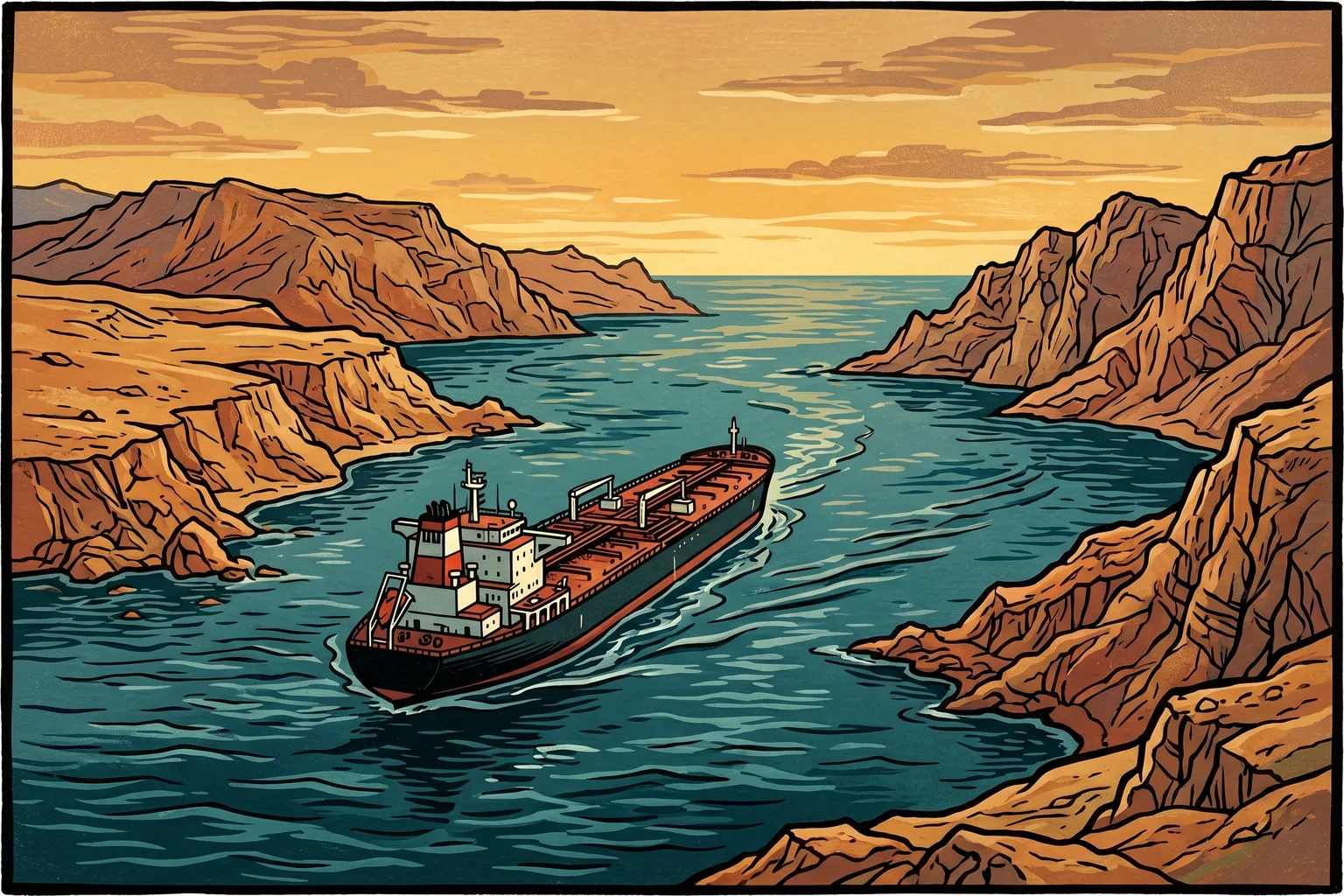
The deal came Saturday. The harder work starts now.
President Trump posted on social media that “The Deal with the Islamic Republic of Iran is now complete,” and that he had authorized “the toll free opening of the Strait of Hormuz” and “the immediate removal of the United States Naval blockade.” NBC News reported that Pakistan served as the mediating party and that a formal signing ceremony is set for June 20 in Geneva. The framework includes a 60-day window for nuclear negotiations.
As of this morning, actual ship movement through the strait remains limited. Al Jazeera reported that only four tankers, several cargo ships, and smaller vessels have transited since the announcement. Mine-clearing operations are underway. Shipping insurers are reassessing the passage. Full commercial traffic won’t come back in a day or two, and the markets know it.
PBS NewsHour reported that Brent crude fell more than $4 per barrel on the announcement. That’s a meaningful one-day move, though Brent had been trading above $100 a barrel for weeks, reflecting the accumulated economic cost of the Hormuz closure.
Those who’ve been following this column since the Islamabad Declaration two weeks ago will recognize the architecture: Pakistan brokered a preliminary framework, and the formal deal followed. This is the resolution the framework was designed to produce, assuming both sides were serious, which now appears to have been the case.
The last time the United States and Iran resolved a major crisis through third-party mediation was January 19, 1981. Algeria brokered the Algiers Accords that ended the 444-day hostage crisis: 52 American diplomats released, Iranian assets in American banks unfrozen, an international arbitration tribunal established to process claims from both governments. Algeria received limited public credit at the time. The logic then and now is the same: a country with genuine interests in regional stability and working relationships with both sides isn’t a neutral mediator. It’s an invested one. That’s often precisely what makes the mediation work, because the country brokering the deal has something to lose if it fails.
The 60 days of nuclear talks are the piece with the most uncertain outcome. Iran’s nuclear program is considerably more advanced now than it was during the JCPOA negotiations of 2013 to 2015, which took more than 20 months to complete even with established working channels and a framework agreement already in hand. What the two governments are now negotiating over has changed. Whether 60 days produces anything durable, or whether it produces a framework for a longer process, is a question the next two months will begin to answer.
The Federal Open Market Committee opens its two-day June meeting today. A rate decision is expected Wednesday afternoon. Yahoo Finance reported that the committee’s current target range sits at 3.50 to 3.75 percent. New Fed Chair Kevin Warsh holds his second post-meeting press conference Wednesday.
The backdrop has changed since the last meeting. Headline CPI ran at an annualized rate of 3.8 percent through May, the highest since May 2023, according to Go Markets. The Iran deal announcement and the subsequent drop in oil prices introduce a deflationary signal the committee didn’t have when it last gathered. Markets are pricing in no change at this meeting. The probability of a September cut has moved higher since the weekend.
First major decisions under a new Fed chair tend to attract more scrutiny than the data alone would justify, because the chair is still establishing how they communicate and what they prioritize. In 1987, Alan Greenspan had been on the job two months when the Dow Jones fell 22.6 percent on October 19 in what became known as Black Monday. He issued a single sentence before markets opened the following morning: “The Federal Reserve, consistent with its responsibilities as the Nation’s central bank, affirmed today its readiness to serve as a source of liquidity to support the economic and financial system.” The market bottomed that day. The brevity and clarity of the statement mattered as much as its content. Warsh’s equivalent test hasn’t arrived, but Wednesday’s press conference is still an opportunity to establish a tone. Markets will be listening for more than the rate number.
Iran drew New Zealand 2-2 in a group stage World Cup match today that Al Jazeera called “politically charged”, given the ceasefire news still settling around it. The result keeps Iran in contention in their group. This is the first World Cup with 48 teams competing in 104 matches, a format FIFA approved in 2017 that expanded the field by 16 teams and added roughly three weeks to the tournament calendar. Canada, Mexico, and the United States are co-hosting through mid-July. The United States defeated Paraguay 4-1 in the group stage opener, with Gio Reyna scoring.
Russian forces launched a large-scale drone and missile strike series against Ukraine overnight Sunday into Monday, targeting Kyiv, Dnipro, and Kharkiv. The Kyiv Post, citing ISW assessments, reported 192 combat engagements between Ukrainian and Russian forces on Sunday, with the heaviest concentration in the Pokrovsk sector of Donetsk Oblast. Strikes damaged energy and communications infrastructure in the Chernihiv region. A missile hit the Kharkiv village of Dobrenka and injured five people, including a child.
The ISW noted that Russian forces are using AI-generated footage to fabricate claims of tactical successes, a complication that makes independent verification of actual battlefield conditions slower and less reliable. It’s a different kind of information problem than what war correspondents have faced before.
The Pokrovsk sector sits at a road junction that controls access to several smaller cities in eastern Donetsk. It’s been one of the most heavily contested stretches of the front for the better part of a year, and what’s happening there isn’t dramatic in the way a significant breakthrough would be. It’s the grinding, expensive kind of fighting over terrain that determines the shape of a front over months, not days. The pace of Russian offensive operations hasn’t moderated during the weeks when American attention was concentrated on the Hormuz situation. That’s worth noting, because the assumption that multiple crises compete for Russian resources doesn’t appear to be accurate. They’ve maintained the tempo.
Swiss voters rejected a referendum Sunday that would have capped the country’s permanent resident population at 10 million by 2050. CNN reported that 55 percent voted against the proposal, with Swiss voters choosing to prioritize “economic stability and ties with the European Union over worries immigration was stretching public services and pushing up rents.” The Swiss People’s Party championed the initiative. Switzerland’s population reached 9.1 million at the end of 2025, up roughly 10 percent over the preceding decade.
The result preserves Switzerland’s ability to ratify a 2024 economic integration agreement with the EU, which a population cap restricting free movement of workers would have complicated considerably.
This was the third major Swiss immigration referendum in twelve years. In 2014, Swiss voters approved an initiative to reintroduce immigration quotas, which the government then spent years trying to implement without losing bilateral treaties with the EU, and ultimately abandoned. In 2020, voters rejected ending free movement with the EU by more than 61 percent. The pattern is consistent: when Swiss voters have been asked to choose between immigration restriction and economic integration with Europe, they’ve chosen economic integration. Not by landslides. But consistently. The Swiss People’s Party has won narrow victories on immigration before and seen them unwound by the practical constraints of Switzerland’s relationship with the EU. Sunday’s vote is the clearest version yet of that dynamic playing out before the implementation stage.
Malaysia’s law banning social media use for children under 16 formally entered force today, one of the more comprehensive laws of its kind enacted anywhere, with penalties for non-compliant platforms of up to 10 million ringgit. The enforcement obligation falls on the platforms rather than on parents.
Australia passed comparable legislation last November. The challenge for both countries is the same: verifying user ages in environments where many children share devices with adults and where platforms have commercial incentives to keep users rather than accurately identify them. What the law establishes is platform liability for a failure to make a good-faith effort. Whether that changes actual behavior at scale is what the next year will begin to show. The countries that have passed these laws are accumulating data. Other governments are watching.
It is Monday, June 16. The Iran-U.S. deal to reopen the Strait of Hormuz was announced over the weekend, with limited ship traffic moving and a formal signing set for Geneva on June 20; the Federal Reserve opens two days of meetings today with a rate decision expected Wednesday from new Chair Kevin Warsh; Iran and New Zealand drew 2-2 in a politically charged World Cup group match; Russia launched overnight strikes against Kyiv, Dnipro, and Kharkiv with 192 engagements recorded Sunday; Swiss voters rejected a population cap referendum; and Malaysia’s under-16 social media ban entered force today. That’s the day.
If Glenn Suttner’s Money column from last Monday is still in your reading queue, this is a good week to get to it. “How to Avoid Probate” answers a question most people don’t ask until they’re already dealing with a problem they didn’t know they had. Glenn’s in the Money section.