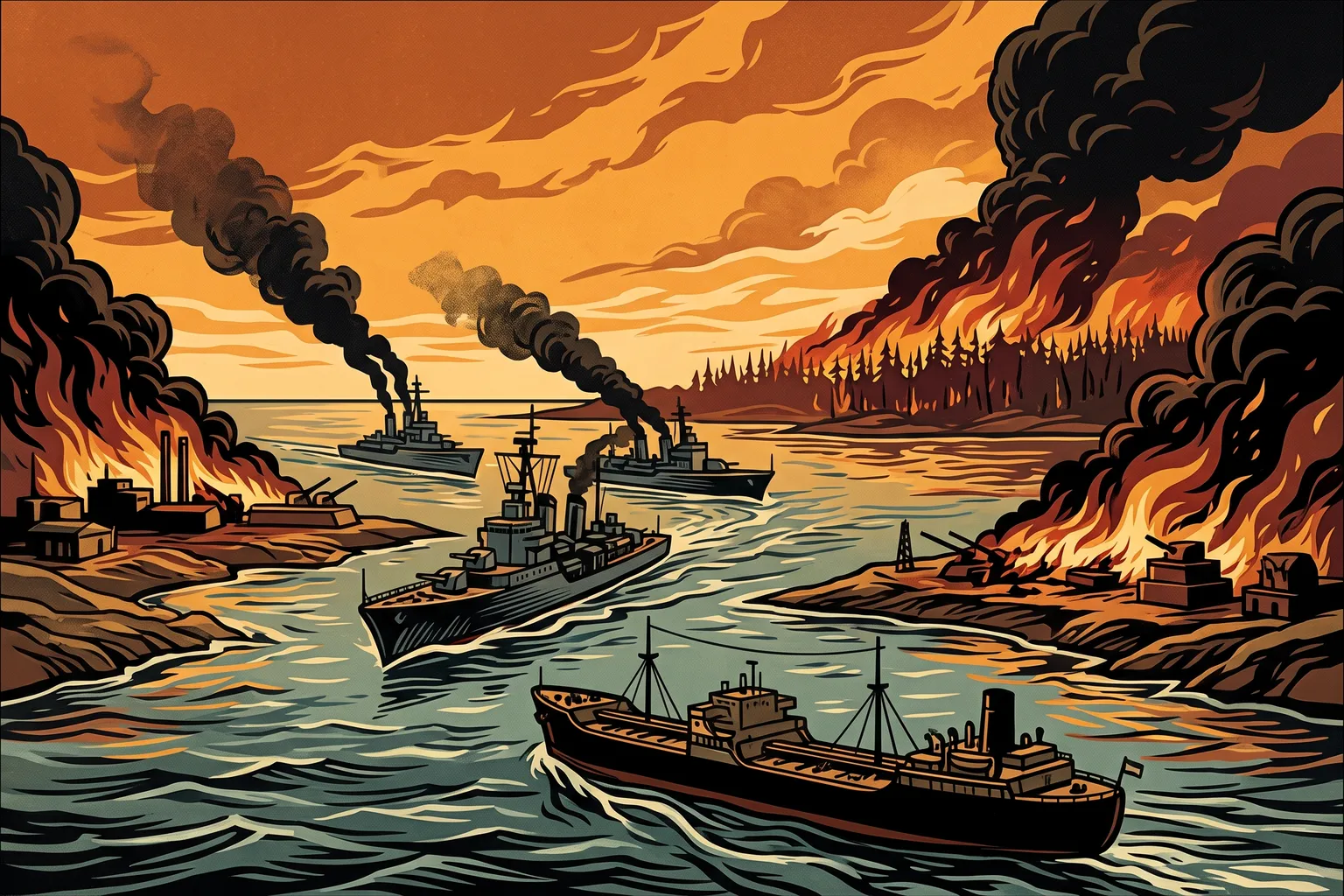
US Central Command launched strikes against Iranian military targets for the third consecutive night on Monday, hitting sites at Bushehr, Chah Bahar, Jask, Konarak, Abu Musa, and Bandar Abbas. CENTCOM said the operation struck 140 targets, all aimed at degrading Iran’s ability to threaten commercial shipping in the Strait of Hormuz. CBS News is tracking the operation.
The strikes came alongside a reimposed naval blockade. US Central Command announced that as of 4 p.m. Eastern on Monday, American forces had resumed blocking traffic to and from Iranian ports and coastal areas. President Trump also announced a 20 percent toll on all non-Iranian cargo passing through the strait, writing on social media that the United States would become its “GUARDIAN.” When asked how long the conflict might last, Trump said, “We’ve demolished their military. We’re hitting them very hard.” NPR has been following his statements through the day.
Two UAE tankers were struck by Iranian missiles in the southern Strait of Hormuz on Monday, according to the UAE defense ministry, as reported by CBS News. An Indian crew member aboard one of the vessels was killed.
The Strait carries roughly a fifth of the world’s oil supply. The last time the United States sustained naval operations there at this scale was the Tanker War of 1987 and 1988, when Iran and Iraq had been attacking neutral shipping in the Persian Gulf for years. The Reagan administration agreed in 1987 to reflag Kuwaiti oil tankers as American vessels and escort them through threatened waters. The resulting effort, Operation Earnest Will, was the largest US naval convoy operation since World War II, according to the US Naval Institute. It lasted fourteen months and ended not with a formal agreement but with the exhaustion of both parties after the Iran-Iraq War concluded in August 1988. The underlying question of who governs passage through the Strait wasn’t resolved then. It hasn’t been resolved since.
Secretary of State Marco Rubio on Monday announced a campaign to isolate and dismantle the International Criminal Court. Writing in the Wall Street Journal, Rubio said the US would dismantle the court “brick by brick,” deploying every diplomatic tool available and calling on allies to join the effort. The administration sanctioned eight additional ICC judges and deputy prosecutors, adding to earlier sanctions against Prosecutor Karim Khan.
Three of the sanctioned judges filed a federal lawsuit in Manhattan the same day, according to The Hill, arguing the sanctions were designed to pressure the court into dropping investigations rather than address any legitimate legal violation. The ICC’s statement said the measures represented an attempt at “extrajudicial pressure.”
The United States has had a consistent policy toward the ICC for more than two decades, though the form of that policy has varied. President Clinton signed the Rome Statute establishing the court in December 2000 but didn’t submit it to the Senate for ratification. In May 2002, President Bush formally withdrew the US signature, with John Bolton, then Undersecretary of State for Arms Control, delivering the notification to the United Nations, according to Human Rights Watch. It was, at the time, a step without clear recent precedent: the United States withdrawing from a multilateral treaty that hadn’t yet entered into force. The ICC opened that summer anyway. It now has more than 120 member states.
French firefighters on Monday were battling blazes that have burned through more than 1,900 hectares of the Fontainebleau forest, a UNESCO biosphere reserve about 60 kilometers southeast of Paris, according to France 24. France deployed four Canadair aircraft, two Dash planes, and three water-bombing helicopters. It was the first time fire-bomber aircraft from the south of France had been sent to the Paris region. Around 600 firefighters worked in rotating shifts. About 1,000 residents were evacuated. Police arrested two suspects in connection with the blaze.
Macron described the fire as “an exceptionally large wildfire,” according to Euronews. Monday was Bastille Day, France’s national holiday. It was also the day 26 million people across France were placed under a red heatwave alert, the country’s highest level, according to France 24. This was France’s third heat event since May. French forests had already burned through 17,000 hectares this year, twice the rate of the same period in 2025, according to French officials.
France overhauled its emergency response to summer heat after 2003, when a European heat wave killed an estimated 14,802 people in France alone, according to the French National Institute of Health, part of a continental death toll that exceeded 70,000. The emergency system France built in the aftermath, including early warning mechanisms and neighborhood cooling networks, cut heat-related deaths by roughly 90 percent in subsequent years, according to the Christian Science Monitor. The system is still in place. It’s being tested this summer at a pace its designers didn’t plan for.
Israel signed a framework agreement Monday valued at 8.5 billion shekels, approximately $2.3 billion, to expand settlements in the occupied West Bank, including 12,000 new housing units and major infrastructure projects, according to Israeli media.
The Oslo Accords of September 1993 called for a negotiated final status agreement on the West Bank’s future. The parties set a five-year window. Monday’s framework isn’t the first settlement expansion since then. It is among the largest.
German Chancellor Friedrich Merz, French President Emmanuel Macron, Ukrainian President Volodymyr Zelensky, and outgoing British Prime Minister Keir Starmer met Monday in Paris for a session of the Coalition of the Willing, a European-led group coordinating security and diplomatic support for Ukraine. The group agreed that a ceasefire along the current front line would be the foundation for any sustainable peace, that security guarantees for Ukraine would be set by Ukraine and its partners rather than by Moscow, and that pressure on Russia would continue. Merz was direct: “Russia won’t win this war.”
The 2026 FIFA World Cup semifinal between France and Spain kicks off today at 3 p.m. Eastern time in Dallas. England and Argentina meet Wednesday in Atlanta. The winners play July 19 in the final in New Jersey. According to NPR, it’s the first time all four of FIFA’s top-ranked teams have reached the semifinals of the same World Cup. France won the tournament in 2018; Spain in 2010; Argentina defended its title in 2022; England has won once, in 1966.
France’s Kylian Mbappe plays in Dallas today, on Bastille Day, while sixty kilometers southeast of Paris, the Fontainebleau forest still burns.
On the money side this week, colleague Glenn Suttner has a piece worth your time: a clear explanation of what a power of attorney actually is, when you need one, and what the different forms of it do. It’s a legal document most people encounter at a moment of family stress, when there isn’t time to read up on it. Glenn’s piece is better read before that moment arrives.
The Gates Medical Research Institute announced this week that the Phase 3 clinical trial of the M72/AS01E tuberculosis vaccine candidate has reached full enrollment eleven months ahead of schedule, with approximately 20,000 participants enrolled across multiple countries. Tuberculosis kills more than one million people a year. The BCG vaccine currently used to prevent it was developed more than a century ago. M72/AS01E is the most rigorously tested candidate in a generation to change that. The trial is running in the countries where TB remains most deadly. Enrollment eleven months ahead of schedule, at that scale, means 20,000 people decided to show up. That belongs in today’s picture.
Howard Fenn writes The Day, Monday through Friday.