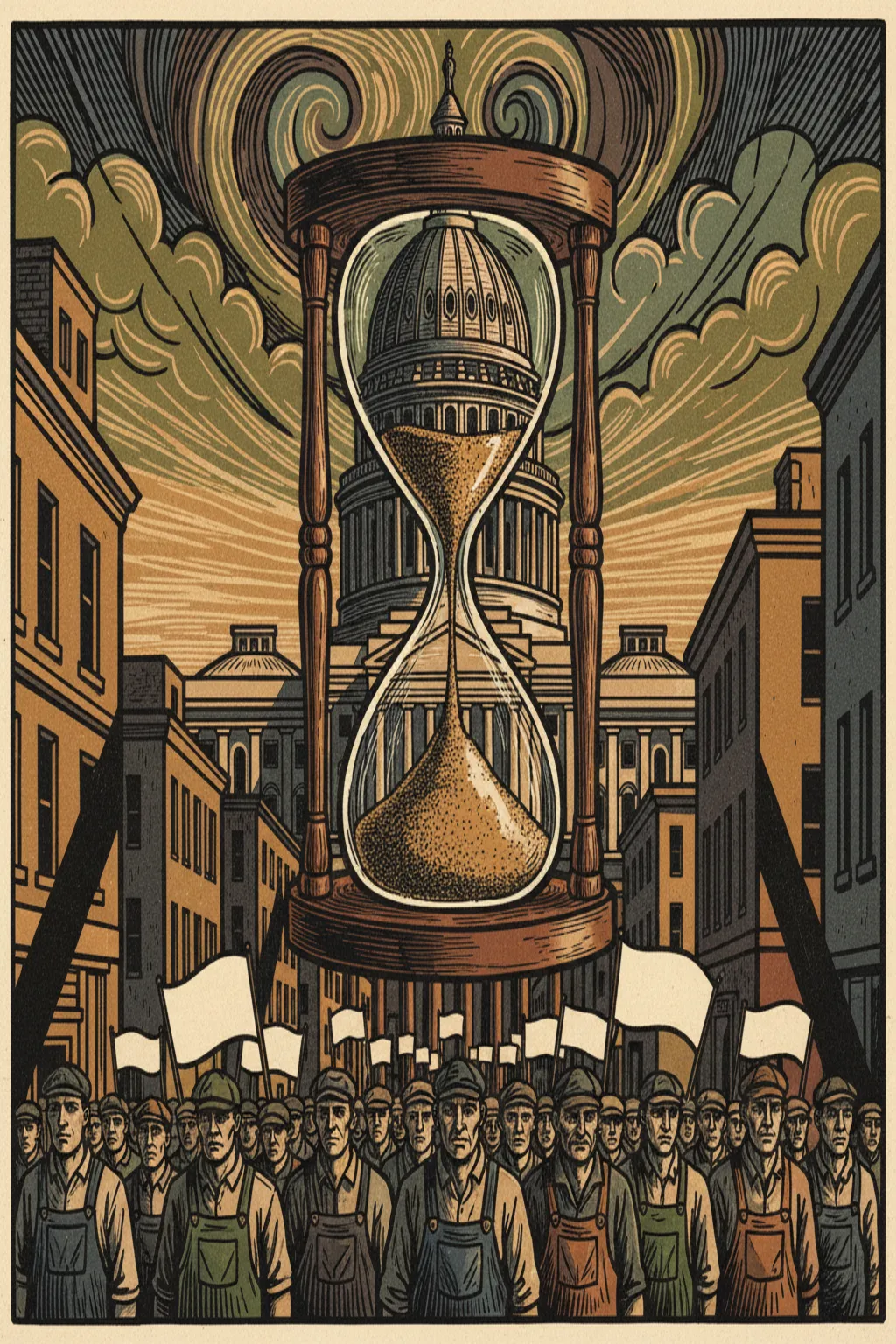
The Iran war reaches its sixtieth day today without congressional authorization, crossing the threshold set by the War Powers Resolution of 1973, CNN reported. President Trump notified Congress of military operations on March 2. Under the resolution, the president has sixty days to conduct military action without a formal declaration of war or an authorization for the use of military force. After that, the law says he “shall terminate any use of United States Armed Forces.”
The Senate voted 47-50 on Thursday to reject a resolution directing the president to remove forces from Iran, the sixth time it has defeated such a measure since the war began, Time reported. Sens. Susan Collins of Maine and Rand Paul of Kentucky were the only Republicans to break with their party. It was Collins’s first vote against the war. Sen. John Fetterman of Pennsylvania was the only Democrat to vote no, The Hill reported. Lawmakers then left for recess. The Senate doesn’t return until the week of May 11.
House Speaker Mike Johnson said Thursday that the United States is “not at war” with Iran. “I don’t think we have an active, kinetic military bombing, firing or anything like that. Right now, we are trying to broker a peace,” he said, NBC News reported. Defense Secretary Pete Hegseth told senators that “we are in a ceasefire right now, which our understanding means the 60-day clock pauses or stops,” CBS News reported.
The War Powers Resolution was passed on November 7, 1973, when Congress overrode President Nixon’s veto. The law was written in response to the secret bombing of Cambodia, which Nixon had authorized without telling Congress. Every president since has tested its limits. None has formally conceded its constitutionality. Fifty-three years later, the same law meets a new war, and the core question hasn’t changed: who decides whether American forces fight.
Across the United States and in cities around the world, workers walked out, stayed home from school, and refused to shop today in what organizers called the largest May Day action in decades. Nearly 500 organizations planned more than 750 events across the country, Fox News reported. At least 19 school districts in North Carolina closed for the day. The 31,000-member Chicago Teachers Union backed the call.
The demonstrations extended beyond American borders. Rising energy costs tied to the Iran war were a central theme. “There will be a louder call for higher wages and economic relief because of the unprecedented spikes in fuel prices,” said Renato Reyes, a leader of the Philippine political group Bayan, The Washington Post reported. The European Trade Union Confederation, representing 93 organizations in 41 countries, said: “Working people refuse to pay the price for Donald Trump’s war in the Middle East.”
May Day is an American invention, though most Americans don’t know it. On May 1, 1886, an estimated 300,000 workers across the country walked off their jobs in a general strike for the eight-hour workday. In Chicago, 40,000 joined. Three days later, a bomb at a rally in Haymarket Square killed seven police officers and at least four civilians, and the violence reshaped American labor for a generation. In 1889, the international socialist movement designated May 1 as International Workers’ Day in commemoration. One hundred and forty years later, the date still draws people into the streets. The original demand was the eight-hour day. Today the concerns include wages, energy costs, and the steady automation of jobs that people used to do.
The United Arab Emirates left OPEC today, ending nearly sixty years of membership and stripping the cartel of its third-largest producer, Al Jazeera reported. Energy Minister Suhail Mohamed al-Mazrouei called it “a policy decision” made “after a careful look at current and future policies related to level of production,” CNBC reported. The UAE plans to expand production from 3.4 million barrels per day to 5 million by 2027.
The exit follows weeks of Iranian missile and drone attacks on UAE territory and disruptions to shipping in the Strait of Hormuz that have constrained the country’s ability to export, The Washington Post reported. OPEC was founded in Baghdad in September 1960 by five countries, one of them Iran. Qatar left in 2019. The UAE has now followed. The organization is smaller than it was, and the region it was built to stabilize is at war.
In Oakland, California, the trial of Elon Musk’s lawsuit against Sam Altman and OpenAI completed its first week, CNN reported. Musk spent three days on the stand, alleging that OpenAI’s leaders abandoned the company’s nonprofit mission to pursue profit. He is seeking $130 billion in damages. “What you can’t have is the for-profit become the main event, and that’s what we have here,” he testified, CNBC reported.
OpenAI was incorporated as a nonprofit in 2015 with a stated purpose of developing artificial intelligence safely and making it available to the public. It has since become one of the most valuable technology companies in the world. Whether it honored the mission it was founded on is now a question for twelve jurors in a federal courtroom.
And in Stevenage, England, a six-year-old girl named Saffie Sandford can see.
Saffie was born with Leber congenital amaurosis, a rare genetic condition that causes progressive blindness. Last spring, days before her sixth birthday, doctors at Great Ormond Street Hospital treated her first eye with Luxturna, a gene therapy designed for her specific mutation. They treated her second eye in September. She can now see hazards in her path, keep up at school, and play on a climbing frame, UCL reported. Researchers published new evidence showing that treating children younger strengthens visual pathways during a critical window of brain development. Fifteen children have received the therapy at Great Ormond Street since 2020.
It is Friday. A war passed a deadline. Workers filled the streets in a tradition that started in this country 140 years ago today. And in England, a girl who couldn’t see can see now. That’s the day.