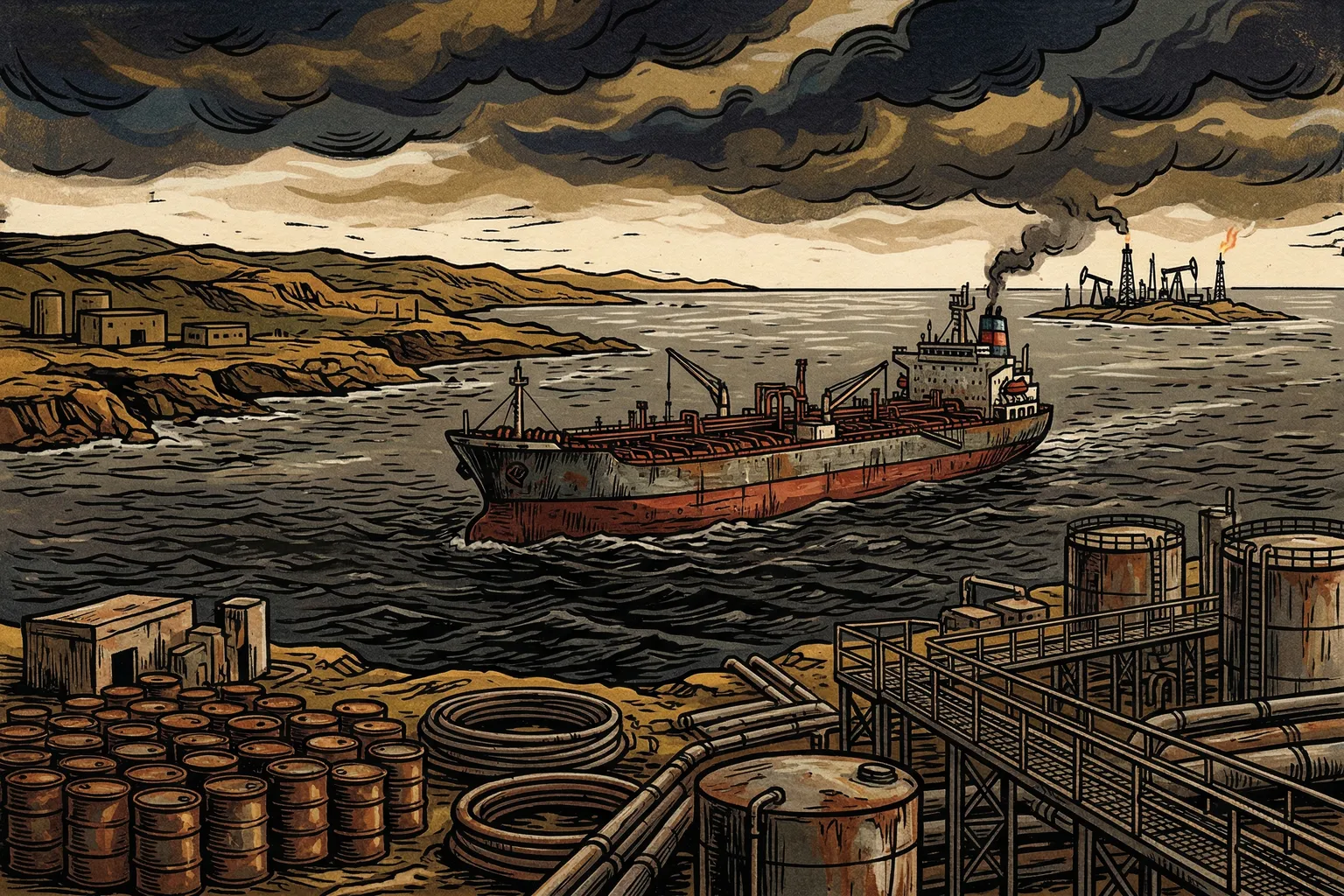
Oil hit $116 a barrel on Monday after President Trump told the Financial Times that the United States could send forces to seize Iran’s Kharg Island, the terminal through which roughly 90 percent of Iran’s crude oil exports flow, NPR reported.
“Maybe we take Kharg Island, maybe we don’t,” Trump told the newspaper. “We have a lot of options.” He added that holding the island would mean American forces “had to be there for a while.” In separate remarks to reporters aboard Air Force One on Sunday night, Trump said negotiations with Iran were going well but added, “you never know with Iran, we negotiate with them and then we always have to blow them up.”
Meanwhile, fighting continued. The Israel Defense Forces said it struck weapons production sites in Tehran overnight, including a facility used to assemble long-range anti-aircraft missiles. Israel and Hezbollah traded fire along the Lebanese border. Iran struck a power and desalination plant in Kuwait, killing an Indian worker. The International Atomic Energy Agency confirmed on X that Iran’s Khondab heavy water production plant, attacked on March 27, had sustained severe damage and was no longer operational.
Brent crude, the international benchmark, has risen more than 50 percent since the start of March. That surpasses the previous record for a monthly oil surge: 46 percent, in August 1990, when Iraq’s army invaded Kuwait. The difference in 1990 was scope. That supply disruption involved two countries. This one involves the Strait of Hormuz, which carries about a fifth of the world’s daily oil supply, and the war is now in its fifth week with no resolution in sight. Australian Prime Minister Anthony Albanese announced Monday that his government would cut fuel taxes for four months. British Prime Minister Keir Starmer held emergency talks with executives from BP and Shell.
In 1953, the CIA and British intelligence overthrew Iranian Prime Minister Mohammad Mosaddegh after he nationalized the country’s oil industry. The stated purpose was to secure Western access to Iranian petroleum. It succeeded. Its consequences are still unfolding, 73 years later. “Take the oil” isn’t a new idea in this part of the world. It’s one of the oldest.
Satellite images confirmed Monday that an Iranian missile strike on Saudi Arabia’s Prince Sultan Air Base destroyed a U.S. Air Force E-3 Sentry, the airborne radar platform the military uses to coordinate air operations, Bloomberg reported. It was the first combat loss of an E-3 in the aircraft’s 49-year service history. The plane was valued at roughly $270 million, according to the New York Post.
The loss matters beyond the airframe. The E-3 fleet has been scheduled for retirement, but its replacement, the E-7 Wedgetail, isn’t expected to reach operational capability until the late 2020s. There aren’t spares sitting in a hangar. Fifteen U.S. service members were wounded in the Friday strike on Prince Sultan, including five in serious condition, the AP reported. Iran has targeted American personnel at bases across the region since the war began. The Pentagon’s total: 13 American service members killed, more than 300 wounded.
The Supreme Court will hear arguments Wednesday on whether all children born in the United States are automatically citizens, NPR reported. It’s the first time the court has taken up the scope of birthright citizenship since 1898.
President Trump signed an executive order on his first day in office seeking to end the practice for children born to parents who are in the country without legal status. Multiple federal courts blocked it. The question before the justices turns on the 14th Amendment’s opening clause, ratified in 1868 to protect the citizenship of formerly enslaved people: “All persons born or naturalized in the United States, and subject to the jurisdiction thereof, are citizens of the United States.”
The last time the court ruled directly was United States v. Wong Kim Ark. Wong was born in San Francisco to Chinese parents who were barred from naturalizing under the Chinese Exclusion Act of 1882. The court ruled 6-2 that he was a citizen. The decision has stood for 128 years. Only about three dozen countries, mostly in the Western Hemisphere, still offer automatic birthright citizenship, according to NPR. American public opinion on the practice depends almost entirely on how the question is framed.
The third round of “No Kings” protests drew crowds to more than 3,300 events across all 50 states on Saturday, a record for the movement, the Washington Post reported. The previous round, in October, drew roughly 5 million participants across about 2,600 events, according to organizers.
Immigration enforcement and the war in Iran dominated. Carina Kagan, a Mexican-Filipino American whose daughter serves in the Army overseas, drove more than two hours from Lake of the Ozarks, Missouri, to the Kansas City rally. “Right now, the military boots on the ground possibility is the biggest thing in my head,” she told NPR. “It’s just a useless, vain war.” White House spokesperson Abigail Jackson called the demonstrations “Trump Derangement Therapy Sessions.” Bill McKibben, founder of the No Kings-affiliated group Third Act, told NPR that older Americans have a particular stake in the protests. “There have been plenty of presidents in my lifetime I didn’t much like,” he said. “But there’s never been any that I thought were fascist.”
A New York Times analysis of satellite imagery and weapons fragments found that a newly developed American weapon, the Precision Strike Missile, struck a sports hall and a school in the southern Iranian city of Lamerd during the opening hours of the war on March 1, the Times reported.
The PrSM is a long-range surface-to-surface missile that only recently entered production. The Lamerd strike appears to be among its first uses in combat. Survivors and Iranian media reported that children were among the dead. The Pentagon hasn’t commented on the specific strike. The Times investigation, based on fragment markings and impact patterns, is the first independent analysis to link a specific American weapons system to damage at civilian sites in this war.
Independent verification of what weapons hit what targets is how the historical record gets built. It took 20 months after the March 1968 massacre at My Lai for the story to reach American newspapers, when Seymour Hersh reported it through a small news service. The work of documenting what happened, and with what, takes time. It doesn’t become less important for taking it.
The average price of a gallon of gasoline in the United States is approaching $4, up more than a dollar from the start of March, the New York Times reported. In California, Washington, and parts of the Northeast, it has already crossed that line.
Before the war began on March 1, the national average sat around $2.90. Americans haven’t paid $4 a gallon since the summer of 2022, when prices spiked briefly after Russia’s invasion of Ukraine. That spike lasted about three months. This one shows no sign of easing.
And at the Juno Awards on Sunday night, Joni Mitchell walked onto the stage and sang.
Mitchell, who is 82, performed “Big Yellow Taxi” with Sarah McLachlan and Allison Russell. Prime Minister Mark Carney presented her with the Lifetime Achievement Award. She hadn’t appeared publicly in Canada since 2013. In 2015, she suffered a brain aneurysm that left her unable to walk or speak for months. She spent years in recovery. She came back slowly, first at the Newport Folk Festival in 2022, then at a handful of concerts in the United States.
“I had an aneurysm, which changed my life, oddly, for the better,” she told the audience, Pitchfork reported. “I went into a coma, which helped me to quit smoking. And my house filled up with the most wonderful nurses. So my life has changed for the better out of a catastrophe like a phoenix.”
She is 82. She came home, and she sang.