Diplomats from Saudi Arabia, Turkey, and Egypt gathered in Islamabad on Sunday for talks aimed at ending the war between the United States, Israel, and Iran, the Associated Press reported. Pakistani Prime Minister Shehbaz Sharif said he and Iranian President Masoud Pezeshkian held “extensive discussions” on the regional hostilities.
The United States and Israel weren’t participating.
More than 3,000 people have been killed in one month of war. Egypt’s Badr Abdelatty said the meetings were aimed at opening a “direct dialogue” between the U.S. and Iran, which have communicated almost entirely through mediators since the fighting began February 28. But the war kept going while the diplomats talked. Explosions could be heard throughout Tehran on Sunday as Israel announced new waves of incoming strikes.
Iran’s parliament speaker, Mohammad Bagher Qalibaf, dismissed the Islamabad talks as a cover while the U.S. dispatched additional troops to the Middle East. He warned against any ground invasion and said Iran was ready to set American troops “on fire,” according to Iranian state media. U.S. Secretary of State Marco Rubio said Friday that Washington “can achieve all of our objectives without ground troops.”
There was one small opening. Iran agreed late Saturday to allow 20 more Pakistani-flagged vessels through the Strait of Hormuz, the critical passageway it has worked to choke since the war began. It isn’t much. But it suggests that even while the rhetoric escalates, someone in Tehran is keeping a channel open.
In January 1969, the Paris peace talks on Vietnam formally began with all four parties at the table. The war continued for four more years before producing the Paris Peace Accords. Between the opening session and the final agreement, more than 20,000 Americans and hundreds of thousands of Vietnamese were killed. Peace talks are not peace. They are the announcement that someone, somewhere, has decided the fighting should end. The fighting doesn’t always listen.
The economic consequences of this war are getting harder to measure and harder to ignore.
Iran struck Qatar’s Ras Laffan natural gas terminal on March 18, wiping out 17 percent of Qatar’s liquefied natural gas export capacity. State-owned QatarEnergy said repairs will take up to five years, the AP reported. The International Energy Agency has called the disruption to Persian Gulf energy flows “the largest supply disruption in the history of the global oil market.”
Brent crude settled Friday at $105.32 a barrel. It was roughly $70 before the war. U.S. benchmark crude hit $99.64. “Historically, oil price shocks like this have led to global recessions,” said Christopher Knittel, an energy economist at the Massachusetts Institute of Technology.
The damage goes beyond oil. The Persian Gulf accounts for a third of the world’s urea exports and a quarter of its ammonia. Up to 40 percent of global nitrogen fertilizer exports pass through the Strait of Hormuz. With the strait choked off, urea prices are up 50 percent and ammonia 20 percent. Those numbers will eventually become food prices. They always do.
In October 1973, OPEC imposed an oil embargo on nations supporting Israel during the Yom Kippur War. Oil prices quadrupled in six months. Gas lines stretched for blocks in American cities. The embargo lasted five months and reshaped global energy politics for a generation. The difference now is that the current disruption involves physical destruction of infrastructure. An embargo can be lifted by a vote. A liquefied natural gas terminal that took years to build takes years to rebuild.
The shutdown of the Department of Homeland Security reached its 44th day on Sunday, making it the longest government shutdown in American history, the AP reported.
Congress left Washington for a two-week spring recess without resolving it.
What looked like a deal collapsed spectacularly on Friday. Senate Majority Leader John Thune and Democratic leader Chuck Schumer agreed to fund most of DHS but not Immigration and Customs Enforcement or Border Patrol. Thune told reporters Friday that “we can get at least a lot of the government opened up again and then we’ll go from there.” House Speaker Mike Johnson rebuked the plan within hours, calling it “a joke.”
The House then passed its own bill, 213-203, to fund the entire department through May 22. Schumer called it dead on arrival. Rep. Nick LaLota of New York said that on a Republican conference call Friday, dozens of members from moderates to hard-line conservatives opposed the Senate plan. “The Senate chickened out,” he said. “The cowards there, only a few of them in the middle of the night with I think only three to five senators present on the floor, chickened out because they wanted to go home for two weeks.”
President Trump signed an executive order to pay TSA employees, who haven’t received a full paycheck since February 14. It doesn’t cover the Coast Guard, FEMA, or thousands of other DHS employees. The previous record was 43 days, set last fall when the entire federal government shut down. There’s no resolution in sight before Congress returns in mid-April.
Saturday’s “No Kings” rallies drew large crowds across the country and in Europe in the third round of protests against President Trump’s policies, the AP reported. More than 3,100 events were registered in all 50 states.
Bruce Springsteen headlined the flagship rally at the Minnesota Capitol in St. Paul, performing “Streets of Minneapolis,” a song he wrote in response to the deaths of Renee Good and Alex Pretti, two people killed when federal agents conducted immigration raids in Minneapolis. “Your strength and your commitment told us that this was still America,” Springsteen told the crowd. “And this reactionary nightmare, and these invasions of American cities, will not stand.”
People rallied from New York City to Driggs, Idaho, a town of fewer than 2,000 in a state Trump carried with 66 percent of the vote. Leah Greenberg of the organizing group Indivisible said two-thirds of the RSVPs came from outside major urban centers. The White House dismissed the protests. “The only people who care about these Trump Derangement Therapy Sessions are the reporters who are paid to cover them,” spokesperson Abigail Jackson said.
Organizers estimated previous rounds drew more than 5 million in June 2025 and more than 7 million in October. They expected 9 million participants Saturday.
Pope Leo XIV rejected claims that God justifies war during his Palm Sunday Mass before tens of thousands in St. Peter’s Square, the AP reported. “Brothers and sisters, this is our God: Jesus, King of Peace, who rejects war, whom no one can use to justify war,” Leo said. “He does not listen to the prayers of those who wage war, but rejects them.”
The homily landed in a week when religious language has been invoked on multiple sides of the Iran conflict. U.S. Defense Secretary Pete Hegseth has hosted monthly evangelical worship services at the Pentagon and has framed the conflict in explicitly Christian terms, the Washington Post reported. Russia’s Orthodox Church has described its war in Ukraine as holy. Iran frames its military operations through Shia Islamic obligation. Leo prayed especially for Christians in the Middle East, who he said “are suffering the consequences of an atrocious conflict.”
North Korean leader Kim Jong Un observed a test of an upgraded solid-fuel engine for missiles capable of reaching the U.S. mainland, state media reported Sunday, according to the AP. The Korean Central News Agency said the engine’s maximum thrust reached 2,500 kilonewtons, up from about 1,970 kilonewtons in a similar test in September. Kim called the test of “great significance in putting the country’s strategic military muscle on the highest level.”
Some experts are skeptical. This was a ground engine firing, not a missile launch, and North Korea didn’t disclose key information about combustion time or engine configuration. Missiles with solid propellants are easier to move and harder to detect than liquid-fuel weapons, which makes them strategically significant if the numbers hold. The “if” is doing considerable work in that sentence.
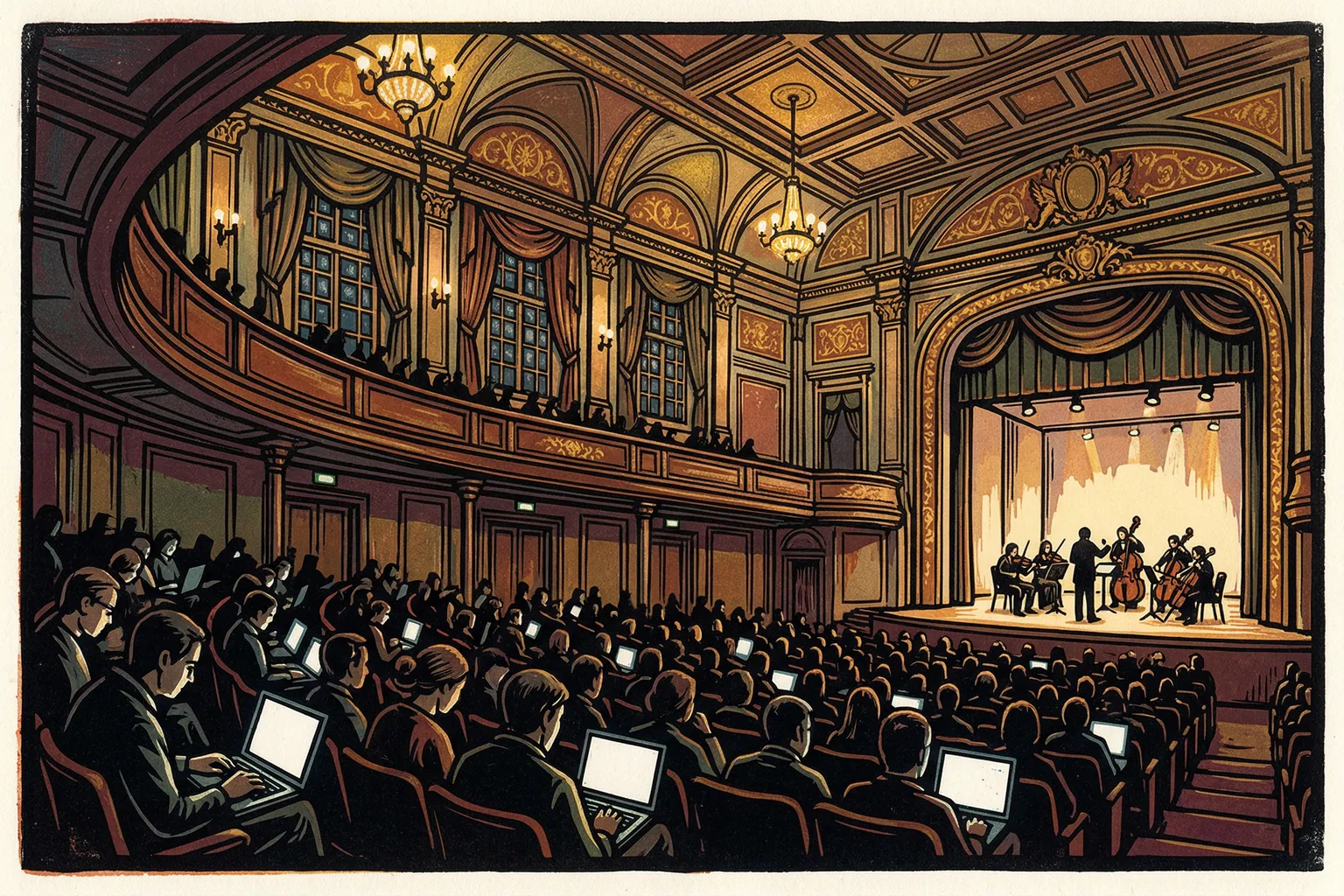
And in Amsterdam, the Royal Concertgebouw turned its famous main hall into a study room, the AP reported. Students sat in the plush red seats with laptops open, working on dissertations and exam prep while musicians played Pachelbel’s Canon in D, some Handel, some Schubert, and a few pieces from Studio Ghibli films for good measure.
The study sessions began during the pandemic, organized by Entree, the Concertgebouw’s youth association, to help students concentrate and introduce them to classical music. They’ve been a hit ever since.
Kyra Mulder, a 21-year-old occupational therapy student at the Amsterdam University of Applied Sciences, said the music surprised her. “It’s actually very calming and helping in concentrating on the work that we have to do, which is something that surprises me because normally I don’t really listen to classical music,” she told the AP.
The Concertgebouw opened in 1888. Its walls carry the gilded names of Ravel, Mahler, Wagner, and Mozart. On this particular day, the names looked down on rows of students who weren’t there for the music but were, by the end, grateful for it. A building designed to fill a room with sound found another way to do the same thing.