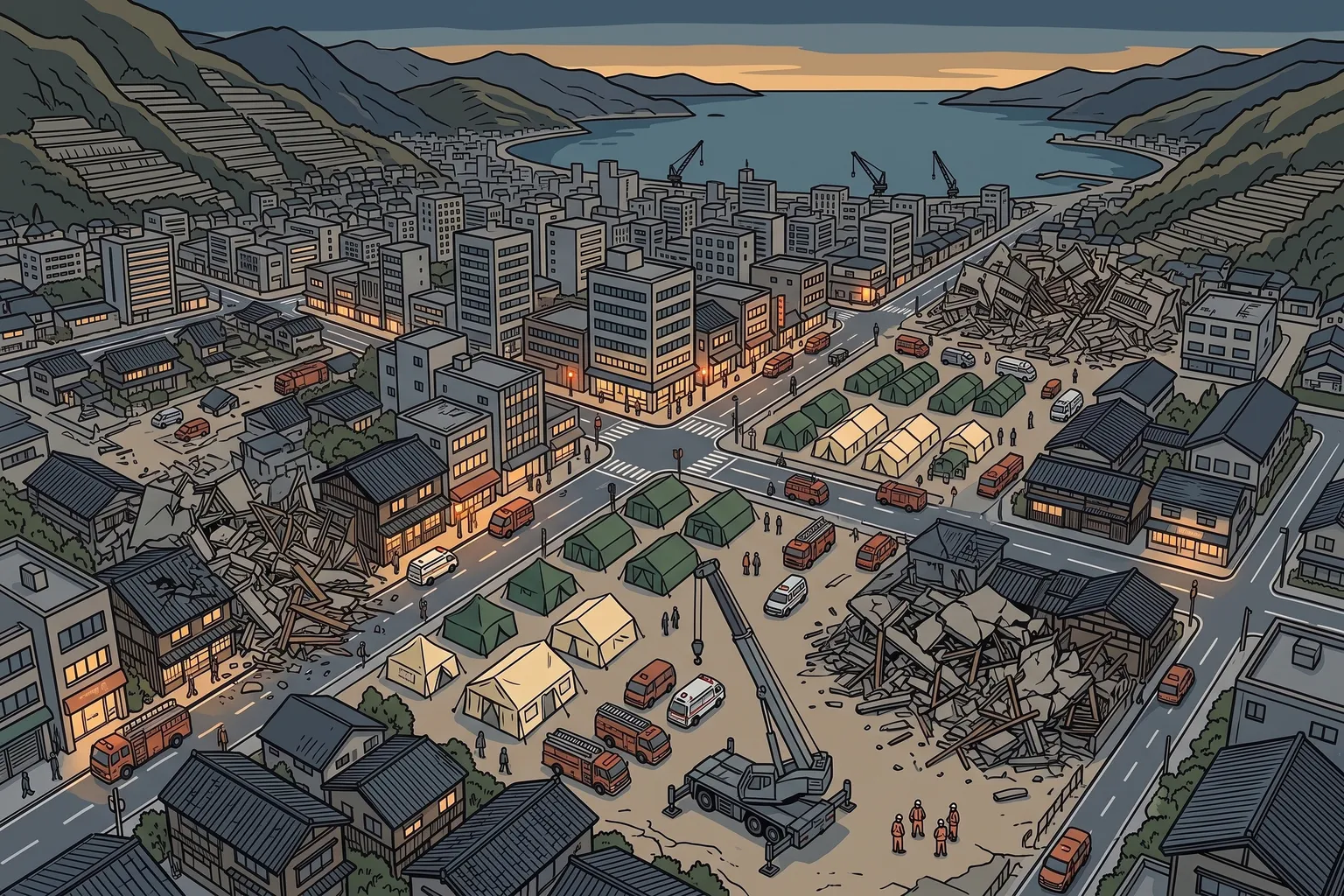
The rescue crews working through Kumamoto Prefecture on Thursday morning had twelve fewer hours than they did on Wednesday morning, and twelve fewer hours matters when you’re searching rubble.
The death toll from Tuesday’s earthquake climbed to 35 by Thursday, according to Japanese authorities. NPR’s coverage from Thursday morning confirmed the updated count. At least 129 people have been injured. More than 15,000 remained in approximately 400 evacuation centers across the prefecture, most of them in schools and community centers built to earthquake code. Japan Ground Self-Defense Force crews have deployed more than 4,600 personnel to the affected areas. The Kyushu Shinkansen, connecting Kumamoto to Kagoshima-Chuo through some of the hardest-hit districts, remains suspended pending safety inspections. The Japan Times and NBC News have both been covering the rescue operations as they develop.
The picture of what Tuesday afternoon looked like in specific places is becoming clearer as reporting comes in. At the Aeon Mall Kumamoto, which had just reopened in June after years of reconstruction following the 2016 earthquakes, a gas explosion roughly eighty minutes after the initial strike compounded the toll. The mall that had been a milestone in the region’s recovery from the last disaster became one of the worst scenes of this one. The Nippon Paper Industries plant north of the city lost a chimney that collapsed onto workers. In Hikawa town, hundreds of homes were damaged or destroyed. More than 250 aftershocks have followed the main shock, including a magnitude 6.1 on Wednesday.
The economic impact is moving through Kyushu’s manufacturing sector. Toyota has suspended production at three plants in Fukuoka. Honda halted factory operations through Thursday. Sony and Renesas Electronics are on indefinite suspension. Kumamoto Prefecture holds a significant share of Japan’s semiconductor manufacturing capacity. After the 2011 Tohoku earthquake and tsunami, disruptions to Japanese auto and electronics supply chains rippled through assembly operations as far away as the United States for months. The same geography of industrial concentration applies now, and the same accounting will take time to complete.
In 1995, the Kobe earthquake killed more than 6,400 people and produced a comprehensive national reform of Japan’s earthquake response protocols. What Kumamoto is showing, in the second major earthquake to strike the same prefecture in a decade, is that the reforms worked in the ways reforms can work: the response was rapid, the shelters opened, the troops deployed within hours. And the buildings still fell, and the people in them were still there.
A fragile pause in U.S.-Iran hostilities appeared to hold through Thursday, though Iranian officials continued to publicly deny that any formal ceasefire existed. Peace talks are continuing in Oman. The U.S. delegation includes Vice President JD Vance, Jared Kushner, special envoy Steve Witkoff, and Secretary of State Marco Rubio. ABC News has maintained live updates on the negotiations throughout the week.
The concern this week isn’t only what happens in the Strait of Hormuz. On Tuesday, an Iranian drone struck a U.S.-owned floating storage unit at Egypt’s Damietta port, near the entrance to the Suez Canal, and fire spread to an adjacent liquefied natural gas tanker. The IRGC said the struck vessels had “continued to move on an unsafe and illegal route despite warnings.” Iranian Foreign Minister Abbas Araghchi, on Egypt specifically, noted that “Egypt is considered a friend and important partner in the region.” Whether that relationship holds after a burning LNG tanker at an Egyptian port is one of the questions the Oman talks are now working around.
The Suez Canal is not the Strait of Hormuz. It’s hundreds of miles from the Persian Gulf, controlled by a different sovereign government, and until Tuesday hadn’t been directly touched by this conflict. That a drone from the Iran-U.S. fight reached it is a geographic expansion of the war that changes the risk calculus for the 2,000 ships and 20,000 mariners still stranded in the Persian Gulf. The International Crisis Group has tracked the Hormuz flashpoints since the conflict began in February.
Bob Whitfield wrote about the dual chokepoint problem in Sunday’s Ideas section, before Tuesday’s Damietta strike. His piece, “The Backup Route,” explains what it costs in time, money, and carbon to reroute oil around the Cape of Good Hope. This week the geography of that problem got more complicated.
Russian forces launched a major barrage of missiles and drones across Ukraine on Wednesday night, killing at least 10 civilians and wounding dozens more. NPR confirmed the strikes and the casualty figures Thursday morning. Kyiv was among the cities hit. Ukraine’s National Police confirmed a 31-year-old man was killed in the capital, with two others wounded. The Washington Post reported casualties across multiple cities, with the toll still rising into Thursday.
One Russian missile crossed into Poland during the barrage. NATO scrambled jets. Poland’s airspace is NATO airspace under Article 5. A missile inside it, whatever the circumstances of its trajectory, requires a formal response. NATO’s characterization Thursday was that the missile was likely errant rather than intentional. NATO made the same characterization after a similar incident in November 2022, when a missile struck a Polish village near the Ukrainian border. That episode was contained diplomatically. The pattern’s durability is not guaranteed by its repetition.
Two days before the strikes, Ukrainian President Volodymyr Zelenskyy met with President Trump privately at the White House. Zelenskyy said afterward the session was “good.” He described the discussions as covering Patriot interceptor licenses and “several other ideas that could help.” Ukraine has been pushing for permission to allow allied countries to manufacture Patriot missiles domestically, which would reduce dependence on American production timelines. Al Jazeera covered the White House meeting and Zelenskyy’s public comments when he left. The Russian barrage came forty-eight hours later.
The Ebola outbreak in the Democratic Republic of Congo has become, by the measure of speed, the most alarming on record. As of Thursday, the total confirmed case count stood at 3,442, with 1,521 deaths. The European Centre for Disease Prevention and Control updated its assessment this week. Forty-eight of the DRC’s 140 health zones are now affected, across five provinces. The outbreak is driven by the Bundibugyo strain, for which there’s no approved vaccine and no specific treatment. One hundred and nineteen health workers have been infected. Thirty-six have died.
In mid-July, Médecins Sans Frontières said: “In two months, this outbreak has become the third largest, and fastest growing, Ebola disease outbreak on record.” MSF has published its response operations and that assessment here. The case count has continued to climb since that statement. The WHO is stretched, and the geographic spread across five provinces makes containment significantly harder than it would be in a concentrated outbreak.
This one isn’t getting the coverage it should. A summer that has included an Iran conflict, a Venezuela earthquake, Ukraine, a U.S. heat emergency, and a World Cup doesn’t leave much room in the news cycle for a public health crisis building in Central Africa. The numbers in the DRC are real. The trend is moving the wrong way.
Thirty-seven days have passed since two earthquakes struck Venezuela’s coastline within 39 seconds of each other. The official death toll stands at 5,546. The Venezuelan government has still not published a missing-persons count. The United Nations has estimated that 50,000 people remain unaccounted for.
The gap between 5,546 and 50,000 is large and is not going to close quickly. Most formal rescue operations ended around day 10. The country is now in the recovery phase: slower, more expensive, and far less visible than the initial rescue effort. Acting President Delcy Rodríguez has acknowledged the death count would likely rise as debris clearance continues. Venezuela has drawn $346 million from its International Monetary Fund reserves for reconstruction. More than 23,500 people remain in temporary shelters. More than 58,000 buildings were destroyed or damaged. The math of rebuilding all of that in a country with a fragile economy and complicated international relationships is going to take years to work through, and the cameras won’t be there for most of it.
The third major heat dome of the summer has put 80 million Americans under heat advisories this week. The confirmed death toll from heat illness this summer stands at 44, with researchers who study heat mortality consistently noting that official counts miss a significant share of actual deaths. The Extreme Heat Emergency Act, introduced last October, hasn’t advanced to a floor vote in either chamber. The Stafford Act still doesn’t cover extreme heat. The heat will end when the weather changes. The law won’t change on its own.
If the heat is prompting thoughts about different geography, our colleague Sylvia Chen spent Tuesday writing about what it actually looks like to retire in Panama, beyond the brochure version. She takes the trade-offs seriously. You’ll find the piece in the Living section.
On July 28, Uganda completed its 42-day post-exposure surveillance window and was officially declared free of Ebola.
Uganda shares a long border with the DRC. When the Bundibugyo outbreak was declared a Public Health Emergency of International Concern this spring, Uganda activated its border monitoring protocols and placed communities near the DRC frontier under active surveillance. Twenty cases were detected. Two people died. The last patient was discharged on July 16. The 42-day window that followed, twice the maximum incubation period for Ebola, closed without a new case. The World Health Organization maintains the official outbreak tracking.
The DRC outbreak is ongoing. Uganda’s is not. The surveillance system that Uganda built and tested against one of the most dangerous pathogens known to medicine held. That’s the part of Thursday’s news that ends on solid ground.