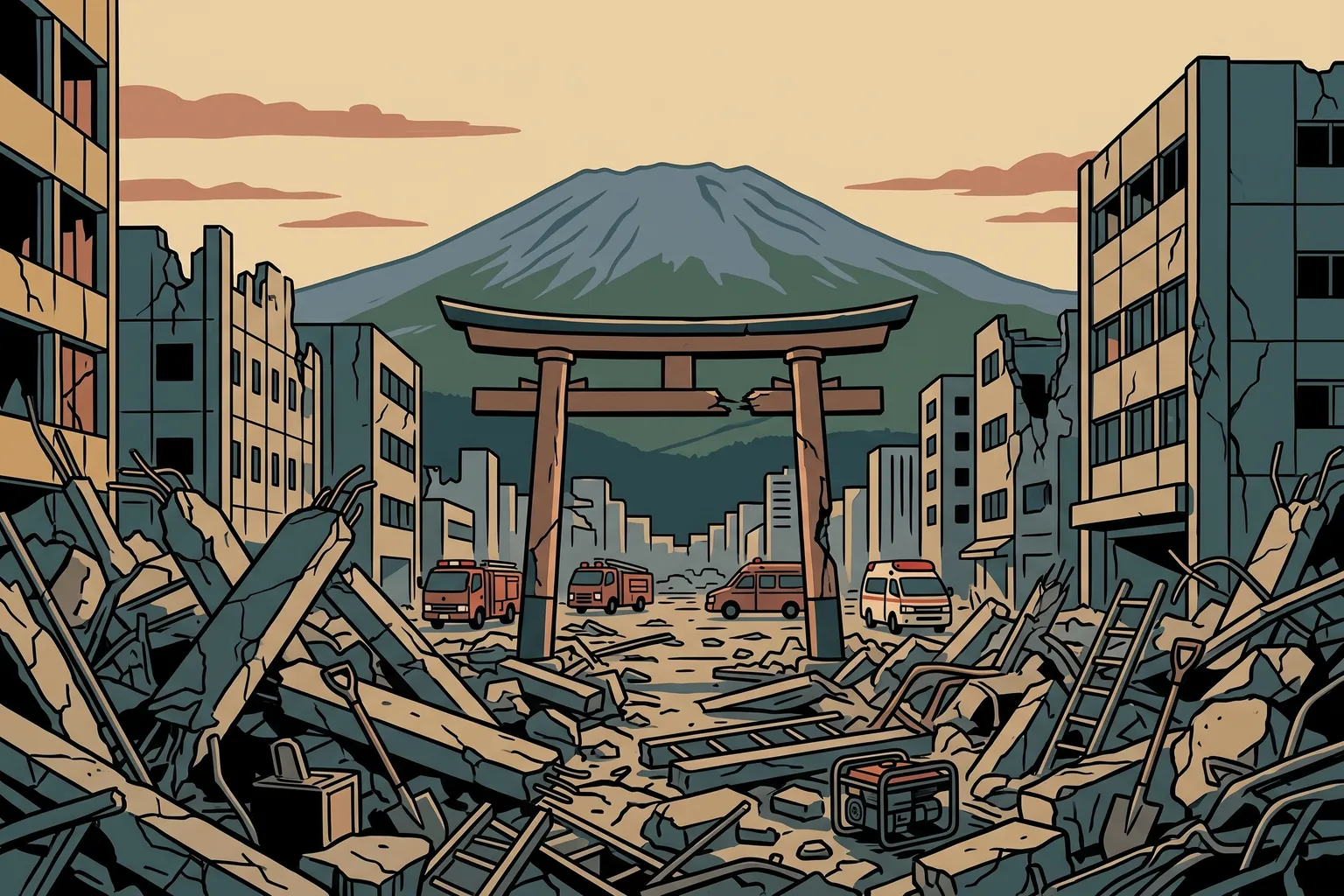
The earthquake struck at 4:27 on Tuesday afternoon, which meant the shopping mall had a full crowd when sections of the roof came down.
The mall is the Aeon Mall Kumamoto. It had just reopened in June after years of reconstruction following the 2016 Kumamoto earthquakes, a pair of magnitude-7 strikes that killed 50 people and damaged more than 120,000 structures across Kyushu. The June reopening was celebrated as a milestone in the region’s recovery from that earlier disaster. Six weeks later, the same fault moved again.
The Japanese Meteorological Agency measured Tuesday’s earthquake at magnitude 7.1. The U.S. Geological Survey later revised the figure to 6.8. Either way, rescue crews were still working through the rubble on Wednesday morning, three days after the initial strike. At least 23 people are confirmed dead. At least 62 are injured, six of them seriously. More than 10,000 people spent Tuesday night in evacuation centers across the prefecture. NPR reported Wednesday morning that hope for finding additional survivors was dwindling. Al Jazeera has been covering the rescue operations in detail.
Japan has the most sophisticated earthquake response system on earth. The country built it the hard way, reforming after the 1995 Kobe earthquake killed more than 6,000 people, and then again after the 2011 Tohoku tsunami. Shelters opened quickly. Search teams deployed within hours. The U.S. Embassy in Tokyo issued a natural disaster alert for the Kyushu region on Tuesday. The Kyushu Shinkansen high-speed rail line has been suspended between Kumamoto and Kagoshima-Chuo stations pending safety inspections. Roads in the hardest-hit areas remain damaged and slow to pass.
None of that changes what happened to the mall that had just finished being rebuilt, or to the 23 people confirmed dead on a Tuesday afternoon in a city that had already been through this once.
The Federal Reserve voted 9 to 3 on Tuesday to hold its benchmark interest rate at 3.5 to 3.75 percent. It’s the fifth consecutive meeting with no change. The three dissenters, all regional bank presidents from Cleveland, Minneapolis, and Dallas, wanted to raise rates by a quarter point. The complete FOMC statement is on the Federal Reserve’s website.
Chair Kevin Warsh has been running shorter press conferences than his predecessors, and Tuesday was no exception. He said: “I understand the desire for rolling forecasts and commentary from this committee, but for our part, we need to observe market reaction to developments direct and unfiltered.” Investors had been hoping for something more. Markets closed with mild disappointment. Analysts now expect one or two rate increases before the end of the year.
The statement described the economy as expanding “at a solid pace despite elevated uncertainty that owes, in part, to the conflict in the Middle East.” That language is unusually direct for a Fed statement. It means the Hormuz disruption is now formally inside the committee’s economic accounting, alongside the higher energy costs it has pushed into supply chains and household budgets. CNBC covered the vote, the dissent, and what it means for markets.
In 1994, the Fed under Alan Greenspan held rates steady through much of a strong recovery and then raised them seven times in twelve months when inflation appeared to be building. The tightening curbed the inflation. It also contributed to a bond market sell-off that set off a financial crisis in Mexico and pushed Orange County, California, into bankruptcy. The lesson isn’t that holding rates is wrong or that raising them is wrong. It’s that the consequences of the decision tend to arrive far from the conference room and well after the vote, in places and populations the committee isn’t directly watching. Three of the nine committee members thought it was past time to act. The other six disagreed. NPR’s economics coverage explains what the hold means for borrowers.
U.S. Central Command said Tuesday that it has redirected 20 commercial ships it accuses of trying to evade its blockade on Iranian ports, up from 12 as of Saturday. The State Department announced additional sanctions against Iranian entities the same day, targeting the energy transactions that have continued to generate revenue for Tehran despite the ongoing military campaign. CBS News has maintained live updates on the U.S.-Iran conflict throughout the summer.
The analytics firm Kpler reports that transits of the Strait of Hormuz by all ships, Iranian and non-Iranian alike, remain extremely limited. Fuel shortages have developed in parts of Asia. Consumer prices across the Pacific Rim are beginning to reflect what happens when the world’s most important oil chokepoint handles a fraction of its normal traffic.
In 1987, during the Iran-Iraq War’s tanker war phase, the Reagan administration launched Operation Earnest Will. U.S. Navy vessels escorted Kuwaiti oil tankers through the Persian Gulf under American flags, the largest naval convoy operation since World War II. It involved scores of U.S. warships over fourteen months and kept the oil moving. The critical difference between 1987 and now is that Earnest Will was protecting ships along a shipping lane. What CENTCOM is managing today isn’t a contested route but a contested strait, 21 miles across at its narrowest, with two governments actively disputing who controls it. Convoy operations can protect individual ships. They can’t reopen a sea lane that both sides have chosen to fight over. The International Crisis Group has tracked the Hormuz flashpoints since February.
If you want to understand how the Hormuz situation connects to the Red Sea disruption and what it actually costs in days, dollars, and carbon to reroute tankers around the Cape of Good Hope, Bob Whitfield laid it out clearly in his Sunday piece in Ideas. He calls it “The Backup Route.” It’s worth your time.
Thirty-six days have passed since two earthquakes, 39 seconds apart, struck the Venezuelan coastline. The death toll has reached 5,000. The World Bank has estimated physical damage at $19.6 billion. A separate United Nations estimate puts the figure at $37 billion. The two numbers measure different things and aren’t contradictory; they illustrate the scale of the problem. Al Jazeera has followed Venezuela’s recovery closely.
Venezuela’s interim government has drawn $346 million from its reserves at the International Monetary Fund, the first such access since dealings between Venezuela and the Fund resumed in April. Acting President Delcy Rodríguez described it as funding for “the recovery and reconstruction process.” Al Jazeera reported on the IMF access earlier this month. About 18,000 people remain homeless. More than 58,000 buildings were destroyed or damaged. Schools have reopened in 18 of Venezuela’s 24 states. In the hardest-hit areas along the La Guaira coast, classes are still suspended.
Every major disaster follows a similar arc in the press. The first two weeks fill the broadcast schedule. The death tolls update by the hour. Then the cameras find another story, and the rebuilding begins. It’s slower than the rescue phase and less photogenic, and it tends to take years longer than the initial recovery estimates suggest. Venezuela is in that second chapter now. The $346 million from the IMF is real money. The math on rebuilding 58,000 structures in a country with a fragile economy and complicated international standing is also real. Those two facts don’t resolve easily. World Vision has the most current summary of the humanitarian situation.
The Senate Judiciary Committee postponed its scheduled vote on Todd Blanche’s nomination to be attorney general on Wednesday. Two Republican senators, John Cornyn of Texas and Thom Tillis of North Carolina, said they hadn’t yet received written assurances from the Justice Department about the settlement of a lawsuit filed by the president against the IRS. Questions about the department’s handling of the Epstein files and the structure of a DOJ fund that critics have called politically motivated have also come up during the confirmation process. CNBC reported Wednesday on the stalled committee vote.
The nomination has support from organizations representing more than 600,000 law enforcement officers and from 23 state attorneys general. In the committee, right now, what matters is the math in that specific room, and two members haven’t committed. The nomination isn’t dead. It’s in negotiation. In a closely divided committee, the distance between those two states can close in either direction, and sometimes quickly. The Christian Science Monitor has tracked the confirmation’s trajectory since the hearings began.
On July 16, a team of researchers led by the Center for Astrophysics at Harvard and the Smithsonian published findings in the journal Science confirming that they had detected an atmosphere on a rocky planet in the habitable zone of another star. The planet is called LHS 1140 b. It orbits a red dwarf 48 light-years from Earth, which is close as astronomy goes. The Smithsonian has a thorough account of what the discovery means.
LHS 1140 b is 1.73 times the radius of Earth and 5.6 times its mass. The researchers detected helium escaping from the planet, which is a confirmed signature of an atmosphere. It’s the first time an atmosphere has been verified on a rocky planet in the habitable zone of another star. Habitable zone means the orbital band within which liquid water could exist on a surface. Scientists have used that condition for decades as their working definition of where life, as we understand it, might be possible.
We don’t know if there’s water on LHS 1140 b. We don’t know if there’s life. What the researchers found is that there’s air. That’s more than we knew two weeks ago. Carnegie Science published the full institutional announcement.