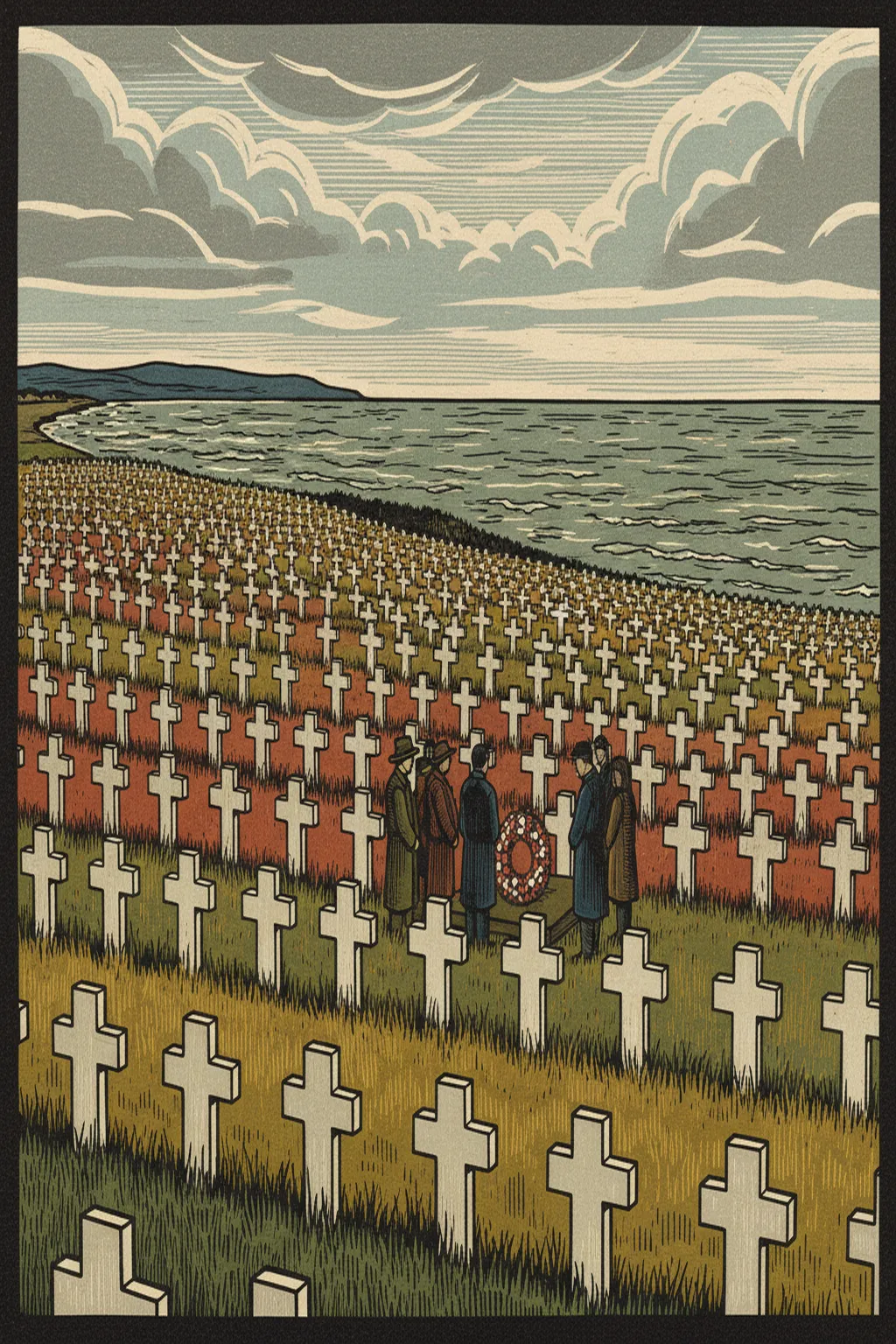
Ceremonies at the Normandy American Cemetery marked the 82nd anniversary of the D-Day landings this morning. The American Battle Monuments Commission held its commemorative event at 11 a.m. local time, at the cemetery above Omaha Beach where 9,389 Americans are buried in white crosses and Stars of David. Twenty-five World War II veterans made the return trip, brought over through a program organized by the Best Defense Foundation with Delta Air Lines. The ABMC noted that each year these ceremonies carry greater weight as the number of veterans able to attend continues to fall.
On June 6, 1944, approximately 156,000 Allied troops crossed the English Channel and landed on five beaches along fifty miles of the Normandy coast. The National D-Day Memorial puts the confirmed Allied dead on that first day at 4,414, including 2,501 Americans. Thousands more were wounded. The operation was the largest seaborne invasion in history, and within a year the war in Europe was finished.
The men who were eighteen that morning are a hundred years old today. A few of them were in Normandy this morning, standing at the bluff’s edge looking out at the water where it happened. Over 120 additional events are taking place across the Normandy region between June 2 and June 7, most of them without cameras, most of them attended by people who drove or flew there because they thought it mattered to show up. That number is probably about right.
Ukraine’s military launched its most extensive drone campaign of the year overnight, reaching targets approximately 1,000 kilometers inside Russian territory. The primary objective was Kronstadt, the historic naval fortress island in the Gulf of Finland near St. Petersburg, where Ukrainian drones struck naval arsenals and bases, according to President Zelensky. Russia’s Defense Ministry said its air defense systems downed 376 drones during the night, including more than 140 over Leningrad Oblast. Leningrad Oblast governor Alexander Drozdenko confirmed fires at a Defense Ministry facility in the Lomonosovsky district and said evacuations were underway. At least 12 drones were reported downed approaching Moscow.
The timing was not accidental. This weekend is the final day of the St. Petersburg International Economic Forum, the annual gathering Putin uses to project economic credibility to foreign governments and investors. Ukraine has targeted the forum before. It targeted it again.
Kronstadt has its own weight in the history of that region. The fortress island was part of the outer defense ring that helped Leningrad hold during the 872-day Nazi siege, from September 1941 through January 1944. Its guns covered the supply routes across the frozen Lake Ladoga that kept the city from starving. Military fire hasn’t reached the St. Petersburg area from outside since that siege ended. It reached there again last night.
Iran suspended peace negotiations with the United States this week, citing what Tehran described as Israeli violations of ceasefire terms in Lebanon. On June 2 and 3, Iranian drones hit Kuwait’s main international airport, killing one Indian national and wounding 63 others, including passengers and airport workers. Kuwait had reopened the airport only days earlier after a months-long closure forced by the conflict that began February 28. U.S. Central Command called the attack “deliberate, calculated, and unjustified.” Iran’s Revolutionary Guard denied firing at the airport, claiming the damage came from a failed U.S. interceptor missile. The U.S. rejected that account.
The U.S. military struck an Iranian military ground control station on Qeshm Island in the Strait of Hormuz in response. Iran said it had targeted U.S. facilities in Kuwait and Bahrain. Tehran has since threatened to “completely block” the Strait of Hormuz and the Strait of Mandeb, two shipping corridors that together handle a significant share of the world’s energy exports. Trump told ABC News on June 1 that he believed a deal reopening the strait was reachable “over the next week.” Iran’s suspension of talks suggests the two sides aren’t on the same schedule.
In April 1988, Operation Praying Mantis was fought in those same waters after Iran mined tanker routes during the Iran-Iraq War, the largest U.S. naval surface engagement since World War II. The Strait of Hormuz has been threatened in every decade since and has never closed. That history doesn’t guarantee a specific outcome. It does show how many times the worst case has been avoided, which is some form of evidence even if it isn’t a guarantee.
A Serbian United Nations peacekeeper was killed by mortar fire in southeastern Lebanon on June 4. Sergeant Milovan Jovanivić was struck at his position near Marjayoun. Two fellow peacekeepers were wounded. The UN Secretary-General’s spokesperson issued a statement condemning the attack and extending condolences to the Jovanivić family and to Serbia.
He’s the seventh UNIFIL peacekeeper killed since Lebanon hostilities resumed on March 2. Israel attributed the mortar fire to Hezbollah. Hezbollah denied hitting a peacekeeping position and stated its “unwavering commitment” to UNIFIL’s role in the region. The statement from Hezbollah was issued the same day the UN statement condemning the killing was released.
UNIFIL, the United Nations Interim Force in Lebanon, was established in 1978 after Israel’s first major ground incursion into the country’s south. The word “Interim” is still in the name. The force is forty-eight years old. Lebanese President Joseph Aoun, speaking on June 4, called the Washington ceasefire framework the “last chance” for a comprehensive truce. Jovanivić was killed hours after that statement.
The Bureau of Labor Statistics released its May employment report Friday morning. U.S. employers added 172,000 jobs last month, nearly double the 85,000 economists had projected. The unemployment rate held at 4.3 percent. BLS data shows the rate hasn’t moved outside a range of 4.3 to 4.5 percent since July 2025, a sustained narrow band that hasn’t appeared in U.S. labor data since the late 1990s.
The number that deserves a second look isn’t the headline figure. It’s the revision. The BLS revised its March estimate upward by 29,000 and April by 64,000, for a combined 93,000 jobs added to the prior two months’ counts. When revisions of that size run consistently in one direction, the most likely explanation is that the survey methodology is catching up with ground conditions, not that hiring is accelerating month over month. The May figure could move in either direction when August’s revision arrives.
Leisure and hospitality added 70,000 jobs in May, well above the sector’s recent monthly pace of 14,000. Whether that reflects World Cup hiring, which opens across sixteen U.S., Canadian, and Mexican cities on June 11, or broader travel demand, or something else, the May data alone doesn’t settle it. Healthcare added 35,000. Average hourly earnings rose 3.4 percent over the past year, per BLS.
The late 1990s comparison is worth holding carefully. In 1997, when the unemployment rate last held this stable for this long, the Federal Reserve kept waiting for inflation that hadn’t yet arrived. It arrived in 2021, twenty-four years later, from directions nobody in 1997 was watching. The Fed’s current concern isn’t the 1990s scenario; it’s Iran-driven energy costs, global supply chains, and whether AI adoption is suppressing headcount in ways that don’t show up until the hiring doesn’t happen. Those are different pressures. The record of low unemployment generating unexpected downstream effects is the part that stays consistent.
This week in the Letters section, Lorraine Kessler published “Since You Asked: Signs of Emotional Immaturity.” She writes about the patterns that appear in people who haven’t grown past certain emotional reflexes, and she does it without turning the piece into a checklist or a clinical exercise. It’s about recognition, which is the part of that subject most advice writing skips entirely. If you’ve spent time trying to name something you’ve been watching in someone close to you and haven’t quite gotten there, Lorraine’s probably gotten there. Friday is a good day to start with her column if you haven’t already.