Two hundred and fifty years ago today, the Continental Congress formally adopted the Declaration of Independence. The vote to break from Britain had come two days earlier, on July 2. The document was dated July 4, and the date stuck. Two and a half centuries is a span that defeats ordinary imagination, so the country does what countries do: it marks the occasion with events, fireworks, and varying degrees of reflection on what the day is supposed to mean. The varying is fine. The marking is the point.
On the National Mall in Washington, more than a million people gathered for a full day of programming. President Trump is scheduled to speak at 9:45 tonight. A fireworks display beginning at 10:30 p.m. will launch an estimated 850,000 shells from ten sites spanning the Lincoln Memorial Reflecting Pool and barges on the Potomac River, which organizers say will set a Guinness World Record for the largest fireworks display ever assembled. It runs approximately 40 minutes. CNN reported on the full schedule and the scale of the evening’s events.
This is the third centennial-scale July 4th in American history. The prior two are worth placing on the shelf beside this one.
July 4, 1876 was Philadelphia. The Centennial Exposition had been open since May and would draw roughly ten million visitors before it closed in November. The country was eleven years past the Civil War and still navigating Reconstruction. Ulysses Grant was completing a second term defined as much by corruption scandals as by governance. Alexander Graham Bell gave what was then the largest public demonstration of the telephone at the Exposition. The country was a hundred years old and trying to square what it had done in those hundred years with what the founding documents had said it would do. The trying didn’t resolve. It rarely does. But the Exposition drew ten million people, which means ten million people showed up anyway.
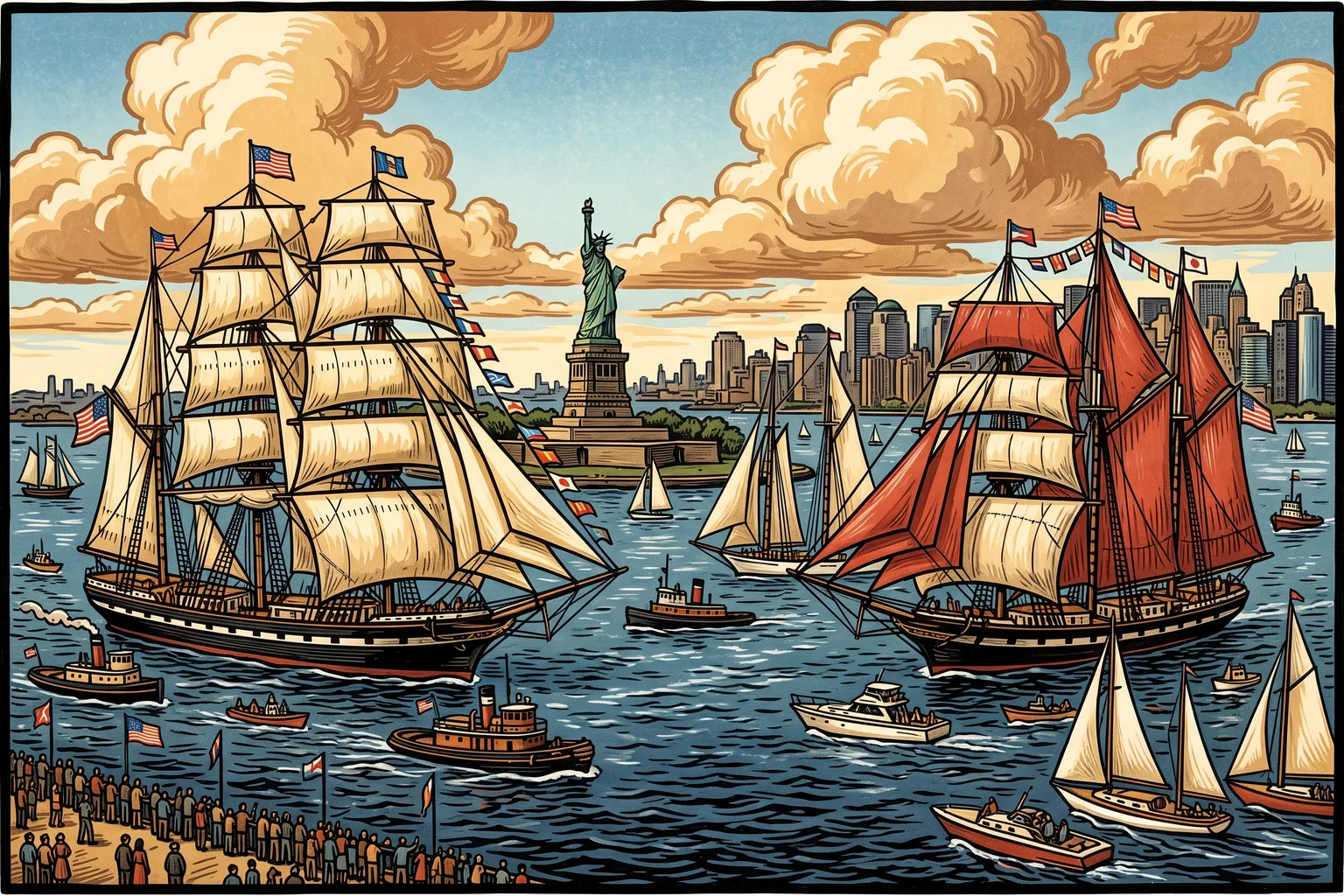
July 4, 1976 was New York Harbor. Operation Sail brought sixteen tall ships and some 225 sailing vessels from thirty nations for an international naval review. Gerald Ford reviewed the fleet from the deck of the USS Forrestal. Six million people gathered along the waterfront from Brooklyn to the New Jersey shore. The country was two years past Watergate and one year past the fall of Saigon, and the Bicentennial turned out to be genuinely joyful in a way that surprised people who had expected it not to be. Something about tall ships under sail in a harbor does work on people that most celebrations can’t. The country needed it. The ships delivered. [More on today’s harbor event at the close of this column.]
Iran opened the state funeral for Supreme Leader Ayatollah Ali Khamenei this morning at the Grand Mosalla prayer complex in Tehran. His coffin was placed in a glass case at 6 a.m. local time, and the public farewell ceremony began receiving mourners. Iranian authorities expect between fifteen and twenty million people to attend events over the next six days, which would make it the largest state funeral in Iran’s history. NPR reported from Tehran on the opening of the ceremony.
Iranian officials didn’t publicly acknowledge the date they chose to begin. At the Grand Mosalla, some mourners carried red flags, which carry the meaning of revenge in Shiite tradition, and crowds chanted “Death to America.” Today is July 4, 2026. The 250th anniversary of American independence. Those are the facts as reported. U.S.-Iran peace negotiations have been paused for the duration of the funeral. CBS News is tracking the ceremonies and the state of the negotiations.
Khamenei led the Islamic Republic from 1989 until his death. He was the republic’s second supreme leader. The first, Ayatollah Ruhollah Khomeini, founded the government after the 1979 revolution and died June 3, 1989. The Assembly of Experts elected Khamenei acting Supreme Leader the following day, June 4. The constitution was amended to remove a clerical qualification Khamenei didn’t hold, and the appointment was made permanent in August 1989. The framework Khomeini built, Khamenei administered for nearly four decades. The question now is who comes next. The peace talks between Washington and Tehran were already complicated before Khamenei’s death. They resume with a new interlocutor whose identity and posture haven’t been fixed. The pause is more than ceremonial. The Washington Post reported on the diplomatic context and what the transition means for negotiations.
The heat dome sitting over the eastern United States has expanded since Thursday. More than 185 million Americans are under heat alerts today, up from the 90 million reported earlier this week as the dome pushed further north and east. Washington, D.C., reached 100 degrees this morning. Philadelphia, where FIFA World Cup knockout-round matches are scheduled this afternoon, faces heat index values near 110 degrees. The National Weather Service has counted more than 300 temperature records falling this week. CBS News has been tracking the heat projections and the health advisories in place across the country.
President Trump told reporters Thursday that he’d deliver lengthy remarks from the National Mall regardless. “Even if it’s 107 degrees,” he said. The Hill reported on that exchange. Emergency medical stations are in place across the event area. The fireworks begin at 10:30 p.m., by which point the temperature will have dropped, though not to anything near seasonal norms. One million people are expected on the Mall for the evening.
The Russia-Ukraine war continued through the holiday. Following Thursday’s large-scale missile and drone attack on Kyiv, which killed at least 21 people and damaged more than 130 buildings, Ukraine’s military authorities issued mandatory evacuation orders for civilians from 61 settlements in the Kharkiv region as Russian forces pressed advances along that sector. Ukrainian drone strikes this week knocked out operations at the Lukoil-Nizhegorodorgsintez refinery, one of Russia’s largest gasoline producers. Al Jazeera has been tracking the front-line developments and the pattern of Ukrainian energy strikes inside Russian territory.
Vladimir Putin said this week that “massive, coordinated strikes against the infrastructure of Ukraine’s military-industrial complex and the facilities supporting its operation must continue.” The Kharkiv evacuation orders cover settlements that were, until relatively recently, near the active combat zone but outside it. They aren’t outside it anymore. CNN’s analysis of the Thursday Kyiv strike examined why residential targeting made it one of the deadliest single-night attacks on the capital since the war began.
And then there were the ships.
At 9:30 this morning, forty-three tall ships from twenty nations sailed from under the Verrazano-Narrows Bridge, past the Statue of Liberty, and north up the Hudson River to the George Washington Bridge. Thirty-seven U.S. and allied naval vessels were anchored along the parade route for the International Naval Review. At 10:15 a.m., the Blue Angels led a formation of 150 to 185 aircraft over the harbor. An estimated six million people gathered along the waterfront from Brooklyn to the New Jersey Palisades. Sail4th 250 covered the day’s full maritime program, from the first vessel’s departure to the aerial review.
The last time New York Harbor held something like this, it was also July 4th. The 1976 Bicentennial brought Operation Sail, with sixteen tall ships and hundreds of vessels from thirty nations, a naval review, Gerald Ford on the USS Forrestal, and six million people along the waterfront. Same harbor. Same bridge. The Statue of Liberty in roughly the same spot. The ships were different. The city was different. By most accounts, the feeling was recognizable.
There is something that sail-driven ships do to a crowd of people that other large objects don’t quite manage. They move slowly enough to watch properly. They’re old enough in design to feel like a thread back through the centuries that most of what we’ve built doesn’t offer. Forty-three of them crossed through New York Harbor this morning, carrying fifteen thousand sailors from countries that showed up for this particular kind of occasion on this particular day. Six million people were on the waterfront. The heat was real. The ships were real. Both were true at the same time, and the ships were still something.
Our Friday colleague spotlight is Lorraine Kessler, writing in the Letters section. Lorraine’s most recent piece, published July 1, is called “Since You Asked: How to Grieve a Parent.”
The letter is from Patricia in Raleigh. Her mother died four months ago at 81, which everyone keeps mentioning as though the age should change what it feels like. Patricia handled her mother’s care without falling apart. She’s practical. She doesn’t understand why she can’t seem to handle the grief the same way. Her brother flew in for the funeral, cried once, and went back to his regular life. Her sister hasn’t left the house in three weeks. Neither of them looks like someone Patricia recognizes right now.
Lorraine’s answer is the kind of thing that takes thirty years of sitting with bereaved families to be able to say plainly. The caregiving had structure. The grief doesn’t. Four months isn’t enough time. She tells Patricia that the second year is often harder than the first, and she explains why in a way that lands: the first year’s milestones you see coming and brace for, but the second year’s catch you off guard in the spice aisle or a parking lot. She tells Patricia that the impulse to reach for the phone to call her mother isn’t pathology. It’s a thirty-year habit meeting a four-month loss, and the math isn’t in the habit’s favor yet. And she explains, with precision and without judgment, that Patricia’s brother and sister are grieving the same person in two different bodies, and what looks like indifference or collapse from the outside is usually something more private than that.
It’s one of those pieces that makes you want to pass it to someone who needs it. It’s in the Letters section.
Howard Fenn writes The Day, Monday through Friday.