Brent crude crossed $100 a barrel Friday. It’s the first time since the June ceasefire briefly eased things.
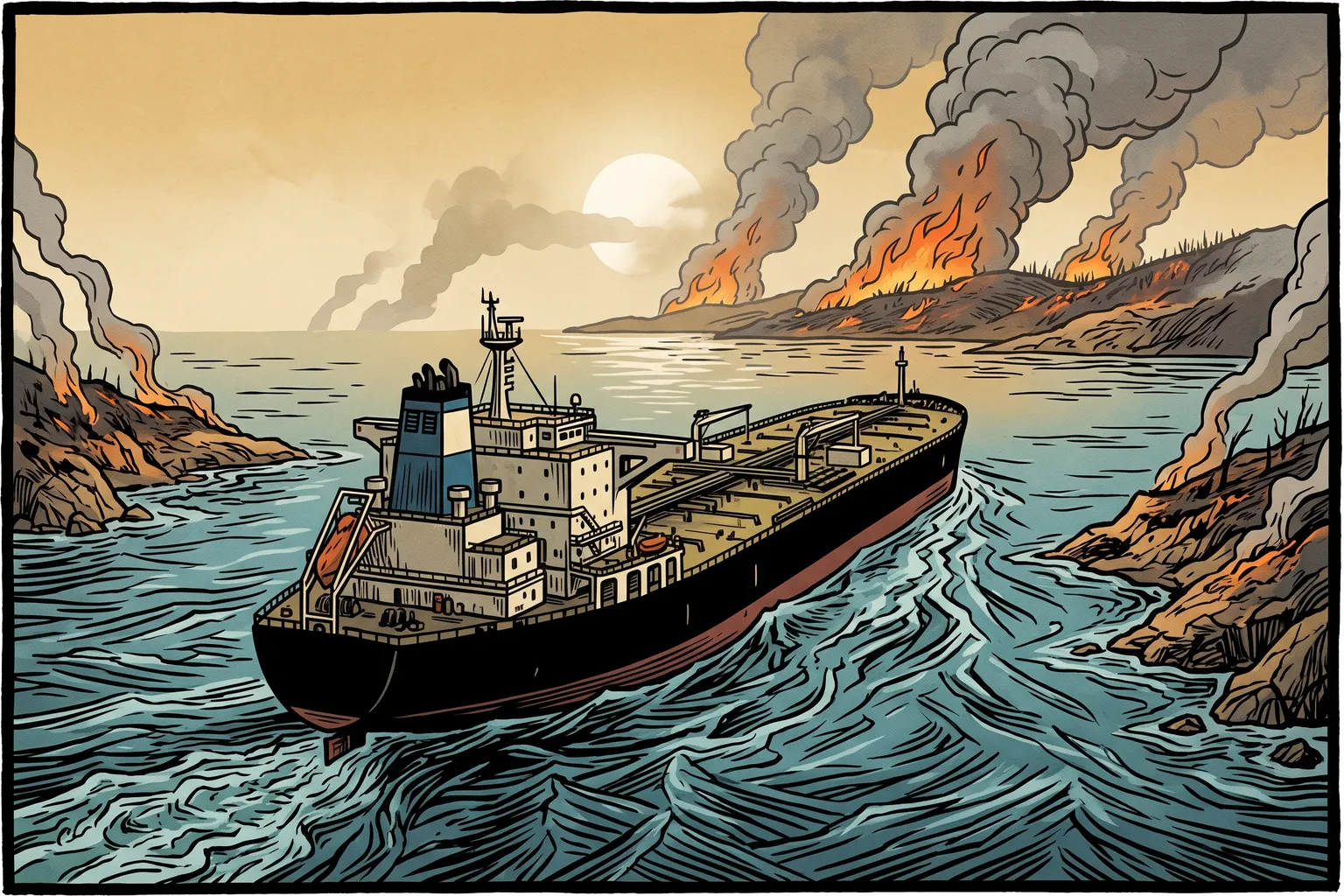
The two-strait problem drove it. The Houthis struck two Saudi tankers in the Red Sea on July 23 and declared a naval blockade on Saudi shipping, opening a second contested maritime corridor at the same time the Strait of Hormuz remains under active pressure. The Strait is carrying about 25 ships a day now, down from a peak of 49 on July 7. The Bab el-Mandeb, through which roughly 10 percent of global oil trade flows on its way to and from the Suez Canal, is now simultaneously under Houthi interdiction. Britain withdrew its embassy staff from Tehran this week, a move the Foreign Office confirmed without elaboration. OPEC+ producers whose exports can route outside the contested zones increased their August production allocations last week. The workaround buys time. It doesn’t reopen the chokepoints.
President Trump told reporters Friday morning that Iran is showing “its most serious commitment yet” in ongoing talks but said the US is “locked and loaded” if military action becomes necessary. Anadolu Agency carried the statement in its morning briefing. Trump also warned China and Russia against supplying weapons to Tehran. The European Union sanctioned five Iranian Revolutionary Court judges the same day for alleged human rights violations, including death sentences handed down to political dissidents connected to the 2022 protests. Two tracks are running at once: one carries the threat of bombs; one carries the slower mechanics of international censure. Both have been running all week without producing a resolution.
The last time Brent crude held above $100 for more than a brief stretch was 2014, when Libyan production disruptions and the rapid advance of ISIS through Iraq coincided to push prices. That episode resolved over months as production adjustments reset the supply picture. The current pressure comes from a different mechanism: not a supply cut but simultaneous blockades on two transit corridors, a combination without a clear precedent in the modern oil market. US gas prices reached $4.019 a gallon Friday, roughly 35 percent above pre-conflict levels. New US tariffs of 10 to 12.5 percent also took effect Friday on 60 trading partners, citing forced-labor concerns and affecting nearly all US trade. Global markets declined. The week ends with oil at $100, a new tariff round in place, and no ceasefire agreed.
Wildfires have forced the evacuation of roughly 200,000 people across Spain and France. Al Jazeera’s Friday coverage puts 141,000 in France’s Gironde and Landes departments, including the entire Cap Ferret peninsula, where more than 50 houses burned. Spain’s count in the Madrid region is roughly 25,000 more, including more than 1,200 elderly and disabled residents evacuated from care facilities. French Prime Minister Lecornu described the situation this week: “The fires which are hitting our country have reached a level that has never been seen before.” Madrid’s emergency chief Carlos Novillo was specific about what that meant on the ground: “The wildfire is at its peak and is currently beyond the capacity of firefighters to contain.”
Spain’s national emergency, the first for a wildfire in the country’s history, is in its second day. Two fires near Villa del Prado and San Martin de Valdeiglesias in Madrid province have merged with a blaze in Castilla y Leon; the combined front hasn’t been turned. Temperatures near the capital are forecast to reach 44 degrees Celsius through the weekend. Croatia, Portugal, the Czech Republic, and Slovakia sent aircraft. Italy and Greece sent water bombers. The Irish Times has tracked the cross-border response. The reinforcements are in the air. The fires have been faster than the reinforcements.
Russia struck a defense industry and drone exhibition in Kapitanivka village in the Kyiv region on Thursday, killing at least 10 people and injuring roughly 100. Kyiv regional head Ruslan Oliinyk declared Friday a day of mourning and said: “July 25 is a Day of Mourning in Kyiv region. On July 24, the enemy cynically struck a place where people were present.” UNN carried the declaration. Russia said the exhibition was displaying drones used in attacks on Russian territory and that it had targeted the event deliberately. Among those killed was Valentina Savitskaya, who led Ukraine’s Center for International Cooperation and Strategic Communications at the State Security Administration. President Zelensky responded: “In wartime, with such an enemy, no weapons exhibitions can be held.” Two criminal proceedings were opened, including an investigation into the decision to hold the exhibition during active war.
General Mykhailo Drapatyi, in his second full day as Ukraine’s commander-in-chief, met with US Ambassador Matthew Whitaker to discuss battlefield strategy and joint defense production. A Zelensky-Trump meeting in Washington is reportedly planned for next week, with drone manufacturing and Patriot air defense on the agenda. Russia launched 157 attack drones and two guided missiles overnight into Friday. Sloviansk took aerial bombs that killed 5 and injured 9. Flags in Kyiv region were lowered. The attacks didn’t pause.
Venezuela’s confirmed death toll from the June 24 earthquake sequence reached at least 5,546 Friday, up from 5,398 the day before, according to updated government figures. Two survivors were pulled from rubble on July 23, more than four weeks after the twin quakes. Tens of thousands remain in temporary camps and emergency housing. The Venezuelan government hasn’t released a unified missing-persons count; independent tallies range from 18,000 to more than 41,000. The daily bulletin continues.
A second heat dome is building over the western United States. NBC News is tracking it with updated maps. The first wave, which ran from late June through early July, killed at least 44 people across New Jersey, Pennsylvania, Illinois, New York, and Mississippi. Arizona has confirmed 18 deaths from the forming second wave, with more suspected. The Extreme Heat Emergency Act, which would authorize federal disaster declarations for extreme heat under the Stafford Act, hasn’t advanced to a floor vote in either chamber. Extreme heat has never received a major federal disaster declaration in the law’s history. The legal gap that existed in 1980, when Missouri’s request was denied, remains in place.
The numbers in this week’s news have been very large. Venezuela at 5,546. The heat toll building across two waves. The Ebola count climbing past 1,000 confirmed dead in the DRC. Numbers that large have a tendency to separate from the people they represent, which is one of the things that makes them possible to read about and hard to actually understand. Lorraine Kessler, who writes the Since You Asked advice column in the Letters section, published a piece at the start of the month that’s worth finding this week: How to Grieve a Parent. It came from a reader named Patricia in Raleigh who lost her mother four months earlier and couldn’t explain why she still wasn’t able to get through a morning. “Grief isn’t a task,” Lorraine wrote. “It doesn’t respond to the organizational skills that got you through the last six weeks of her illness.” The losses counted in this column will be grieved that way, by individual people, on their own calendars, in their own kitchens. The piece is there if this week brought that kind of counting closer than usual.
Confirmed deaths from the Ebola outbreak in the Democratic Republic of the Congo passed 1,000 this week. The WHO’s outbreak page carries the current official figures: 2,536 confirmed cases and at least 1,033 deaths as of July 21, concentrated in Ituri province. The WHO has described this as the fastest-growing Ebola outbreak on record. The 2014 West African outbreak took 142 days to reach 1,000 deaths. This one took 67. More than 80 percent of new infections are appearing outside known contact chains, meaning the virus is moving through communities the surveillance systems haven’t yet found. US airport screening at Dulles, Hartsfield-Jackson, George Bush Intercontinental, and JFK remains in effect through mid-August.
Uganda is on Day 10 of the 42-day surveillance countdown required for an Ebola-free declaration. No new cases have been confirmed there since June 21. The last patient was discharged from Mulago National Referral Isolation Centre on July 16, and the countdown started that morning. WHO Africa is tracking the progress. If no new cases appear, the declaration comes August 27.
In 2022, it ran this same protocol through an Ebola outbreak and declared it over in 55 days. What made that work wasn’t speed or luck but consistency: daily surveillance, contact tracing, isolation, reporting, done by the people whose job it was to do it. That protocol is running now. Day 10 of 42. No new cases. August 27 is still out ahead. But ten days is ten days, and ten is where Friday left it.
Howard Fenn writes The Day, Monday through Friday.