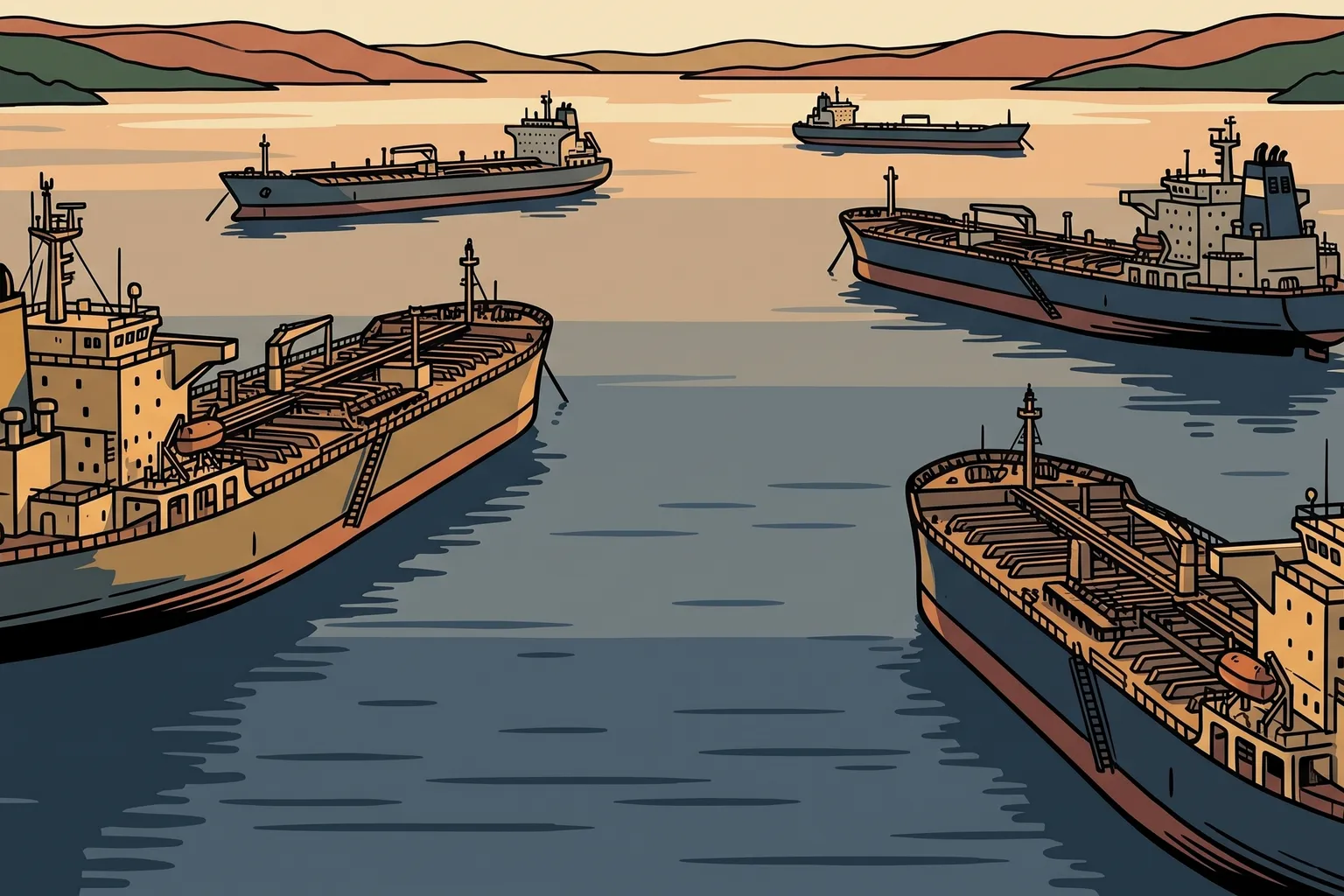
Friday was the deadline everyone had named for a Hormuz deal. Friday came.
Iran’s foreign ministry spokesperson Esmaeil Baghaei said this week that Tehran and Muscat had reached agreement in principle on the geographical coordinates for new shipping corridors through the Strait of Hormuz, and that a joint statement on a provisional arrangement was, in his words, “in the final stages.” A Gulf official had estimated fifty-fifty odds of a signed deal by today. President Trump said Thursday that “a lot of progress had been made” and suggested an announcement was coming. Oil prices fell on the expectation. Friday produced none of the documents.
What Friday produced instead was a different agreement. Saudi Arabia, Turkey, and Pakistan signed what they’re calling the Mecca Joint Deterrence Agreement in the holy city on Friday, according to Al Jazeera’s live coverage. The text states that “any armed attack against any one of the three states shall be regarded as an attack against them all.” Turkey contributes NATO’s second-largest military. Saudi Arabia is the world’s largest oil exporter. Pakistan is the only Muslim-majority country with nuclear weapons. The pact reshapes the regional security picture while the Hormuz negotiation is still being typed.
On the Hormuz talks themselves: as of Friday afternoon, Al Jazeera reported that high-level approval from Tehran was still pending on the framework Iran and Oman had developed. Iran’s conditions haven’t changed. Tehran wants the United States to formally commit to ending military threats before commercial shipping resumes. Tehran also insists the legal regime at the strait won’t return to its pre-war state. Washington insists that any form of Iranian state control over international waters violates international maritime law. Secretary of State Marco Rubio has said this repeatedly. Neither position has moved.
In January 1981, the Algiers Accords freed 52 American hostages who had been held in Tehran for 444 days. The final signatures came so late that the hostages’ planes were clearing Iranian airspace as Ronald Reagan delivered his inaugural address. The talks had moved through Algerian intermediaries in stages, each stage producing a partial agreement that the next stage had to ratify, each stage producing a new set of conditions that everyone assumed were the last ones. From the outside it looked as though a deal was always nearly done. From the inside the parties were moving through a sequential set of conditions where meeting one simply revealed the next. The Hormuz talks have that quality. A deal is still close. Close, in these negotiations, is a geographical description, not a time estimate.
Ukraine
Volodymyr Zelensky arrived in Belgrade on Friday, his first official visit to Serbia since Russia’s full-scale invasion of Ukraine began in 2022. Meetings with Serbian President Aleksandar Vucic are scheduled for Saturday. Serbia has condemned the invasion while declining to impose sanctions on Moscow, a position Vucic has maintained since February 2022. Bloomberg reported that the visit comes as Vucic has been scaling back Russian economic influence in the country.
There’s a separate number from this week that deserves mention. Fighter scrambles along the alliance’s eastern flank rose by more than 250 percent in July 2026 compared with July 2025, according to Allied Joint Force Command. Russian military aircraft repeatedly approached NATO airspace without flight plans and with transponders off. Allied fighters intercepted and escorted them.
General Mykhailo Drapatyi, Ukraine’s new army chief since late July, held the front lines in eastern Ukraine roughly where they were. Zelensky’s request for additional Patriot air defense systems, which he’s raised in every meeting with Western allies for months, remained unanswered.
Spokane
The three fires burning northwest of Spokane are gaining on their containment lines. The Old Trails Fire, at 3,556 acres, is 43 percent contained. The Autumn Lane Fire, at 5,784 acres, is 47 percent contained. The Fairview Fire, at 992 acres, is at 31 percent, according to MyNorthwest. More than 1,500 firefighters from 24 states remain deployed.
Aaron Farinacci, 37, was arraigned Thursday on five counts of first-degree arson. His public defender requested a competency evaluation. The court granted it. His next court date is September 4. Court documents filed this week show that Farinacci told investigators he set approximately 25 fires over the past year.
The fires destroyed more than 800 structures and forced 65,000 Spokane County residents from their homes. Moving in the right direction on containment and being done aren’t the same thing. The people who lost those homes aren’t waiting for the September 4 hearing to figure out where they go next.
Michigan
Tuesday’s Democratic Senate primary in Michigan ended with Abdul El-Sayed defeating Representative Haley Stevens by one percentage point, according to the Washington Post. El-Sayed, a physician and former public health official, ran a progressive campaign against more than $65 million in outside spending deployed in support of Stevens, per NBC News. He’ll face Republican Mike Rogers in November for a Senate seat that’s in play for both parties.
In 2006, the last midterm cycle with a second-term Republican president in the White House, Democrats gained six Senate seats and won control of the chamber. Whether 2026 moves similarly depends on many variables. Michigan’s race is one of them. El-Sayed’s margin in the primary came substantially from Arab American and Muslim communities in the Detroit area. Whether that coalition holds and expands into the general electorate against Rogers is a different calculation than the primary map.
DRC Ebola
The Ebola outbreak in the Democratic Republic of the Congo, caused by the Bundibugyo strain, has now recorded 3,973 confirmed cases and 1,850 deaths, according to UN News. A new 80-bed treatment center opened in the affected region this week. Cases have been confirmed in five displacement camps in Ituri Province, which complicates containment in ways that a fixed-population outbreak doesn’t.
The 2018-2020 Kivu outbreak was previously the largest single Ebola event on record, at 3,481 confirmed cases. This one has passed it. The Bundibugyo strain is historically less lethal than the Zaire strain, but the numbers are moving in one direction and the displacement camp factor is significant.
Kumamoto
Nine days after the magnitude 7.1 earthquake struck Kumamoto Prefecture on July 28, the death toll stands at 39, according to the Japan Times. Thirty-six people died directly in the earthquake. One person died of suspected heatstroke while sheltering in a vehicle, which counts as a disaster-related death under Japanese classification. Roughly 6,500 people remain in evacuation centers.
The prefecture has recorded temperatures above 40 degrees Celsius in the days since the quake. The prefectural government has begun moving shelter residents to hotels and secondary lodging. Fifty makeshift housing units are being built in Uki, twenty more in Hikawa. Japanese disaster response workers use the term kuruma hijiyusha, vehicle evacuees, for the people sleeping in their cars to find air conditioning that the shelters can’t provide. Their numbers have been falling this week. That’s the right direction.
A Colleague’s Work
Jean Hadley published two pieces Thursday that are worth your time if you have a kitchen. The Best Cast Iron Skillets landed on the Stargazer 10.5-inch as her top pick after testing six models. She considered weight, handle geometry, and how the factory seasoning held up through actual use, which is the part that separates the work from the press release. Lodge is in the piece as well, at $35, for people who want the reliable answer without the deliberation.
The Best Stand Mixers is there too, if you’ve been waiting on the KitchenAid question.
Good practical knowledge is hard to come by. Jean does the work.
The Montreal Protocol was signed in 1987 by two dozen governments. It’s now been ratified by every nation on Earth. The agreement required countries to phase out chlorofluorocarbons and other chemicals eroding the ozone layer above Antarctica. When the protocol was signed, atmospheric scientists estimated full ozone layer recovery might take until roughly 2070.
The World Meteorological Organization reported last year that the 2025 Antarctic ozone hole was the weakest and shortest-lived in five years. The closure came earlier than models had predicted. WMO scientists credited the protocol and its amendments, which have now led to the elimination of 99 percent of ozone-depleting substances from global production. The hole is projected to fully close by the late 2060s, roughly on the original timetable.
This isn’t a story about everything working. Most things don’t. But governments representing nations with different economies, different interests, and different political systems agreed on something in 1987 and kept agreeing for thirty-eight years, and the atmosphere above Antarctica is measurably different because of it. The hole is still there. It’s also smaller. That’s the full picture.