A Gulf official put the odds of a deal at fifty-fifty by Friday. Friday is tomorrow.
Iran’s foreign ministry spokesperson, Esmaeil Baghaei, said Wednesday that Tehran and Muscat had agreed on the geographical coordinates of a navigable channel through the Strait of Hormuz, and that a joint statement on a provisional arrangement was, as he put it, “in the final stages.” By Thursday morning, Iran was still saying the deal was close. President Trump said Thursday that “a lot of progress had been made” and suggested an announcement was forthcoming. The oil market moved lower on the expectation. And yet, Thursday ended without a signed document.
This is how the negotiations have moved all summer. A statement of willingness. A report of progress. An announcement that the announcement is nearly ready. Each iteration brings the deal incrementally closer to the page, and each iteration also reminds anyone who has watched these talks that the distance between “agreed in principle” and “signed” is where the hardest arguments live.
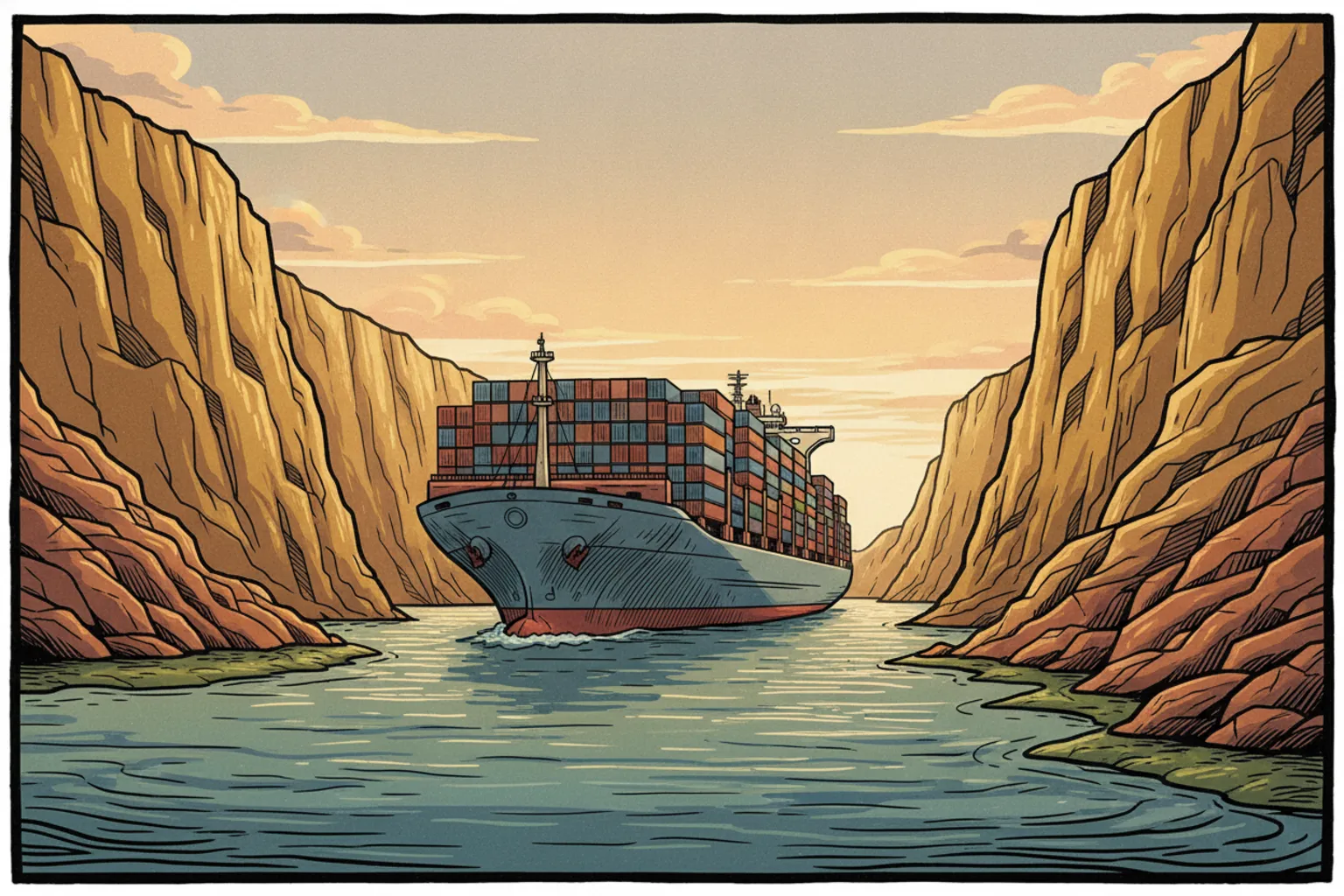
What Iran and Oman have been negotiating, as Bloomberg reported Wednesday, involves new shipping lanes through the strait: commercial vessels entering through an Iranian-controlled corridor and exiting through one controlled by Oman. Iran has also sought assurances that American and Israeli vessels would transit under different terms than neutral commercial shipping, and that the United States formally commit to ending military threats before vessels move freely. The framework doesn’t dissolve those conditions. It structures how they might be satisfied.
In July 1988, after eight years of grinding war with Iraq, the Ayatollah Khomeini accepted United Nations Security Council Resolution 598, the ceasefire that ended the Iran-Iraq War. He had resisted it for nearly a year. When he finally relented, he described accepting it as drinking from a poisoned chalice. The document was done. The fighting didn’t stop immediately. It took weeks of additional work before the guns went quiet, because the acceptance of a resolution and the implementation of its terms are two different things, and the gap between them is where things tend to go wrong.
Thursday isn’t that gap. The talks aren’t yet at Resolution 598. But the historical instruction holds: the announcement that a deal is close isn’t the deal. Friday will tell us something. So will Saturday. The strait has been partially or fully closed to commercial shipping for most of the past month, and the pressure on all parties to make the paper real is accumulating.
Ukraine
Kyiv held its day of mourning Wednesday, honoring the 15 civilians killed and 51 wounded in Tuesday night’s attack. Thursday, the war resumed its tempo.
President Zelensky is scheduled to visit Serbia on Saturday, his first trip to the country since Russia’s full-scale invasion began in 2022. Serbia has maintained historically close ties with Moscow, and the visit carries weight for both sides. NATO reported separately that aircraft scrambles along the alliance’s eastern border rose by 250 percent in July 2026 compared with July 2025, driven by Russian military aircraft skirting Alliance airspace without filed flight plans.
General Mykhailo Drapatyi is two weeks into his command as Ukraine’s new army chief. The front lines in eastern Ukraine held roughly where they were. Zelensky’s request for additional Patriot air defense systems remained unanswered. He has made that request in every meeting with Western allies for months.
Spokane
Aaron Farinacci, 37, stood before a Spokane County judge Thursday for his arraignment on five counts of first-degree arson. Bail was raised to $2 million. Court documents filed this week showed that Farinacci told investigators he was responsible for approximately 25 fires over the past year, not only the Old Trails Fire he was originally charged with setting on August 1.
That fire alone has burned more than 3,500 acres and destroyed more than 800 structures. Along with the Autumn Lane and Fairview fires, it has forced 65,000 Spokane County residents from their homes. Firefighting crews established primary containment lines around all three fires and worked Thursday to reinforce them, according to Oregon Public Broadcasting. More than 7,000 fire personnel remained deployed across Washington state.
Farinacci’s public defender requested a competency evaluation, which the court granted. That evaluation will take time. So, in all likelihood, will the rest of this case.
A Colleague’s Work
Our living and outdoors columnist Gary Kowalski published a piece Wednesday worth your time: “The Best Golf Rangefinders” at /living/best-golf-rangefinder/. Golf is a sport that rewards precision above most other virtues. The shot you’re about to hit, the number from flag to ball, the slope you didn’t account for because you were guessing rather than knowing. Gary tested six models and came away with a clear recommendation. He has done the careful work so you can spend your energy on the shot itself.
Gaza: Uganda Votes Yes
Uganda’s parliament voted Thursday to deploy troops to Gaza as part of the International Stabilization Force proposed by the Trump administration’s Board of Peace. The motion passed after being brought by Uganda’s defense minister. Uganda joins Morocco, Indonesia, and Albania in formally committing to the force, which is to be led by Major General Jasper Jeffers of the United States Army.
The force was proposed in the context of a July 31 framework agreement, under which Hamas agreed to a roadmap for disarmament in stages and Israel agreed to withdraw its forces over time. Both parties attached conditions. Hamas has said it won’t implement any part of the deal until Israel fulfills its own withdrawal obligations. The disarmament roadmap is to be detailed within 14 days of the agreement’s activation.
Uganda’s vote doesn’t make the force real. It makes it one country more real. Whether the July 31 framework holds long enough for an international force to actually enter Gaza remains to be seen.
Ebola: A New Center Opens
The Democratic Republic of Congo’s Ebola outbreak continues to grow. Approaching 4,000 confirmed cases and with more than 1,750 deaths since the outbreak was declared in May, it’s now the second-largest Ebola outbreak in recorded history. The Bundibugyo strain driving it has no approved vaccine, and it’s concentrated in Ituri province, where conflict-displaced populations in overcrowded camps have made containment considerably harder than in outbreaks where health teams have full access.
The United Nations reported this week that a new 80-bed treatment center has opened in the outbreak zone, funded in part by the $242 million in additional U.S. State Department funding announced Wednesday. Treatment access has been one of the limiting factors throughout. More beds don’t solve the containment problem by themselves, but they’re part of what has to happen before the curve bends.
Uganda, which recorded 20 cases and 2 deaths in a cross-border spillover, completed its 42-day surveillance period and was declared Ebola-free on July 28. That is how this ends when it ends: methodically, day by day, contact by contact.
Kumamoto: One Week In
One week after a 6.8-magnitude earthquake struck Kumamoto Prefecture in southern Japan, 38 people are confirmed dead, more than 8,000 remain in evacuation centers, and temperatures have reached 40 degrees Celsius in the region. The extreme heat has complicated every aspect of recovery.
The Japan Times reported Thursday on what the earthquake has revealed about Japan’s preparedness: the country’s physical response systems, roads cleared, rescue teams deployed, emergency coordination functioning, performed well. The daily-life systems, water service restoration, care for elderly residents, supply logistics, were slower, and in some cases still incomplete a week later. Renesas Electronics, the semiconductor manufacturer operating in Kumamoto, resumed production ahead of its original schedule, a positive sign for the global chipmaking supply chain.
Japan rebuilt after the 1995 Kobe earthquake, which killed 6,434 people, with significant investment in seismic engineering and emergency response. The readiness those investments produced is visible in how this week has gone. What the three decades of preparation didn’t fully address was the last-mile problem: not finding people alive, but keeping people who are alive functional while their neighborhood slowly comes back. That work is ongoing in Kumamoto today.
A Pill Once a Week
At the AIDS 2026 conference in late July, Gilead and Merck reported results from two Phase 3 clinical trials showing that an investigational once-weekly pill combining islatravir and lenacapavir maintained viral suppression at rates equivalent to a standard daily antiretroviral regimen. The trials enrolled patients who switched from daily treatments. Viral suppression held. No new safety concerns were identified.
When the FDA approved AZT in March 1987, the first drug shown to work against HIV, the regimen required patients to take a dose every four hours around the clock, through the night, at doses that caused anemia in many who took them. The treatment worked better than nothing. It was also brutal to sustain. The science of HIV treatment has spent nearly four decades moving in one direction: fewer doses, lower toxicity, simpler schedules. Once a week is the logical end of that direction.
For the tens of millions of people living with HIV worldwide, adherence to a daily regimen is effective medicine and demanding medicine both. A once-weekly pill doesn’t change the virus. It changes the friction. And reducing friction in medicine tends, reliably, to mean more people actually taking the treatment that works.
That’s something.