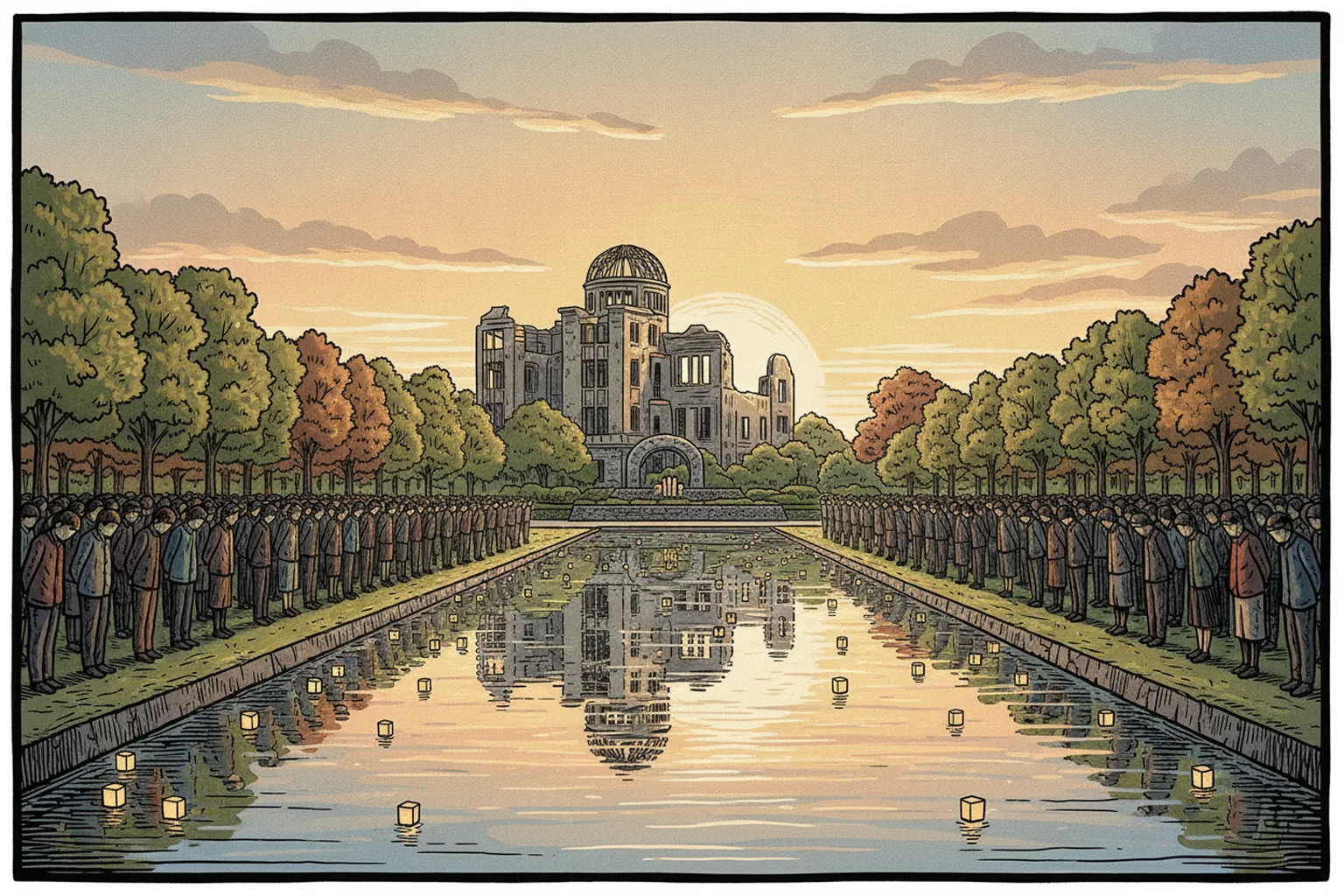
August 6, 1945, at 8:15 in the morning, a United States B-29 released an atomic bomb over Hiroshima, Japan. Eighty-one years later, to the hour, 50,000 people stood in silence in Hiroshima’s Peace Memorial Park as the Peace Bell rang.
Hiroshima Mayor Kazumi Matsui gave the city’s annual peace declaration and told the crowd: “Downplaying the inhumanity of nuclear weapons and accepting the use of force to pursue one’s own prosperity risk cycles of violent retaliation that could ultimately result in another Hiroshima or Nagasaki.” ABC News carried the full AP account of the ceremony. Delegations from about 120 countries attended, including representatives from the United States and from Iran. Japanese Prime Minister Sanae Takaichi was present. Matsui’s declaration said that too many of the world’s leaders “still consider nuclear deterrence a realistic approach and legitimize violence,” which he argued pushes the goal of a nuclear-free world further away rather than closer.
It’s worth holding that word for a moment. Deterrence. On this particular August 6, in this particular year, the word isn’t a relic of Cold War strategic doctrine. It’s a live argument happening in real time between governments that are, as of Wednesday morning, still negotiating across a body of water through which twenty percent of the world’s oil supply passes. The governments sending delegations to the ceremony in Hiroshima are the same governments that are trying to agree on who controls the Strait of Hormuz. The mayor’s remarks weren’t abstract.
The city that holds this ceremony every year isn’t trying to adjudicate the history of 1945. Hiroshima understood what a nuclear weapon does to a place with people in it, and it decided that knowing this and saying so, out loud, every year, at the moment it happened, was one of the things a city could do. In August 1955, ten years to the month after the bombing, the city opened its Peace Memorial Museum, designed by the architect Kenzo Tange. The rubble and the ceremony are both part of the same city, and always will be.
Our colleague Arthur Dandridge, who writes about books and the traditions that build readers, has a piece in the Ideas section today that feels right for this morning. His guide, “Toni Morrison: Where to Begin,” recommends starting with Song of Solomon and approaching Beloved on its own terms, without the armor of expectation. Morrison’s subject was memory, and what happens to people who carry histories too heavy to speak plainly. On a morning when Hiroshima rings its bell and world powers send delegations to a park built over rubble, that’s the right kind of reading.
There was no deal on the Strait of Hormuz on Wednesday.
Treasury Secretary Scott Bessent had said Tuesday that a deal was possible “today or tomorrow.” President Trump said Wednesday morning the strait would be reopened “soon.” By midday, there was no announcement. CNN’s live updates on Wednesday reported that Iranian and Omani negotiators have finalized a draft framework and are waiting for final approval from Supreme Leader Ayatollah Mojtaba Khamenei. Iran’s official spokesperson Gharibabadi continued to deny any direct negotiations with the United States. The talks, by Iran’s account, are exclusively between Iran and Oman.
The shape of the proposed arrangement: Iran would have a measure of control over the strait’s transit lanes. Iran has pushed for service charges on commercial vessels using the route, a provision the United States had previously called unacceptable. Whether that language survived into the current draft isn’t publicly known. One Gulf official familiar with the talks told NBC News there is a “50:50” chance Iran and Oman reach something by Friday.
The pattern is recognizable. Public denial while back-channel progress continues is a recurring feature of Iranian diplomacy, with enough precedents that it qualifies as a tradition. The Algiers Accords of 1981, which ended the Iran hostage crisis, were negotiated through Algeria over months while Iran publicly refused to deal directly with the United States. That pattern doesn’t predict the outcome. It does describe how the pieces tend to move.
Russia struck Kyiv and the surrounding region overnight Tuesday into Wednesday, and the Kyiv regional administration declared Wednesday a day of mourning.
At least 15 people were killed and 51 wounded in the strike, according to live updates from the Kyiv Post. Ukrainian drones hit Wildberries warehouse facilities near Moscow and St. Petersburg on Wednesday in response, continuing the economic-attrition strategy Kyiv has been running for several weeks. Separately, wreckage from a Russian Geran-2 attack drone came down near the village of Văleni in southern Moldova, adding to a running list of Russian drone incidents that have landed beyond Ukraine’s borders.
Monday night’s barrage, covered here Tuesday, was the deadliest single strike on Kyiv this month. Wednesday’s attack was a continuation, not a change. The Patriot interceptor shortage remains the central problem for Ukraine’s air defenses. Ballistic missiles still aren’t being stopped. The economic counterstrike strategy hasn’t yet produced the negotiating pressure Kyiv is looking for. Neither of those situations changed this week.
The results from Tuesday night’s Michigan Democratic Senate primary were still settling Wednesday, and they surprised most of the analysts who had been watching the money.
Abdul El-Sayed, a public health physician and progressive who ran for governor of Michigan in 2018, beat Representative Haley Stevens by approximately one percentage point, with nearly all votes counted. NBC News called the race for El-Sayed. AIPAC had backed Stevens with more than $30 million, part of more than $60 million in outside spending from pro-Israel groups that went against El-Sayed in the primary. He won anyway, by a single percentage point. AIPAC said Wednesday it plans to continue opposing El-Sayed through the general election.
He faces former Republican Representative Mike Rogers in November in a race that analysts expect to be one of the most competitive in the country, with Senate control potentially depending on its outcome. If El-Sayed wins, he’d be the first Muslim elected to the U.S. Senate. Michigan’s Arab and Muslim American communities, concentrated heavily in Wayne County, voted in large numbers for El-Sayed. In 2024, many of those same voters had stayed home or voted third party in protest of U.S. policy toward Gaza. Tuesday’s primary was, in part, a measure of whether they’d come back and in what form. They came back with a nominee from within their community.
The outside-spending question is worth watching past this race. AIPAC spent over $60 million in Democratic primaries across the 2026 cycle, according to NBC News, compared to roughly $40 million two years ago. El-Sayed won anyway. What that means for the broader strategy is something the organization’s donors and strategists will be working through for the next few months.
The first meaningful containment progress in the Spokane fires came Wednesday.
The Old Trails Fire, which had been at zero percent containment since it started August 1, reached 13 percent Wednesday, with the Autumn Lane Fire also at 13 percent and the Fairview Fire at 5 percent. MyNorthwest confirmed the containment figures. Favorable weather and cooler temperatures this week gave fire crews the window they’d been counting on since the fires started. The three fires have together burned more than 10,000 acres and destroyed approximately 700 homes. At least 65,000 people remain under evacuation orders.
Aaron F. Farinacci, 37, remains in custody on $1 million bond on suspicion of first-degree arson in connection with the Old Trails Fire. His arraignment is pending. Spokane County confirmed the arrest earlier this week. Investigations into the other two fires are ongoing.
Thirteen percent isn’t containment. But going from zero to thirteen in twenty-four hours, with cooler weather behind it, is the shift that fire crews have been working toward since the weekend. The people under evacuation orders are still not home. The direction has changed.
The DRC Ebola outbreak passed another marker this week. As of August 4, the Democratic Republic of the Congo reported 3,874 confirmed cases and 1,751 related deaths, according to the CDC’s current outbreak summary. This is now the second-largest Ebola outbreak in recorded history. The outbreak is caused by Bundibugyo virus, a strain for which no approved vaccine exists. Ituri province accounts for more than 3,375 of the confirmed cases. The State Department announced Wednesday an additional $242 million in funding for outbreak response and preparedness in the DRC and Uganda. The full State Department update is dated August 5.
WHO has described the situation as “intensifying.” The case numbers that previous outbreaks took years to accumulate have grown to this level in weeks. The additional U.S. funding is the largest single commitment to this response so far.
And finally, something from a laboratory that didn’t make most of today’s news feeds but probably will eventually.
Stanford researchers have discovered a new type of immune cell in planarian flatworms. They’ve named it a ruptoblast. When triggered, the cell explodes, killing up to 70 surrounding cells including bacteria and foreign tissue, and then disappears completely. The whole process takes minutes. The study was published in Cell and detailed in ScienceDaily. Flatworms aren’t humans. But they share enough of the basic architecture of immune response that the ruptoblast is being looked at as a possible model for targeted treatments, for cancer, for infection, for conditions where you’d want the immune system to strike precisely and then stop without a trace.
One exploding cell, taking out seventy, and vanishing. In flatworm biology, apparently, that’s just how it works. For the rest of medicine, it might be the beginning of something.