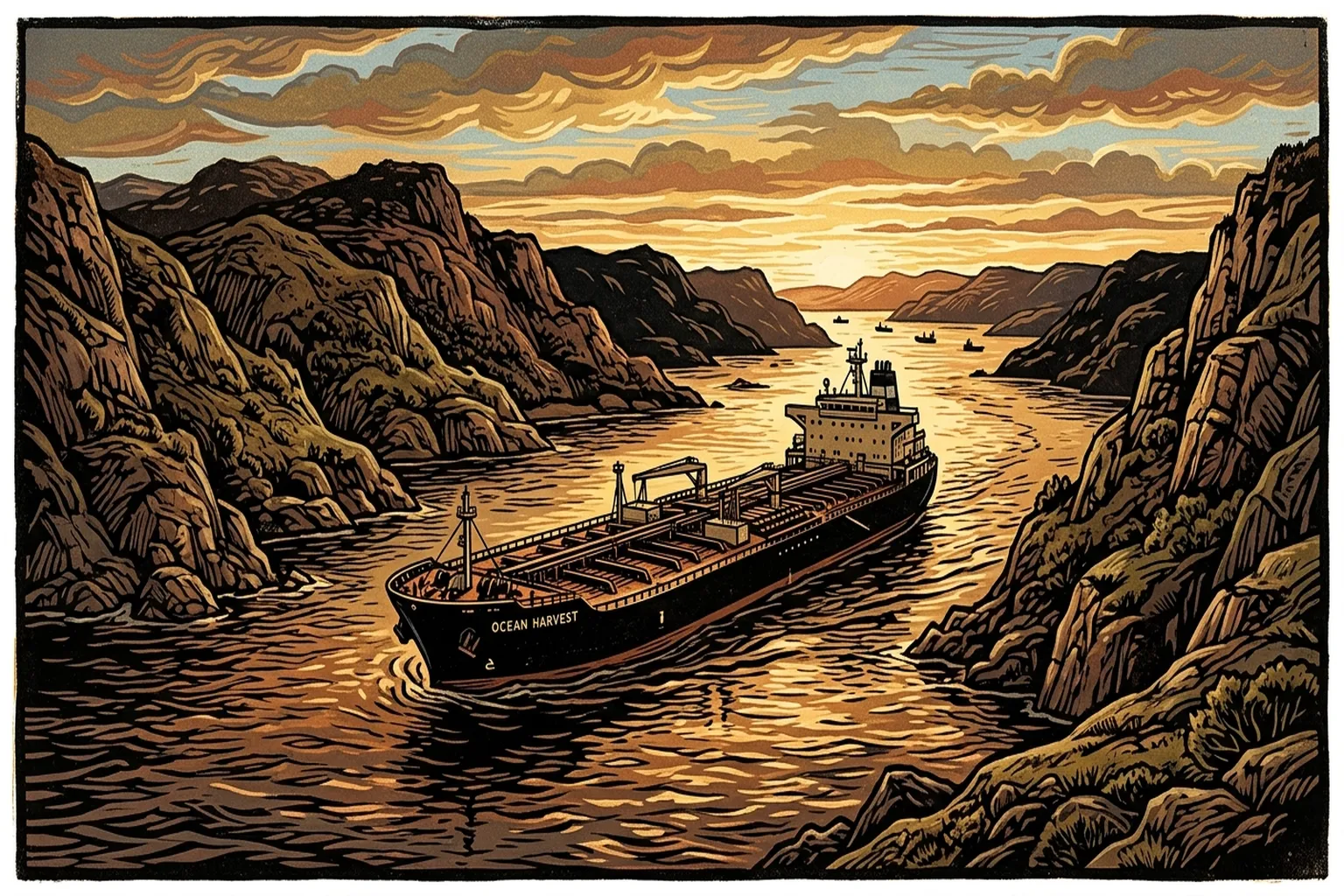
The standoff over the Strait of Hormuz has been running for seven weeks. On Tuesday morning, Treasury Secretary Scott Bessent said it might end today.
Speaking on CNBC, Bessent said: “We’re in talks with the Iranians and I think there is a chance we may have a deal today or tomorrow to open the strait.” Bloomberg confirmed his remarks and the immediate market response. Oil prices fell sharply after he spoke. Secretary of State Marco Rubio, at the State Department, was more measured: “There’s been progress made in those talks, but not finality yet.” CNBC is carrying live updates as Tuesday develops.
The outline being discussed would divide transit lanes: commercial ships would enter the Persian Gulf through an Iran-controlled passage and exit through a corridor along Oman’s southern coast. Iran has pushed for service charges on commercial vessels using the route, a provision the United States had previously called unacceptable. Whether that survives into the final text isn’t clear. Axios reported Tuesday that a 60-day interim agreement between Oman and Iran could be announced as early as Wednesday.
On Monday, Iran’s Foreign Ministry denied any negotiations with the United States and said its only discussions were with Oman. What changed between those denials and Tuesday morning’s market-moving remarks hasn’t been explained publicly. The two situations, public denial alongside back-channel progress, aren’t new to this conflict or to Iranian diplomacy generally. They don’t resolve what’s actually happening. They do describe the pattern of how it typically moves.
Roughly 20 percent of the world’s oil supply passes through the Strait of Hormuz. The Carter Doctrine, announced in January 1980, declared that the United States would use military force if necessary to protect free passage through the Persian Gulf. That posture has shaped American military planning in the region for forty-six years. The current standoff is the first time it has been seriously tested. The talks happening now aren’t about the doctrine. They’re about who controls the lanes, and what that control is worth.
A Russian missile and drone barrage struck Kyiv and the surrounding region overnight, killing 17 people and wounding 44. The Washington Post confirmed the death toll early Tuesday. Russia fired 24 ballistic missiles, four additional missiles identified as hypersonic Zircons or supersonic Oniks, and 115 drones. Ukraine’s forces shot down 98 of the 115 drones. They couldn’t shoot down a single missile.
Zelenskyy posted to social media after the attack: “Ballistic interceptors are what could have saved the lives of those killed today.”
Ukraine’s Patriot systems are the only weapons in its arsenal capable of intercepting ballistic missiles. The interceptor ammunition for those systems has been depleted faster than resupply can replace it, partly because the same weapons stock has been drawn on by the U.S.-Iran campaign. Zelenskyy has been pressing allied governments to authorize transfers of Patriot batteries from their own national inventories. PBS has the full account of Tuesday’s strike and the continuing shortage. That pressure hasn’t produced what he’s asking for.
Ukraine has been countering the Russian air campaign with its own deep-strike effort, targeting oil refineries and logistics inside Russia. Ukrainian drones have struck fourteen Wildberries warehouse facilities, the country’s largest e-commerce retailer, in the past three weeks. The stated strategy is economic attrition, aimed at compelling Russia back to negotiations. The strategy hasn’t compelled anything yet.
A suspect has been arrested in connection with the largest of three wildfires burning across the Spokane, Washington area.
Spokane County investigators identified Aaron F. Farinacci, 37, as a suspect in the Old Trails Fire and arrested him on suspicion of first-degree arson. Spokane County confirmed the arrest. Investigators found Farinacci near the fire’s point of origin carrying matches and a lighter. He is being held on $1 million bond. He has a prior conviction for manslaughter in Arizona.
The arrest doesn’t change what the fire is doing. As of Tuesday morning, the Old Trails Fire remains at zero percent containment. NBC News has confirmed that 67,000 people are under evacuation orders, that the three fires together have burned more than 8,000 acres, and that more than 700 structures have been destroyed. Washington Governor Bob Ferguson declared a state of emergency. The National Weather Service issued its first-ever “particularly dangerous situation” Red Flag Warning for central and eastern Washington. Cooler temperatures are expected later this week. That window is what fire crews are counting on.
The Pacific Northwest is experiencing its worst fire season in thirty years. The conditions driving it, drought, heat, and the accumulated fuel load that builds when small clearing fires are suppressed for decades, have been well-documented by fire scientists for a long time. The 2020 Labor Day fires burned more than a million acres across Washington, Oregon, and California in a single weekend. Spokane’s fires are smaller than that in scale. Not in consequence, for the 67,000 people who aren’t home tonight.
Tuesday is day nine of the Kumamoto earthquake recovery in Japan. The confirmed death toll stands at 38. Eight thousand three hundred and eighty-three people remain in 162 evacuation shelters.
The July 28 quake, measured at magnitude 7.1, produced more than 200 aftershocks in its first twenty-four hours. Seven deaths occurred in the collapse of an Aeon Mall in Kashima. Eight more at a Nippon Paper Industries mill in Yatsushiro. The Japan Times reported last week on early signs of recovery as transportation routes resumed. Shinkansen service has mostly returned. The prefectural government has opened online application systems for disaster victim certificates, which people need to access livelihood recovery grants and tax relief. Japan’s Digital Agency posted a status report through August 4 on relief coordination.
The complication this week is heat. Kumamoto recorded 40.3 degrees Celsius over the weekend. Evacuation shelters and heat shelters are largely the same buildings, which means the people most dependent on air conditioning are the people sleeping on cots. Disaster-related deaths from heat illness remain an active concern in the shelters.
Renesas Electronics, which manufactures semiconductors in Kumamoto, resumed phased production ahead of its announced schedule on Tuesday. Good news for supply chains that have been watching closely. Toyota, Honda, and Sony haven’t announced full resumption timelines yet.
The Ebola outbreak in the Democratic Republic of the Congo is now the second-largest in recorded history.
As of July 30, 3,605 confirmed cases and 1,587 deaths have been reported since the outbreak was declared on May 15, according to the World Health Organization. Al Jazeera confirmed last week that the outbreak had surpassed the 2018-2020 DRC epidemic to become second only to the 2014-2016 West Africa outbreak. The WHO has described transmission as “intensifying,” with active spread in 33 of 49 affected health zones. Ituri province accounts for 88 percent of confirmed cases. WHO’s outbreak notice is updated as new data arrives.
On Monday, a new UN-backed treatment center opened in Nizi, in Ituri. UN News confirmed Monday that the new center added 80 beds to the response. WHO says more are needed.
The 2018-2020 DRC outbreak, which had held the second-place record, took nearly two years to reach 3,481 cases. This one reached that level in weeks. The difference in pace still hasn’t been fully explained. What’s known is that Ituri has had active armed conflict for years, which has complicated contact tracing, vaccination campaigns, and the ability of health workers to move safely through the areas with the highest transmission. The outbreak isn’t contained. By WHO’s description, it’s still growing.
Gary Kowalski, who covers the outdoor life here, published a piece today worth setting aside time for: Kayaking for Beginners: What the French Broad Taught Me. Gary is a lifelong fisherman who picked up a paddle for the first time at 66, on the French Broad River in Asheville, with his daughter. It isn’t a technique piece. It’s about what it means to be a beginner again at something you never expected to try. If the week’s news has you worn out, Gary’s piece is a good place to go.
And in Washington, D.C. on Monday, a twenty-two-year-old tennis player from the Philippines named Alexandra Eala won the women’s singles title at the Mubadala Washington Open, defeating top-seeded Jessica Pegula 4-6, 6-4, 6-0.
She was the first Filipino player and the first player from Southeast Asia to win a WTA Tour title. She trailed Pegula by a set and a break before winning the last nine games of the match. On her way to the final, she had also beaten Olympic champion Zheng Qinwen, former world number one Naomi Osaka, and defending champion Leylah Fernandez.
Al Jazeera confirmed the result. The WTA’s official tournament page has the full bracket.
No Filipino player had won a WTA Tour title before Monday. The field she beat to get there included three of the best players in the world. She did it in three sets, from behind, on the last day of the tournament.
She did it on Monday.