The weekend produced one of the stranger diplomatic sequences of a year that has had many of them.
President Trump announced Saturday night that the United States was canceling a planned attack on Iran. NPR confirmed the announcement. He said he called off the strikes after Saudi Arabia, the United Arab Emirates, Qatar, and Iran had all asked him to hold back. The proposed deal, he said, would include “immediate reopening of the Strait of Hormuz” and “an end to Iran’s nuclear threat.” New negotiations, he said, would begin within a day or two.
Monday arrived. No new talks began.
Iran’s Foreign Ministry said Monday there are no negotiations with the United States. The ministry said Iran’s only current discussions are with Oman, focused on a specific shipping route through the strait. Trump called the Iranian leadership “unbelievably duplicitous.” CBS News confirmed that U.S. officials said no new talks were planned even as Trump was saying otherwise. CNN has been tracking the Monday developments as they come in.
The underlying dispute, stripped of the weekend’s noise, is about geography. Iran has required ships to use an Iran-controlled passage through the Strait of Hormuz since June 19. Oman has proposed an alternative route running along its own coastline to the south. That’s what the ongoing mediation is trying to settle. Roughly 20 percent of the world’s oil supply passes through the strait. Where the permitted lane runs determines a considerable amount of who controls what.
The pattern of public denials alongside back-channel talks isn’t new to this conflict or to Iranian diplomacy generally. During the run-up to the 2015 JCPOA, Iranian officials regularly denied the existence of discussions that were, in fact, taking place. Those public denials were sometimes a sign that something real was happening below the surface. They were also, sometimes, simply accurate. From the outside, the two situations are difficult to tell apart. Trump said Monday he isn’t in a hurry because he isn’t seeking reelection. Iran said Monday there’s nothing to hurry toward.
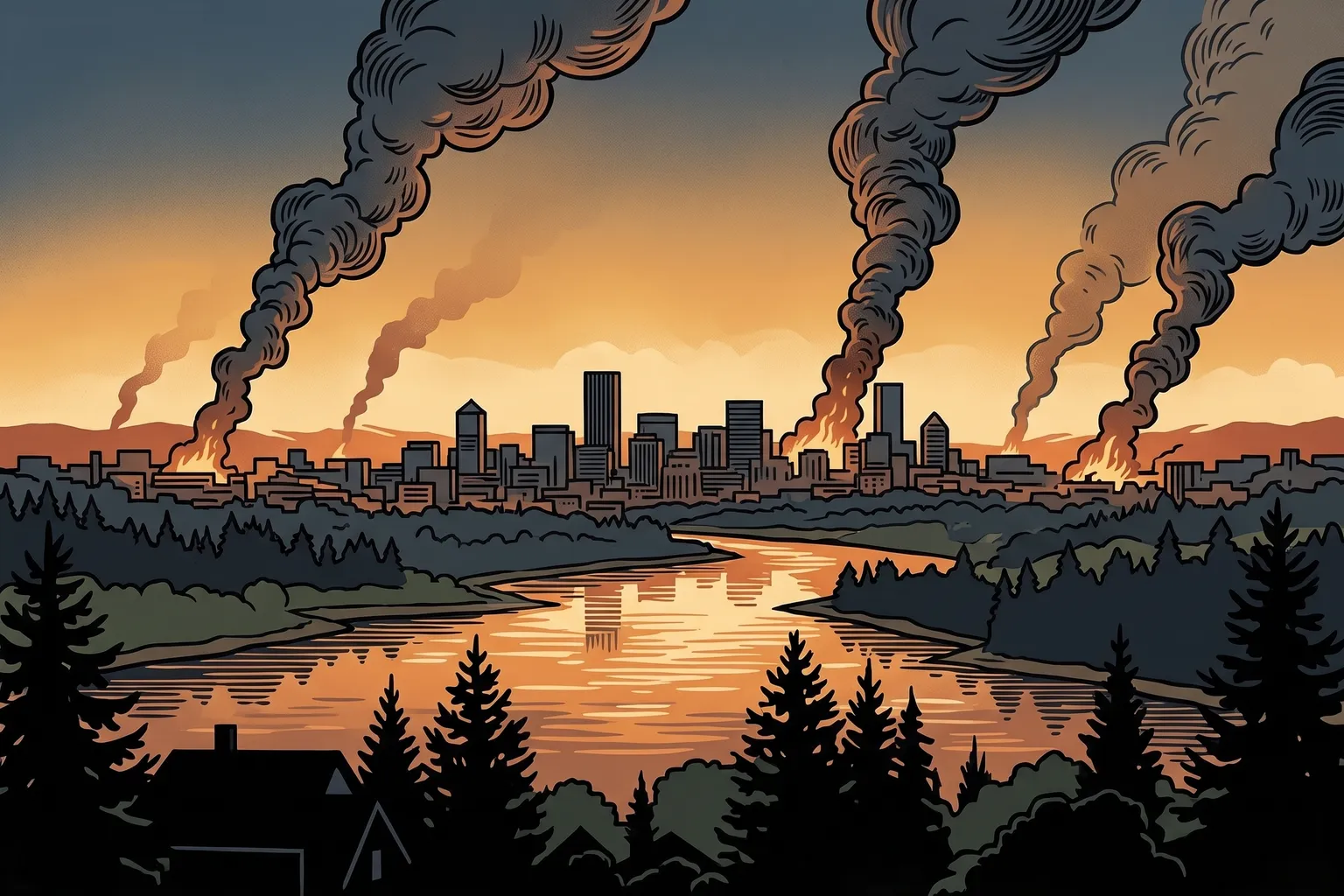
Three fires erupted on the northern outskirts of Spokane, Washington on Saturday. By Monday morning, none had been contained. Together they have burned more than 8,000 acres and destroyed more than 700 structures. NBC News confirmed that 65,000 people are under evacuation orders, with Level 3 orders in parts of the city reading: “Leave NOW. This may be your only notice.”
The largest of the three, the Old Trails Fire, has destroyed at least 640 structures by itself. It began Saturday and remains at zero percent containment as of Monday morning. NPR reported that firefighters had yet to contain any of the three blazes. The Spokane Convention Center has opened as an evacuation shelter. Cooler temperatures are in the forecast for later this week. Officials said that window would give crews a chance to make significant gains. That window hasn’t arrived yet.
CNN has been carrying live updates on the Spokane fires since Saturday. If you have family in the Spokane area, the American Red Cross Disaster line is (509) 783-6195.
One week has passed since a magnitude 7.1 earthquake struck Kumamoto Prefecture in southern Japan on July 28.
The confirmed death toll stood at 38 as of August 3, according to Japanese authorities. 8,383 people remain in 162 evacuation shelters. Nikkei Asia reported Monday that recovery efforts are being accelerated as a separate emergency complicates the work: extreme heat. Kumamoto City recorded a high of 40.3 degrees Celsius on Sunday. Heat shelters and earthquake shelters are now the same buildings, and that combination creates conditions in which disaster-related deaths from heat illness remain an active risk.
Major transportation routes have resumed, including significant shinkansen service. Prime Minister Sanae Takaichi visited the affected area and announced more than 20 billion yen in emergency reserve funds, with the earthquake designated an extremely severe disaster. Toyota, Honda, Sony, and Renesas Electronics are still assessing timelines for full factory resumption. Kumamoto holds a substantial share of Japan’s semiconductor manufacturing capacity, and the disruption to those supply chains is still being measured.
Japan reformed its earthquake response protocols thoroughly after the 1995 Kobe earthquake killed more than 6,400 people. What Kumamoto’s experience in 2016, and again now, has demonstrated is that the reforms worked at the level reforms can work: rapid deployment, shelters opened quickly, relief reached the affected area within hours. The buildings still fell. The people inside them were still there. A week later, thousands of those people are still in those shelters, in forty-degree heat, waiting to learn what comes next.
Ukraine struck drone bases, warehouses, and communications infrastructure in Crimea over the weekend, using the Magura naval drone in what Ukrainian officials described as its first ground-target operation on the peninsula. Russia said it targeted Ukrainian cargo ships in the Black Sea in response. Al Jazeera reported that the exchange over the weekend killed eight people in Russian drone strikes on Ukraine.
President Zelenskyy has been warning for two weeks that Ukraine faces critical Patriot interceptor shortages. His July 28 meeting with Trump at the White House, which he described as “good,” centered on whether allied countries could be permitted to manufacture Patriot missiles domestically, which would reduce dependence on U.S. production timelines. That authorization hasn’t come. The shortages are ongoing. The Kyiv Post has been tracking Monday’s military developments.
The Ebola outbreak in the Democratic Republic of Congo has crossed a threshold.
As of July 30, the outbreak has produced 3,605 confirmed cases and 1,587 deaths since it was declared in May. Al Jazeera confirmed last week that it has become the second-largest Ebola outbreak on record. The only larger outbreak in history is the 2014-2016 West Africa epidemic, which produced more than 28,000 cases over two years. The current outbreak surpassed the 3,470-case total of the 2018-2020 Kivu epidemic in 76 days. The West Africa outbreak took fourteen months to reach that same count.
The Bundibugyo strain driving this outbreak has no approved vaccine and no specific treatment. Epidemiological week 30 was the worst yet: 567 new cases and 296 deaths, roughly 42 deaths per day. A new treatment center opened Monday at the heart of the outbreak, according to the United Nations. Forty-eight of the DRC’s 140 health zones across five provinces are now affected. The ECDC has maintained updated tracking throughout.
This outbreak has produced more than 1,500 deaths in under three months. A summer that has included an Iran conflict, a Japan earthquake, a major U.S. wildfire emergency, and the third heat dome of the season doesn’t leave much space in the news cycle for a public health crisis building in Central Africa. The new treatment center can help people who are sick. It can’t address the pace of spread across a region where health infrastructure has been strained by years of conflict and where 119 health workers have been infected since May. The center’s opening is real. So is everything around it.
If you’ve been following this outbreak and want to help, Médecins Sans Frontières is operating directly in the affected areas. Their response and how to support it is here.
This is Andy Burnham’s second week as Prime Minister of the United Kingdom. He took office July 21, becoming the seventh British prime minister in a decade. His first week produced a £340 million commitment toward ending rough sleeping, the opening phase of what he described as a five-year national effort. Public Finance reported the funding details. The money is projected to provide 1,200 homes and intensive support for at least 3,000 people.
Several senior cabinet members departed in his first days, including the deputy prime minister and the finance minister. The political instability he pledged to end on day one is the condition he’s governing in. Two years remain before the current parliamentary mandate expires. His second week, like his first, begins without a stable cabinet.
Our colleague Carol Gifford published something this morning worth your time. If you’ve ever stood in the supplement aisle holding two bottles and not quite knowing which one to trust, her new piece “The Best Supplements for Joint Pain” does something that aisle rarely does: tells you what the research actually shows, honestly, and where the evidence is thin. It’s in the Health section.
On Sunday morning, off Indonesia’s Madura Island, a ferry caught fire in the Java Sea.
The Mutiara Sentosa 2 was sailing from Surabaya in East Java to Makassar in South Sulawesi. It had 232 passengers and 39 crew aboard when the fire broke out, between 6 and 7 a.m. local time. The Jakarta Post confirmed five people were killed. Search and rescue operations were continuing Monday. The Washington Post reported that the total number of people still unaccounted for remains uncertain.
And 225 people are alive.
Nearby vessels heard the distress call and reached the Mutiara Sentosa 2 while passengers were still in the water. Crews from multiple ships pulled people aboard throughout the morning. Indonesia’s National Search and Rescue Agency confirmed the count. When a ship burns in open water, what happens next depends entirely on who responds to the call. On Sunday morning, off Madura Island, people came.