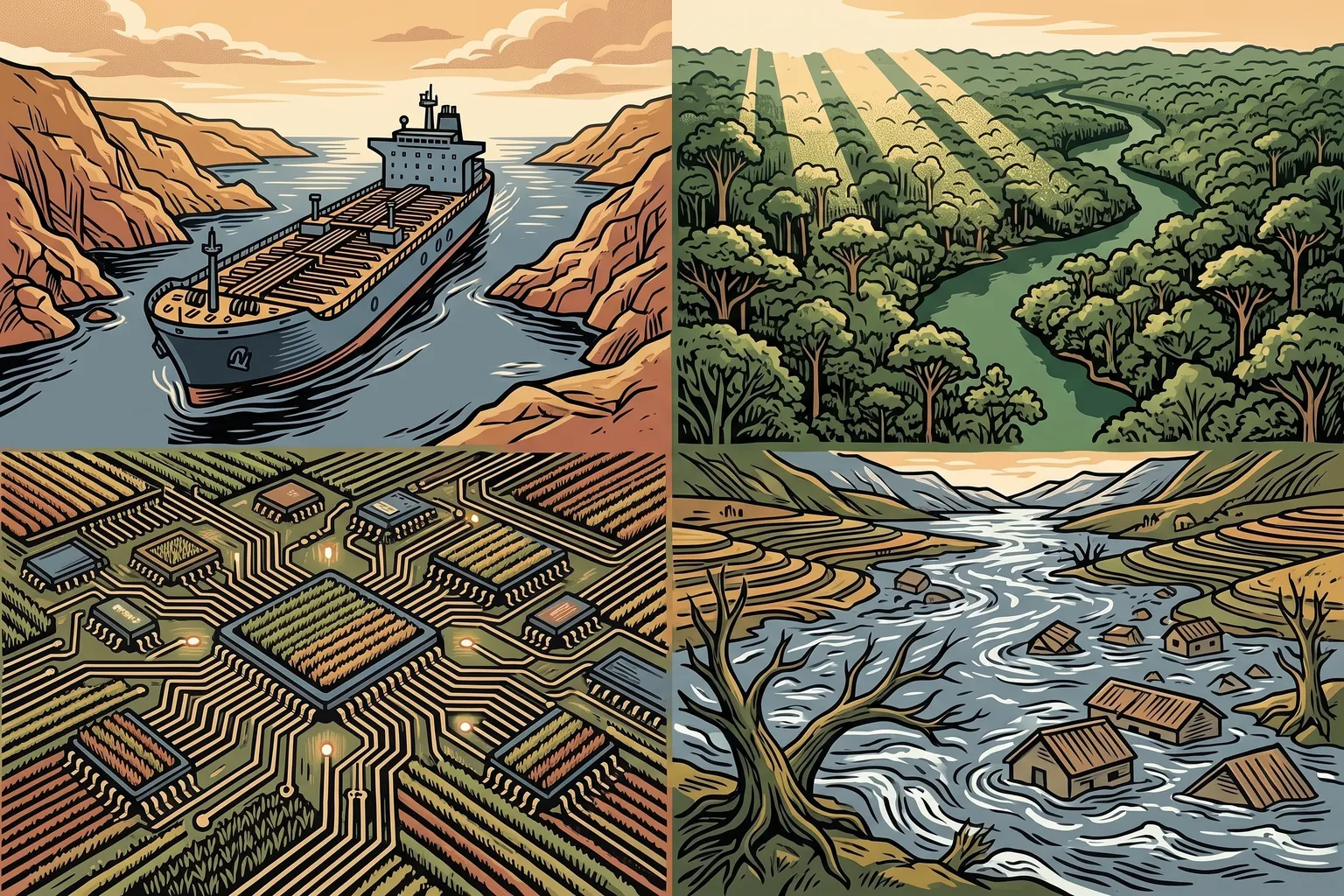
Iran and Oman announced Tuesday that they’ve agreed in principle on a temporary shipping corridor through the Strait of Hormuz. The corridor would be seven miles wide, running through Iranian territorial waters, designed to allow commercial vessels to resume transit without passing through the zone Iran has declared closed to American and Israeli-affiliated ships. Iran’s Deputy Foreign Minister Kazem Gharibabadi made the announcement following talks in Tehran with Oman’s Foreign Minister Badr Albusaidi. Albusaidi said on social media he hoped the two countries would “soon announce” the corridor formally, and that “future management of the strait and a permanent solution will follow in due course.” Al Jazeera has the full account.
The agreement, such as it is, includes a joint initiative to clear mines from the waterway. Technical talks are continuing. Implementation timelines weren’t given. The US hasn’t formally accepted the route. Whether Washington would consent to routing vessels through Iranian territorial waters remains the central unresolved question.
This is the sixth month of the war. The United States and Israel struck Iranian military targets on February 28, including the killing of Supreme Leader Ali Khamenei. An interim ceasefire framework, brokered through mediators in June, required a formal peace agreement within sixty days. Both sides missed the deadline. Hostilities resumed. The Strait of Hormuz has been effectively closed to normal commercial shipping since then. Before the war, about 100 commercial vessels passed through it on a typical day. In late July, that figure was fewer than ten.
Crude oil futures fell on the corridor announcement. Brent dropped about 3 percent to roughly $86 a barrel Wednesday morning. West Texas Intermediate declined 2.8 percent to about $80. The reaction reflects the possibility of relief, not its certainty. A seven-mile-wide corridor agreed in principle isn’t the same as a seven-mile-wide corridor ships can safely use.
The Tanker War, which ran from roughly 1984 to 1988 during the Iran-Iraq conflict, produced something comparable. Both countries attacked neutral shipping in the Persian Gulf to pressure each other’s oil exports. The US Navy launched Operation Earnest Will in 1987 to escort reflagged Kuwaiti tankers through the Gulf under American colors. It wasn’t a solution to the underlying conflict. It was a workaround. Ships moved. The war continued. The corridor announcement this week has a similar feel: a workaround that keeps commerce possible while the deeper dispute remains unsettled.
Flash floods swept through villages along the Nepal-Tibet border early Wednesday morning after a glacier collapsed into the upper reaches of the Lhende River in Rasuwa district. By Thursday, Nepal’s National Disaster Risk Reduction and Management Authority had confirmed 165 dead and 826 missing in Nepal. Chinese officials reported 558 people missing on the Tibetan side, 260 of them foreigners. CNBC has the running count.
Among the unaccounted are approximately 340 foreign tourists, citizens of India, the United States, Australia, the United Kingdom, and Canada. The Gyirong Port, the main land crossing between Nepal and Tibet for trade and tourism, was severely damaged. The flooding cut power to areas representing more than 12 percent of Nepal’s national hydropower capacity. Helicopters have been operating since Wednesday over Nuwakot and Rasuwa districts. China deployed at least 574 rescuers to the border crossing. Heavy machinery is clearing debris to reach isolated villages. NBC News has more on the rescue operation.
Glacial lake outburst floods have been studied in the Himalayas for decades. A 2020 analysis published in Nature Climate Change found that the volume of glacial lakes worldwide had grown 48 percent between 1990 and 2018, driven by glacier retreat (source). The floods themselves aren’t new. The Himalayas have always had them. What has changed is the size of the ice masses waiting to fail, and the speed at which they’re failing.
Nvidia reported second-quarter fiscal 2027 earnings Wednesday evening, and the numbers require some adjustment to take in. Revenue came in at $96.2 billion, up 106 percent from the same quarter a year ago. Data center revenue reached $89 billion, up 117 percent year over year, and now accounts for 92 percent of the company’s total business. The gross margin held at 75 percent. The company forecast roughly $108 billion in sales for the current quarter. Fortune has the breakdown.
One way to measure the scale: the entire global semiconductor industry generated roughly $52 billion in annual revenue in 1990. Nvidia’s data center sales in this single quarter were nearly $90 billion. Microsoft, Google, Amazon, and Meta collectively spent more than $170 billion on AI infrastructure in the second quarter alone, a 79 percent increase from the same quarter in 2025. The bulk of that spending flows to chips, and Nvidia holds an estimated 81 percent market share in the accelerators that run modern AI systems. The numbers aren’t a surprise. Analysts expected this quarter to be large. What’s harder to absorb is that the next quarter is expected to be larger.
The federal government runs out of money on September 30. That’s five weeks from Thursday.
Senate leaders struck a bipartisan agreement earlier this month to fund the government through December 11 via a continuing resolution that keeps agencies operating at existing budget levels. The House had already passed its own stopgap, which runs through December 4. The two chambers need to reconcile the two versions before October 1 or a partial government shutdown begins. Congress is in August recess and returns in September. NBC News has the details on the Senate deal.
This story is getting less attention than it probably warrants, partly because there’s a deal framework and partly because the Iran war, the Nepal floods, and the trade dispute with Canada are all competing for the same space. But the seven-day difference between the House and Senate versions isn’t the only issue. The Senate’s bill includes adjustments to SNAP and WIC food assistance programs and disaster relief funding that the House bill doesn’t contain. Those add-ons will need to survive House Republicans before anything passes. The midterm elections are in November. Nobody in either party wants to be blamed for a shutdown in October.
The longest government shutdown before the forty-three-day one that ended in November 2025 ran thirty-five days, from December 22, 2018, to January 25, 2019 (source). It affected about 800,000 federal workers. About 420,000 deemed essential worked without pay for a month. It ended without the $5.7 billion for border wall construction that triggered it. The cost of those thirty-five days, in lost government services and deferred wages, ran to billions. Nobody got what they wanted. September 30 is the deadline for deciding whether that lesson took.
Canada’s retaliatory tariffs on more than 700 American goods take effect September 8. Twelve days from now. The duties run from 15 to 50 percent, matching the United States’ rates “dollar for dollar” on steel, dairy, appliances, farm equipment, and electronics. Prime Minister Mark Carney said last week that his country is “at war” economically with the United States. Trade talks haven’t resumed. CNN has an analysis of what the escalation means for American consumers.
Canada is America’s second-largest trading partner. It supplies approximately 60 percent of U.S. crude oil imports. Canadian steel and lumber are built into the cost of American construction. The tariffs don’t stop those flows. They reprice them. A tariff on Canadian lumber doesn’t mean American builders stop buying Canadian lumber. It means they pay significantly more for it, and that cost moves forward through the supply chain to whoever is buying the house.
The Smoot-Hawley Tariff Act of 1930, which raised duties on more than 20,000 imported goods, prompted retaliatory tariffs from Canada and dozens of other trading partners. Both U.S. imports and exports contracted sharply in the years that followed. Economic historians still debate how much of the subsequent decline in trade should be attributed to the tariffs versus the Depression that was already underway. What isn’t debated is that both governments achieved an outcome neither had sought, together, by each acting rationally in response to the other.
And one last thing.
Brazil’s National Institute for Space Research reported this week that deforestation alerts in the Brazilian Amazon fell to their lowest level since 2013. The data cover August 2025 through July 2026, when 2,874 square kilometers of deforestation were flagged by satellite, down 36 percent from the previous year and 55.6 percent below the preceding ten-year average. Mongabay has the full analysis.
At its worst, the Amazon was losing more than 27,000 square kilometers per year. The basin contains roughly ten percent of all terrestrial species on Earth and processes an estimated 16 percent of the oxygen produced by land-based plants (source). The forest faces continued pressure from logging, drought, and fire, and the satellite alerts measure only cleared land, not forest degradation that leaves trees standing but damaged. The researchers note the trend hasn’t been confirmed yet by the higher-resolution annual count that Brazil publishes each fall. The trend is real. The forest is still there. Thirteen years is a long time to wait for good news, and it got here anyway.