The United States announced what Treasury Secretary Scott Bessent called “the single greatest financial offensive ever marshalled against an adversary” Monday morning, unveiling a sweeping package of new sanctions against Iran that targets Tehran’s banking and energy sectors and, for the first time at this scale, the Chinese companies and trading intermediaries that have kept Iranian oil moving to buyers despite years of existing restrictions. CNBC has the full account of the announcement.
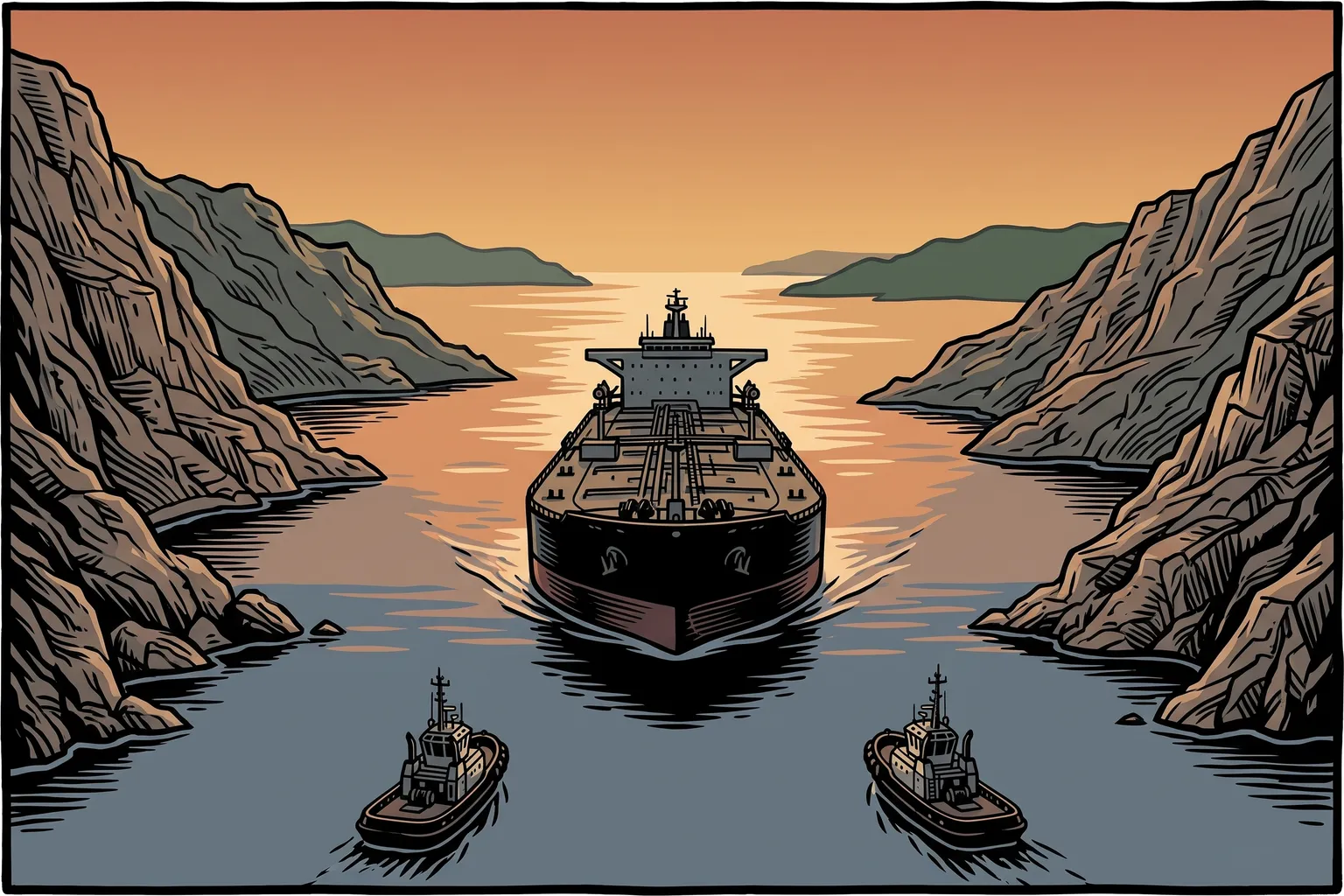
Bessent wrote in a Financial Times op-ed Sunday evening that “at dawn begins an economic D-Day.” In the same piece he described the measures as the campaign’s “endgame.” The Strait of Hormuz, through which an estimated 20 million barrels of oil move on a normal day according to the Department of Energy, had already seen traffic fall to roughly 20 percent of its pre-war average before Monday’s announcement (EIA). CNN is tracking the live developments.
Iran’s Supreme National Security Council responded on Sunday, before the announcement. The council’s secretary threatened to halt all oil exports through the strait and the wider Persian Gulf if the economic war continues, and warned that Iran would treat any country’s participation in it as an act of war, a threat consistent with what Iran’s military and political leadership have been saying for months. The difference is that the strait isn’t operating at the volume that would make such a closure a major escalation. It’s already largely shut. Iran is threatening to formalize what the conflict has already accomplished.
The United States has maintained some form of economic pressure against Iran since November 1979, when President Carter froze approximately $12 billion in Iranian assets following the takeover of the U.S. Embassy in Tehran. Those measures were partially lifted through the Algiers Accords in January 1981. What followed across nine administrations was a sanctions regime that expanded and contracted depending on who occupied the White House and the state of nuclear negotiations. The most significant easing came with the 2015 Joint Comprehensive Plan of Action, which unfroze an estimated $100 billion in Iranian assets in exchange for restrictions on Tehran’s nuclear program. The Trump administration withdrew from the agreement in 2018. The nuclear talks that followed over the next several years produced no replacement agreement. Monday’s package is the end of that negotiating track, at least for now: the stated goal isn’t to bring Iran to the table but to collapse its capacity to fund the conflict.
The United States imposed 50 percent tariffs on approximately $20 billion worth of Canadian goods over the weekend after trade talks between the two countries collapsed late Friday. The tariffs cover alcohol, hockey equipment, cement, and dairy products, with exemptions for energy, potash, and critical minerals. CNBC reported on the collapse of talks and the tariffs taking effect.
The administration invoked Section 338 of the Tariff Act of 1930, which authorizes the president to impose duties of up to 50 percent on imports from countries that have “discriminated against” American commerce. Section 338 has been on the books for ninety-six years. It had never been used before Saturday.
Section 338 was a feature of the Smoot-Hawley Tariff Act, which President Hoover signed in June 1930. The broader law raised import duties across more than 20,000 goods and triggered retaliation from trading partners including Canada, Great Britain, France, and Germany. Within two years of Smoot-Hawley’s passage, American imports had fallen by more than 40 percent and global trade had contracted sharply. Economists have debated for nearly a century how much of that contraction Smoot-Hawley caused versus how much it reflected the Depression already underway. What’s not debated is that the retaliation it prompted accelerated a collapse that had already begun. Section 338 was designed as a targeted tool, not the broad tariff that made Smoot-Hawley famous, which is why it sat unused for ninety-six years while the law it came from became the standard cautionary reference. It made it to Saturday before anyone pulled it off the shelf.
Canadian Prime Minister Mark Carney called the tariffs “a miscalculation” in remarks reported by NBC News, and said talks broke down because the United States introduced “uneconomic and unfair” demands in the final hours. U.S. Trade Representative Jamieson Greer said Canada was the one that walked. Canadian retaliatory tariffs are set to begin September 8, the Tuesday after Labor Day, covering steel, dairy, appliances, agricultural equipment, pulp and paper, and electronics. PBS Newshour has the full breakdown of what the tariffs cover and what Canada has announced in response.
Ukraine marked the 35th anniversary of its Declaration of Independence today. The vote in Kyiv on August 24, 1991, came three days after the collapse of the failed coup attempt against Mikhail Gorbachev, which accelerated independence movements across Soviet republics. The Ukrainian parliament approved the declaration 346 to 1. A referendum in December 1991 confirmed it: more than 90 percent of Ukrainians voted yes. Russia recognized the result at the time.
This is the fifth Independence Day Ukraine has observed since the full-scale invasion began in February 2022. President Zelenskyy addressed the nation in Kyiv. “Ukraine absolutely wants peace,” he said, “but it’s not ready to simply surrender.” The Korea Times reported on the address. Russian forces struck Odesa on the anniversary, hitting two hypermarkets and energy facilities, with Ukrainian officials reporting no immediate information on casualties (Ukrainska Pravda).
Ukraine and Norway signed a defense technology cooperation agreement Sunday, formalizing a joint drone production arrangement that includes what officials described as thousands of mid-strike unmanned systems, with first deliveries expected by summer. The signing took place at the Ukraine-Nordic-Baltic Eight summit in Kyiv. Ukraine has now signed similar defense technology agreements with nine countries and is in negotiations on fifteen more. Ukrinform reported on the signing. European Commission President Ursula von der Leyen marked the anniversary: “On Ukraine’s Independence Day, we show our unfaltering support.”
Senior delegations from Syria and Israel met Sunday in Amman, Jordan, under American mediation. Syria’s delegation was led by foreign affairs chief Asaad al-Shaibani and included the heads of Syria’s general and military intelligence services. The Israeli delegation was led by Mossad director Roman Gofman. Al Jazeera has the full report.
The talks focused on practical mechanisms to halt ongoing Israeli strikes on Syrian territory and on reviving negotiations toward a broader security agreement. The two sides also discussed efforts to prevent the Israel-Turkey rivalry from expanding into Syrian territory.
Syria and Israel have technically been at war since Israel’s founding in 1948. The last sustained high-level contact between their governments came after the fall of Bashar al-Assad in December 2024, when the new Syrian administration began approaching Israel under different terms than its predecessor. The Amman meeting, hosted by Jordan with the United States present, is the most substantive attempt so far to establish a lasting framework. Whether it holds depends, as these things usually do, on whether the conversations survive the first test that comes after them.
And one thing before the week gets fully underway.
Researchers at Karolinska Institutet and Umeå University published a study in JAMA Network Open this week examining colorectal cancer screening outcomes across 376,511 people in the Stockholm-Gotland program, with follow-up data extending as long as fourteen years. Karolinska Institutet summarized the findings here.
The result divides into two numbers. People who received an invitation to participate in screening had a 26 percent lower risk of dying from colorectal cancer compared to those not invited. People who actually submitted the sample had a 43 percent lower risk.
Sweden offers the screening free to adults between 60 and 74 every two years. A kit arrives in the mail. The participant provides a stool sample and returns it. The laboratory checks for trace blood invisible to the naked eye. If something shows up, it’s investigated further. If nothing shows up, the next kit comes in two years.
About a third of people who receive the kit don’t send it back.
Colorectal cancer is the third most common cancer diagnosis in the United States. It’s highly treatable when caught early. This study, covering more than 376,000 people over more than a decade, documented that a simple, mailed, free test reduced the chance of dying from it by 43 percent for those who completed it. That’s not a projection or a modeled estimate. It’s the record of what actually happened to the people who did the test.
A third of them didn’t. Science Daily has more on the findings.
In the Living section: Ruth Ann Pemberton’s “When the House Stops Being Home” ran Saturday, August 22. It’s about the moment a house stops fitting, and the conversation that happens when two people who’ve been carrying that thought separately finally say it out loud. Worth your time.