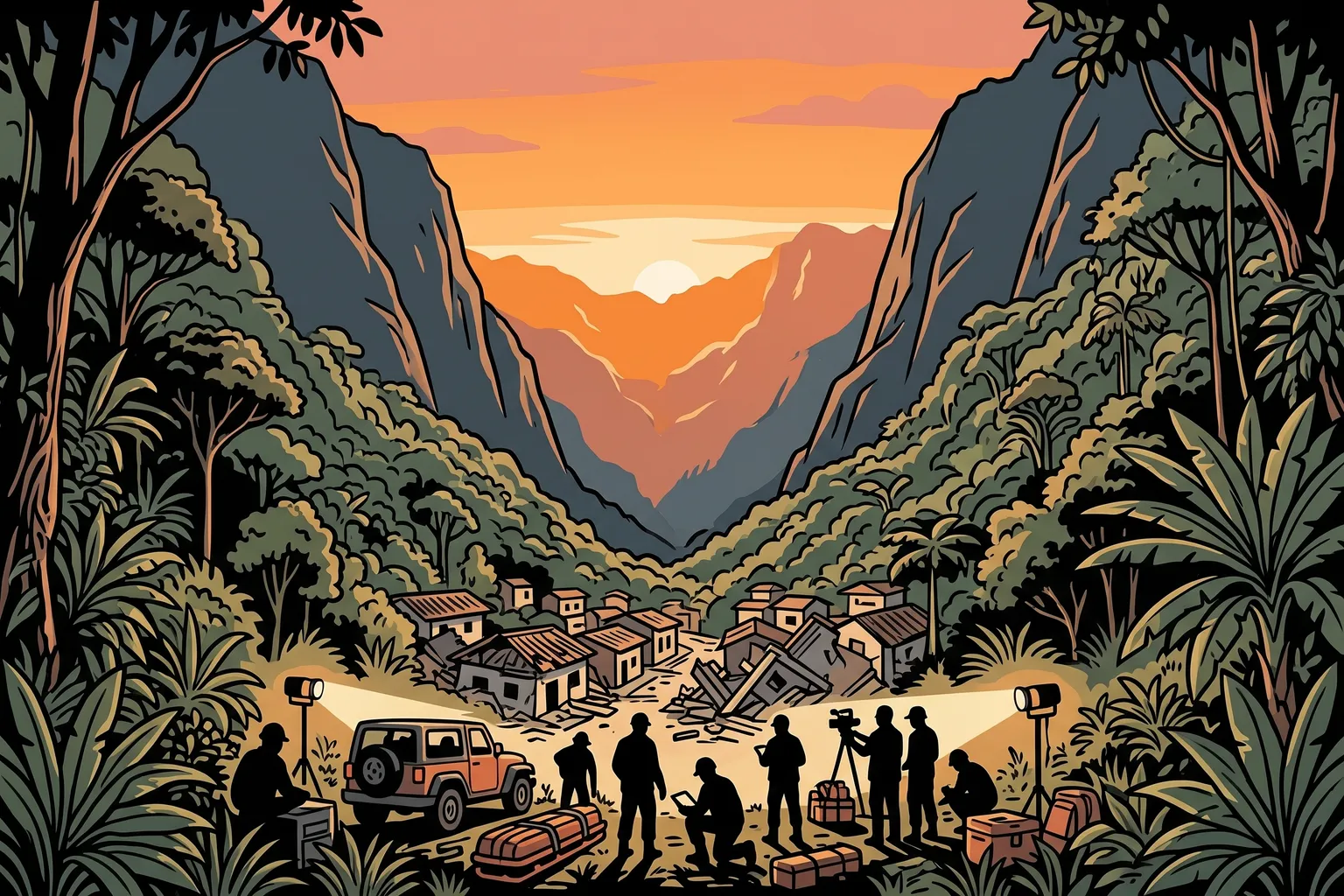
The death toll from Monday’s earthquake in western Colombia reached 265 on Wednesday as rescue teams shifted to what officials are calling the “final phase” of operations. That phrase means something specific. It’s the moment in every major earthquake response when the methods used to search for the living must quietly accommodate the likelihood of finding the dead. The 72-hour mark, after which survival rates in collapsed structures drop sharply, passed Wednesday morning. France 24 reported Wednesday that teams across Chocó and Risaralda departments have entered that transition.
At the epicenter, San José del Palmar remains partially cut off. Remote terrain, damaged roads, and hours of unpaved mountain track have limited access since Monday. When teams reached the town itself, the situation was unusual: the community that generated the shaking registered no confirmed fatalities of its own, though 400 homes sustained damage and at least 20 buildings collapsed. The deaths came from Pereira, from Cali, from communities that received the earthquake’s energy after it traveled outward from the jungle highlands. ABC News reported that Colombia’s army Third Brigade is deploying canine teams, thermal-capable drones, and specialized extraction equipment across the affected zone. Forty-seven aftershocks have been recorded since Monday, at least one reaching magnitude 4.8.
International aid has assembled quickly. The UN, the International Red Cross, IOM, and UNICEF have all activated emergency response operations. The United States committed $15.5 million on Monday. Mexico and Ecuador offered teams. The scale of the missing person problem remains unresolved: the official missing count is in the hundreds, while civilian tracking databases compiled from family reports put the number of unaccounted people closer to 4,000.
On September 19, 1985, a magnitude 8.0 earthquake struck Mexico City before dawn and killed an estimated 9,500 people, though some figures run considerably higher. The Mexican government declared an end to active rescue operations within 72 hours. Volunteer teams from the city’s civil society kept searching anyway, and kept finding survivors for days afterward. The tension between the official announcement and the human refusal to stop was one of the defining features of that disaster. Colombia is in that same window today. Day three.
Iran
The question of what is actually happening in the Strait of Hormuz depends entirely on who you ask, and the two parties most directly in conflict gave contradictory answers on Tuesday. Donald Trump posted on Truth Social: “The U.S.A. has total control over the Strait of Hormuz. I THINK WE WILL KEEP IT!” Within hours, Iran’s Persian Gulf Strait Authority replied: “Claims and repeated posts by U.S. officials that the Strait of Hormuz is no longer blocked do not change the reality. The Strait of Hormuz remains blocked and will not be reopened until Iran’s conditions are accepted.”
Iranian Foreign Minister Abbas Araghchi added his own formulation Wednesday morning. “The U.S. has long miscalculated due to intelligence failures. Case in point: The war on Iran,” he posted. “Now, an even bigger miscalculation on the Strait of Hormuz. Worse than fake news is fake intelligence.”
Shipping data offers one concrete reference point. Approximately six vessels transited the strait on Monday, according to Al-Monitor’s tracking of Gulf shipping traffic, against a pre-crisis baseline of 73 to 140 daily. The Oman-mediated route agreement, which Iran and Oman reached on geographic coordinates, has been framed in Western coverage as progress. Araghchi clarified this week that it isn’t: “The agreement with Oman on the route does not necessarily mean the reopening of the Strait of Hormuz.” Iran’s stated conditions remain unchanged: US compensation for war casualties, sanctions relief, and military withdrawal from the region.
The information gap about what is happening on the water has a long history in American conflict. In August 1964, the Johnson administration cited reports of a second North Vietnamese torpedo attack on US ships in the Gulf of Tonkin to pass the resolution that authorized escalating the Vietnam War. That second attack, declassified NSA documents later confirmed, almost certainly didn’t happen. The lesson wasn’t about deception running in one direction. It was about how difficult it is to know what is occurring on the open ocean during a crisis, when the parties doing the talking have strong reasons to shape the account. Six vessels versus “total control.” The reality sits somewhere in the water between those claims.
Ukraine
Ukraine’s campaign against Russian logistics infrastructure reached a scale this week that EUObserver described as a “record-distance Ukrainian strike” leaving “Russia’s Wildberries facing collapse.” RFE/RL reported that Ukrainian drones have struck 15 Wildberries logistics facilities over the past three weeks, with 13 of the 15 warehouses destroyed by fire. Wildberries is Russia’s largest e-commerce platform, roughly equivalent to Amazon, with roughly 20 million active buyers.
Russia overnight struck Ukraine with 133 drones. Ukraine said it downed the majority. Peace talks remain stalled on conditions Russia introduced after the May ceasefire collapsed. The pattern is the same week after week: strikes, casualties, statements about dialogue, and no movement toward it.
The USS Abraham Lincoln
Here is a story that has been sitting in the defense press for months without getting much broader attention. The USS Abraham Lincoln, a Nimitz-class carrier, has been at sea for 264 consecutive days, according to Forbes reporting published Tuesday. That’s a modern record for a US carrier. The ship has been in the Persian Gulf since January, part of the force presence tied to the Hormuz crisis.
Family members of crew have written to Congress describing food shortages, inoperative toilets, showers with mold, and laundry facilities broken for weeks. The reporting documents multiple attempts by sailors to jump overboard. A Democratic senator has written the Pentagon requesting an accounting. The Navy hasn’t commented publicly on the conditions described. These are the people who are in the actual water, doing the actual work of the policy that is being discussed in terms of shipping lanes and diplomatic frameworks in Washington. A 22-year-old from Kentucky on that flight deck isn’t thinking about the Gulf of Tonkin. She’s thinking about home, and home is eight and a half months gone. This is the thing the shipping charts don’t measure.
DRC Ebola
The World Health Organization’s director-general held a media briefing Tuesday and said it plainly: “It is already the second-biggest Ebola epidemic on record, and it is moving faster than any previous Ebola outbreak.” As of Tuesday: 4,470 confirmed cases, 2,063 deaths, a case fatality rate of 46.2%. The Bundibugyo strain responsible has no approved vaccine and no approved treatment. Contact tracing is running at 80% of cases identified. The target is 95%. Of patients arriving at the main treatment center in Bunia, 90% weren’t on any contact-tracing list, meaning the virus is moving through channels the response workers don’t know about.
Dr. Mohamed Janabi, WHO’s regional director for Africa, offered the operative summary: “The Bundibugyo virus continues to outpace us.” Of the $518 million WHO says it needs, $264 million has been disbursed. UNICEF’s emergency plan is 80% unfunded. Sixty to 70 percent of deaths are occurring in communities, before patients reach a treatment center. The 2014 to 2016 West Africa outbreak, which killed 11,325 people, was eventually brought under control in part by aggressive community-level response in specific outbreak towns, a lesson WHO published extensively afterward. The lesson is in the institutional memory. Whether the resources required to act on it arrive in time is a different question.
Kumamoto
Two weeks after the earthquake, the number of people sleeping in emergency shelters in Kumamoto prefecture has declined from 10,467 in the immediate aftermath to 6,092, per Kyodo wire reporting published Tuesday. The death toll holds at 39. Temperatures are again expected to reach 35 degrees Celsius in the prefecture this week. Electricity at some centers remains intermittent, limiting access to cooling for the people inside. Temporary prefab housing in Uki and Hikawa isn’t expected to be ready before September.
Governor Takashi Kimura: “We will make preparations so that evacuees can relocate as soon as possible.” US Forces Japan airlifted 16 tons of drinking water from Yokota Air Base to survivors this week. There are 1,293 volunteers registered and working in the affected area. Those numbers will matter more in September and October, when the acute coverage ends and the long work of rebuilding begins.
My colleague Bob Whitfield has a piece in the Ideas section from Monday called “The Table in Mecca,” and if the Mecca Defense Agreement and the Hormuz standoff have felt abstract this week, Bob makes them concrete. He covered Congress for years and two presidential campaigns, and he writes about shifts in American power the way someone does after forty years of watching the thing happen: without drama, which makes it more unsettling. Eight minutes, and worth them.
In Aru, a town in eastern Congo’s Ituri Province, there have been no new confirmed Ebola cases in two weeks. The reason is specific: health workers extended their contact-tracing operations beyond the confirmed contacts of known cases to include the surrounding community, casting the net wider than standard protocol, and the transmission chain broke. The detail appeared in UN News coverage from the same week that described the outbreak outpacing the global response.
One town. A different approach. Two weeks without a case.
The outbreak is still spreading almost everywhere else in Ituri Province. The WHO briefing on Tuesday made that clear. But Aru stopped. The way Aru stopped is going to get studied. It will inform how the response changes. What worked in one town gets tried in another.
Progress in public health doesn’t usually look like a press conference. It looks like this: someone in a specific place tries something slightly different, the virus runs out of people to reach, and the work gets written down so it can be repeated somewhere else. That’s what happened in Aru. It’s still happening.
Howard Fenn writes The Day, Monday through Friday.