The death toll from Monday’s earthquake in western Colombia has climbed to more than 200, with the figure still rising as rescue teams work through the rubble of Pereira, Cali, and a dozen smaller communities across Chocó and Risaralda departments. The official count of missing people stands at 195, but citizen-tracking databases compiled from family reports put the number of unaccounted people closer to 4,000. At least 2,595 people are injured.
Rescue crews still haven’t reached the epicenter near San José del Palmar, a community in the remote highland jungle of Chocó province, where a debris-blocked highway network and hours of unpaved mountain road have combined to delay access. NPR reported on Tuesday that workers are moving through collapsed structures “with cranes, excavators and, at times, their bare hands, cutting through twisted steel and passing buckets of debris in desperate searches for those still trapped.” A CNN live blog from Monday night was headlined: “Rescuers unable to reach Colombia earthquake epicenter as more than 200 dead.”
Physical damage in the affected communities continues to come into focus. At least 61 buildings have collapsed across the region, 40 of them in Cali alone. More than 1,575 homes are damaged or destroyed. Eighteen health centers have sustained structural damage. Mexico is preparing 255 search and rescue troops along with humanitarian supplies, pending Colombia’s formal request for assistance. Ecuador’s government has offered a 47-member self-sufficient team. The United States committed $15.5 million in emergency aid on Monday, and additional assessment teams are being positioned.
What happened in Pakistan’s Kashmir province in October 2005 provides a reference point for the access challenge Colombia is confronting. A 7.6 magnitude earthquake there killed more than 73,000 people, and mountain roads cut by shaking and landslides delayed rescue teams for days in areas where survival windows had already closed. The earthquake that struck Colombia on Monday morning registered 7.4 and hit terrain that is even more remote. Tuesday is day two.
Iran
Iran’s foreign ministry gave its official assessment of the Mecca Joint Deterrence Agreement: it sees “no reason to be concerned.” Spokesperson Esmaeil Baghaei described the Saudi-Turkish-Pakistani pact as a “change in perception” toward regional self-reliance, according to Middle East Eye. Parliament member Ebrahim Rezaei offered a sharper reading. “A paper agreement with Turkey and Pakistan will not bring them security,” he told Iran International, “just as decades of one-sided dependence on the Americans failed to do so.” Iranian clerics in separate statements warned that the pact’s signatories should expect consequences.
The Hormuz strait continues to operate far below normal capacity. Approximately ten vessels per day are making the crossing under naval escort, according to CNBC reporting on August 10, compared to the pre-crisis baseline of 88 to 130 per day. Washington redirected 55 commercial ships away from Iranian ports last week. The Oman-mediated framework talks, which Iran has described as in “final stages” for three weeks now, produced no agreement by Tuesday.
The Baghdad Pact of 1955 brought Turkey, Iraq, Iran, Pakistan, and the United Kingdom into a mutual defense framework with American backing. Cold War-era architecture, designed to contain Soviet influence across the Middle East. Iran left that pact after 1979. Seventy-one years after its signing, a new alignment of Turkey, Saudi Arabia, and Pakistan has formed without the United States at its center and with Iran on the outside. The country that spent the Cold War inside the regional alliance is now the country the alliance is being built against. That’s a significant shift in the geometry, and Tehran’s mix of official calm and parliamentary belligerence suggests it knows it.
Minnesota
Lt. Gov. Peggy Flanagan won Minnesota’s Democratic-Farmer-Labor Senate primary on Tuesday with 58.7 percent of the vote, or 364,167 ballots, according to Axios Twin Cities. Rep. Angie Craig finished with 39.7 percent, 246,157 ballots. Craig conceded Tuesday night and endorsed Flanagan.
Flanagan, who is White Earth Ojibwe, would become the first Native American woman elected to the United States Senate if she wins in November. NBC News noted in its election night coverage that Ben Nighthorse Campbell of Colorado, a member of the Northern Cheyenne Nation, served as the only Native American senator in the modern era, from 1993 to 2005. No Native American woman has held a Senate seat. Republican nominee Michele Tafoya, a former sports broadcaster who won her party’s primary Tuesday night, will be on the other side of that November ballot. The race is considered competitive.
DRC Ebola
Congo’s Ebola outbreak crossed 2,000 deaths on Tuesday. The toll stood at 2,011 as of Monday, according to Al Jazeera, with 4,381 confirmed cases. This is now the second-largest Ebola event in recorded history, behind the 2014 to 2016 West African outbreak that killed 11,310 people. It is also the fastest-growing Ebola outbreak ever documented. The World Health Organization estimates at least 1,000 of those deaths occurred in the last three weeks.
The causative strain is Bundibugyo, for which there’s no approved vaccine and no approved treatment. Clinical trials of candidate therapies are under way. The outbreak is concentrated in displacement camps across Ituri Province, which complicates containment significantly because the population moves and the virus moves with it. The 2018 to 2020 DRC Kivu outbreak, previously the largest Bundibugyo event in history, recorded 3,481 confirmed cases over roughly two years. This outbreak passed that number in approximately ten weeks.
The death toll crossed 2,000 on Tuesday. The number of people who know that is smaller than it should be.
Kumamoto
Two weeks after a magnitude 7.1 earthquake struck Kumamoto prefecture in southwestern Japan, 6,165 people remain in 99 evacuation centers across the region, per the Japan Times. The confirmed death toll is 39. Temperatures have exceeded 35 degrees Celsius in the prefecture in the days since the quake, raising health concerns for shelter residents, particularly those with existing medical conditions. Japan’s Meteorological Agency has warned residents to remain alert for aftershocks at lower-5 intensity or higher for another month.
Movement into more permanent housing has been slower than recovery planners projected. The government approved 24 billion yen, roughly $153 million, from its contingency fund for recovery, and a program to move shelter residents into hotel rooms is under way. The Kyushu Shinkansen line between Kumamoto and Shin-Minamata stations remains closed. The 2016 Kumamoto earthquake sequence, which struck the same prefecture, took more than two years to fully clear its evacuation centers. Recovery of the housing stock took longer still. Ten years on, the region rebuilt. The framework built from what went wrong in 2016 is what 2,451 registered disaster volunteers are working inside right now.
My colleague Ruben Navarro is in the Living section today with a piece called “What It Means to Be a Regular,” and if you have eight minutes I’d encourage you to read it. It’s about the corner booth at a Mexican restaurant in San Antonio’s King William District, about what changes the night the owner’s wife walks you to your table without asking where you want to sit, and about what disappears when a place like that closes. Ruben writes clearly and precisely and with real affection for his subject. This one is good.
Yesterday, writing about tomorrow, I noted that the moon’s shadow was on its way to Spain. Today it arrives.
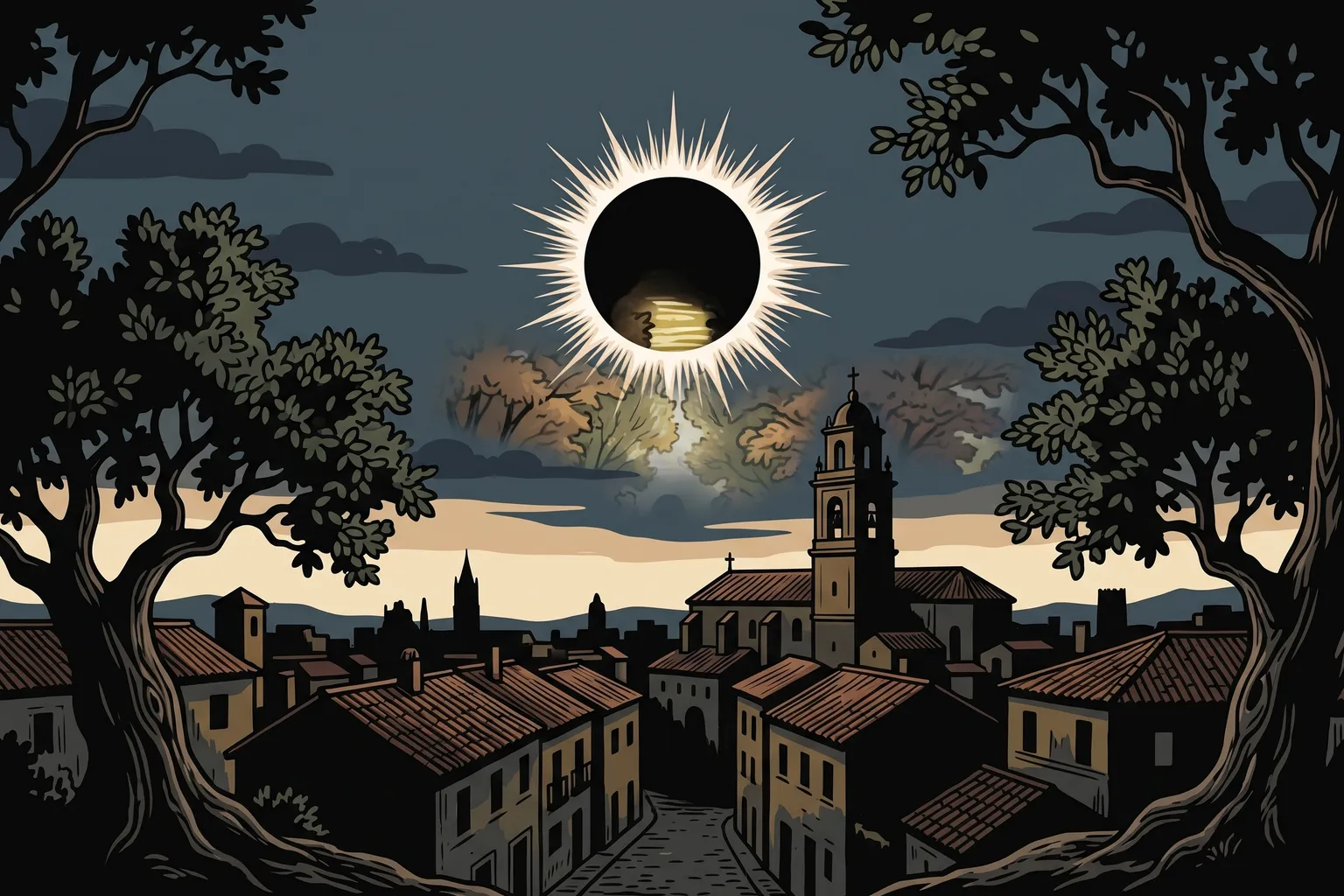
The first total solar eclipse visible from the Iberian Peninsula in more than a century is crossing northern Spain this evening, reaching totality at approximately 8:27 p.m. local time as the sun descends toward the horizon. The path of totality runs through León, Valladolid, Burgos, Bilbao, Santander, Zaragoza, Teruel, and Valencia. About 15 million people live inside it. Tonight the eclipse coincides with the peak of the Perseid meteor shower and a rare alignment of six planets visible in the same sky. At the horizon, viewers will see the solar corona appear against a sky already shading toward orange and gold. The eclipse tracking from Al Jazeera has been updated for today.
Totality will last up to 110 seconds depending on location. That’s roughly the time it takes to read the first six paragraphs of this column. The people in León and Zaragoza and Valencia tonight won’t be reading. They’ll be outside, watching the sky go dark, and then come back.
That seems like the right place to be on a Tuesday in August.
Howard Fenn writes The Day, Monday through Friday.