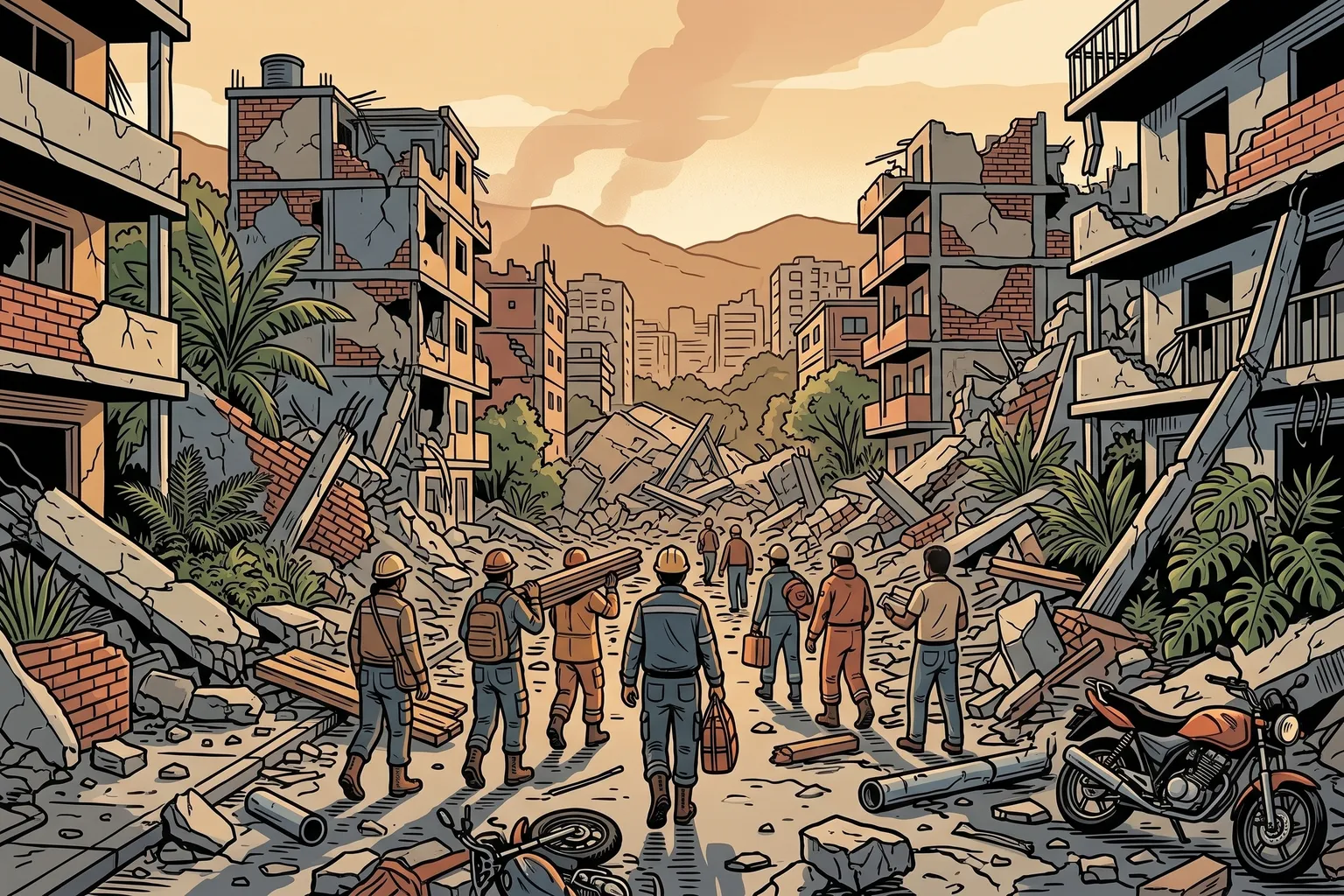
A magnitude 7.4 earthquake struck western Colombia on Monday morning, killing at least 132 people and injuring more than 570 others in what officials are calling the country’s strongest earthquake in a generation. The epicenter was near San José del Palmar, a community in the Chocó province about 250 miles west of Bogotá, and the shaking reached Cali, Pereira, Quibdó and dozens of other cities and towns.
In Pereira, the commercial center of Risaralda department, at least 60 people are confirmed dead. In Cali, Colombia’s third-largest city, the pediatric and neonatal wings of a major hospital collapsed, and city officials reported 188 people missing as of Monday afternoon. Both cities imposed curfews to manage access for rescue teams. Families had posted information on more than 2,700 missing people to citizen tracking sites by nightfall. Roughly 1,600 buildings are reported damaged or destroyed. Rescue crews, soldiers and neighbors formed human chains to move concrete by hand, stopping every few minutes to listen for sounds from below.
President Abelardo de la Espriella declared a national disaster. The Trump administration committed $15.5 million in emergency aid for shelter, food and earthquake assessments, the State Department said.
The last earthquake of comparable scale to strike this part of Colombia was in January 1999, when a major quake centered near Armenia, in the coffee-growing Quindío department, killed more than 1,100 people and left roughly 250,000 homeless. The Quindío and Risaralda departments share a border. Both lie along the same fault system, at the convergence of the Nazca, South American and Caribbean tectonic plates. Monday’s earthquake is substantially stronger and struck farther west, where the ground is more remote and structures are less engineered to absorb it. Rescue efforts were intensifying as of Monday afternoon. The death toll has been rising all day.
Iran
The Mecca Joint Deterrence Agreement, signed Friday by Saudi Arabia, Turkey and Pakistan, is now in effect. The text declares that an attack on any one of the three countries will be treated as an attack on all three. Turkey contributes NATO’s second-largest military. Saudi Arabia is the world’s largest oil exporter. Pakistan is the only Muslim-majority nuclear power. Whether that collective weight shifts Tehran’s calculus on the Hormuz negotiations is the question the agreement raised without answering.
The Iran-Oman talks have produced a proposed framework, which Iran’s foreign ministry described last week as an agreement. Under Tehran’s version, American and Israeli vessels would be barred from the strait, violators would face fines of up to 20 percent of cargo value, and nations Iran considers to have damaged it would be denied passage until compensation is paid. Washington’s position hasn’t changed: any framework that gives Iran effective control over international shipping lanes violates international maritime law. Neither side moved over the weekend. The parties are still talking.
In 1984, as the Iran-Iraq War entered its fourth year, both sides began systematically attacking tankers in the Persian Gulf in what became known as the Tanker War. By 1987, the United States was escorting Kuwaiti tankers under American flags to protect them from Iranian attack. The Hormuz chokepoint has been a strategic pressure valve in regional conflict for nearly fifty years. What’s different now is that Iran is negotiating the terms of an opening while watching three neighbors formalize a mutual defense treaty next door. That is new. How Tehran responds to it is not yet known.
Minnesota
Polls opened Monday in Minnesota for a Democratic Senate primary that has drawn national attention as a contest between the party’s establishment and progressive factions. Lt. Gov. Peggy Flanagan and Rep. Angie Craig are the two principal candidates for an open Senate seat. Flanagan has led recent polling; Craig has led fundraising. The primary has turned substantially on immigration enforcement, particularly after federal operations earlier this year left two Minnesota residents dead during an arrest. The Republican primary, also voting Monday, features former sports broadcaster Michele Tafoya, basketball player Royce White and former Navy SEAL Adam Schwarze.
Both primaries close at 8 p.m. Results won’t be clear until after midnight. The winner on the Democratic side enters the general with less than three months and a competitive race ahead.
DRC Ebola
The Ebola outbreak in the Democratic Republic of the Congo recorded 3,973 confirmed cases and 1,850 deaths as of Friday, according to UN News. A new 80-bed treatment center opened in the outbreak zone this week. The Bundibugyo strain responsible for this outbreak has no approved vaccine and no specific treatment, though clinical trials of candidate therapies are ongoing. Uganda, which recorded a small number of cases in July, declared its outbreak over on July 28 after twelve consecutive days without a new case.
The 2018-2020 DRC Ebola outbreak, previously the largest Bundibugyo event on record, recorded 3,481 confirmed cases over roughly two years. The current outbreak passed that total in approximately ten weeks. Cases are concentrated in displacement camps across Ituri Province, which complicates containment in ways a fixed-population outbreak doesn’t. The comparison is useful not as a number but as a description of pace.
Kumamoto
Two weeks after the magnitude 7.1 earthquake struck Kumamoto prefecture in southwestern Japan on July 28, more than 6,200 people remain in 99 evacuation centers across the region. The death toll stands at 39. Temperatures have exceeded 40 degrees Celsius in parts of the prefecture since the quake hit, complicating conditions in shelters. The Japanese government approved 24 billion yen, about $153 million, from its contingency fund for recovery. A secondary program to move shelter residents into hotels is under way. The Kyushu Shinkansen line between Kumamoto and Shin-Minamata stations remains closed, with JR Kyushu expected to provide a reopening update before the end of August.
The 2016 Kumamoto earthquake sequence, which struck the same prefecture and killed 50 people, took more than two years to fully clear its evacuation centers. Recovery of the region’s housing stock took longer still. The 2026 response has a volunteer coordination framework built substantially on what the 2016 recovery revealed about what goes wrong when you don’t have one. There are 2,451 registered disaster volunteers currently deployed. That number grew over the weekend.
Twenty-seven years ago today, on August 11, 1999, the moon’s shadow crossed the English Channel and moved over northern France, Germany, Austria, Romania and Turkey before exiting over the Black Sea. Crowds gathered across the path. It was the last total solar eclipse visible from mainland Europe.
Tomorrow, August 12, a new path of totality crosses Greenland and Iceland and then cuts across the northern half of Spain, arriving at sunset. About 15 million people live inside the path, including in the cities of León, Valladolid, Zaragoza and Valencia. Maximum totality will last 2 minutes and 18 seconds. In the westernmost cities, viewers will see the corona appear low above a horizon that’s already fading to orange. Tomorrow it arrives.